

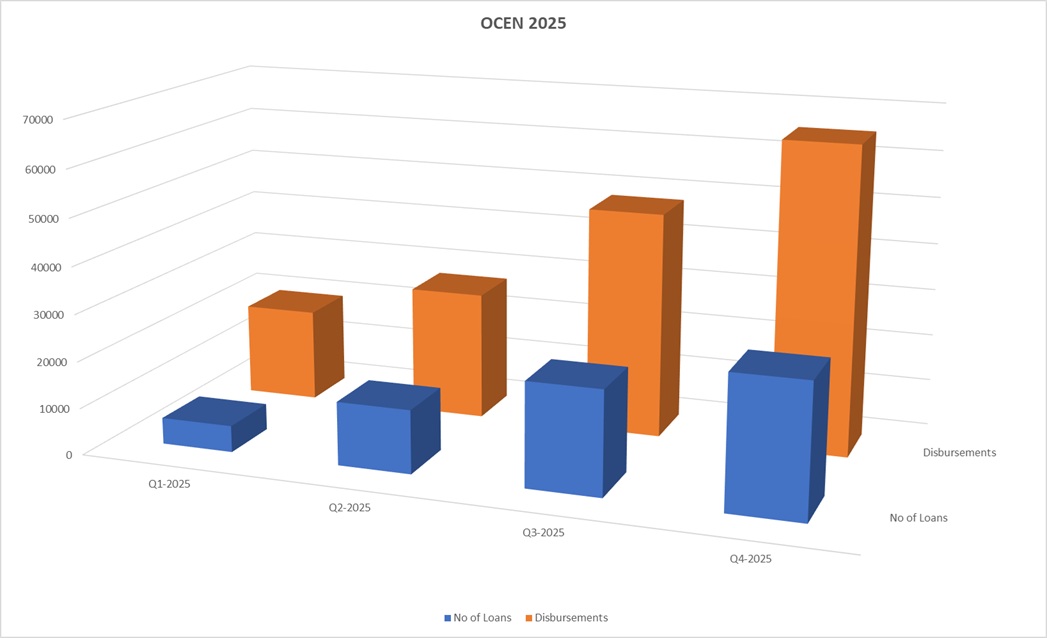
OCEN 2025

The calendar year 2025 has been a transformative period for the Open Credit Enablement Network (OCEN), evolving from a digital protocol into a powerhouse for financial inclusion. During 2025, OCEN successfully facilitated approximately 70,000 loans, resulting in over ₹1,600 Crore in disbursements.

This journey is not just about the numbers; it is about proving that a digital-first, cash-flow-based approach can solve the long-standing credit gap for underserved MSMEs with unparalleled efficiency.

A Year of Relentless Monthly Momentum

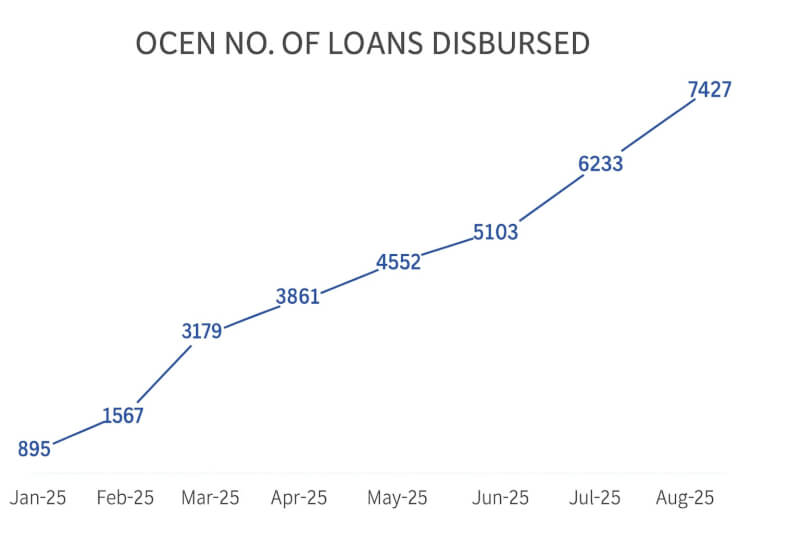
The 2025 journey began with a steady climb and rapidly escalated as more lenders and borrower agents integrated into the ecosystem. The monthly growth in the number of loans disbursed showcases a consistent upward trajectory. This steady monthly rise provided the foundation for the explosive quarterly growth that defined the year.

Consistent Quarterly Growth (QoQ)

When looking at the 2025 performance on a quarterly basis, the scale of adoption becomes even more evident. The network didn’t just grow; it accelerated every three months.

Period (2025)No. of LoansDisbursements (₹ Lakhs)
Quarter 15,64119,795
Quarter 213,51627,316
Quarter 322,14248,092
Quarter 428,12265,275

The jump from Q1 (5,641 loans) to Q4 (28,122 loans) represents an increase of nearly 400% in loan volume within a single year. Similarly, disbursements surged from ₹197.9 Crore in Q1 to over ₹652.7 Crore in Q4, demonstrating the massive appetite for small-ticket, short-tenure credit.

Portfolio Quality: The Ultimate Validator

The most significant achievement of 2025 isn’t just the volume—it’s the quality of the credit. Traditional MSME lending often suffers from high risk and significant non-performing assets (NPAs). OCEN has fundamentally challenged this narrative.

Participating lenders have seen highly encouraging results in portfolio health, characterized by strong performance, minimal portfolio losses and high confidence. The cash-flow-based underwriting model allows lenders to assess real-time business health rather than relying on stale collateral documents. Data-driven, short-tenure lending ensures high repayment rates.

The Future is Cash-Flow Based

OCEN’s 2025 journey proves that when you align technology with the actual business cycles of small enterprises, everyone wins. MSMEs get the “just-in-time” capital they need, and lenders gain access to a high-quality, low-risk asset class. With over ₹1,600 Crore disbursed in 2025, the protocol has set a new benchmark for how India can democratize credit and fuel the next wave of economic growth.

For more information, please visit: http://ocen.dev

Please note: The blog post is authored by our volunteer, Rahul Bhaik
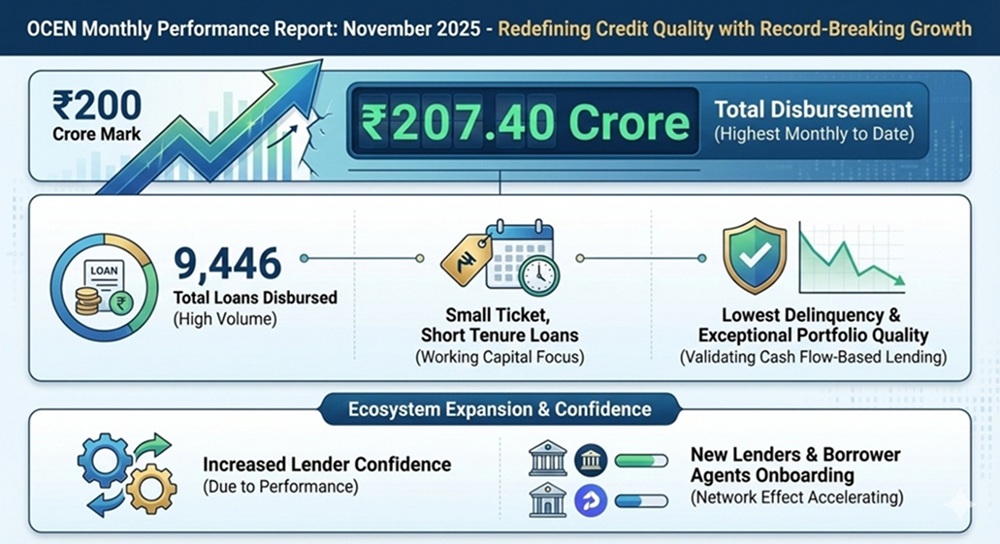
OCEN Crosses the ₹200 Crore Monthly Milestone: Redefining MSME Credit Quality

November 2025 has officially set a new standard for the future of cash flow based digital lending for MSMEs in India. For the first time, monthly disbursements through the OCEN protocol have breached the ₹200 Crore mark, proving that the shift toward cash flow-based lending is not just a pilot—it is a powerhouse.

As we move toward the close of 2025, the narrative is shifting from “how much” can be lent to “how well” it is being managed.

November 2025: By the Numbers

The growth trajectory of OCEN continues to follow a healthy curve. The protocol recorded its highest disbursement month to date, characterized by high-velocity, small-ticket lending that reaches the very grassroots of the MSME sector.

  • Total Disbursement: ₹207.40 Crore
  • Total Loans Disbursed: 9,446
  • Primary Loan Profile: Short-tenure, small-ticket working capital

This monthly performance brings the total calendar year disbursement to new heights, reinforcing OCEN’s role as an important digital highway for reducing the MSME credit gap.

The Quality Paradox: High Growth, Lowest Delinquency

In traditional lending, rapid growth often comes at the cost of asset quality. OCEN is turning this logic on its head. Despite the surge in volume, the participating lenders are reporting the lowest delinquency rates in the MSME segment.

The loan portfolio performance on OCEN has been exceptionally better than traditional MSME lending portfolios, which often struggle with high NPAs due to delayed data and static underwriting. By leveraging cash flow transaction data, OCEN allows for precision underwriting enabling the lenders see the actual health of a business today, not six months ago. As the Lenders focus on underwriting a Cash flow transaction rather than underwriting a borrower, the Short-tenure loans ensure that capital is cycled quickly linked to the Cash flow being financed, reducing long-term exposure risk.

This “quality-first” growth has sparked a wave of confidence across the participating lenders. We are currently seeing multiple new lenders and borrower agents at various stages of onboarding onto the OCEN framework. As more entities join, the network effect will only intensify, making credit even more affordable and accessible for the millions of “Rajnis” running small shops and enterprises across India. OCEN is not just lending money; it is building a system of trust where verified data, not just collateral, becomes the currency for growth.

For more information, please visit: http://ocen.dev

Please note: The blog post is authored by our volunteer, Rahul Bhaik
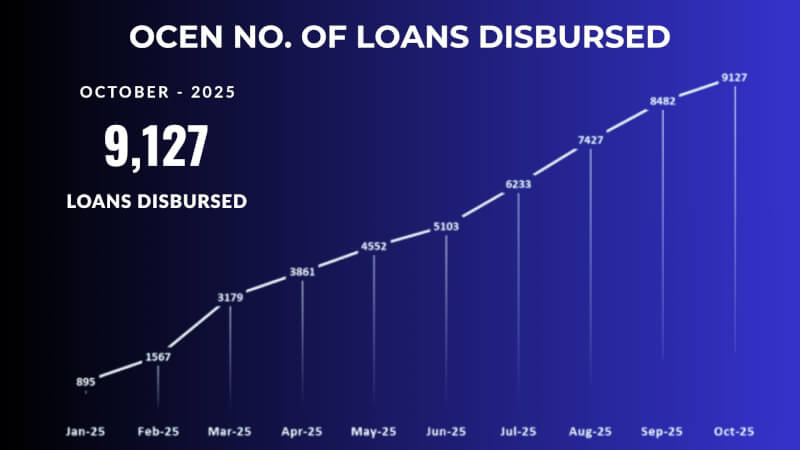
India’s silent Credit Revolution: OCEN Surpasses 50,000 Loans and ₹1100 Crore in 2025

The Micro, Small, and Medium Enterprises (MSME) sector is the engine of the Indian economy, yet for years, it has been choked by a massive credit gap. Traditional, collateral-heavy lending processes simply could not keep pace with the dynamic, short-tenure funding needs of small businesses.

Open Credit Enablement Network (OCEN): Built on the principles of India Stack, this digital protocol is not just facilitating loans; it is fundamentally rewiring the architecture of MSME credit, making it instant, affordable, and accessible. The monthly growth witnessed in the calendar year 2025 proves the model is not just viable, but highly scalable, marking a new era of financial inclusion.

The Power of Cash Flow-Based Lending

OCEN’s disruptive approach lies in shifting the lending paradigm from asset-based to cash flow-based underwriting. For millions of creditworthy small businesses, their true financial health is reflected in their daily or monthly transactions, not in static, year-old balance sheets. By leveraging India’s digital public infrastructure, OCEN allows lenders to assess risk based on real-time, consented data helping them to take faster decisions and making small-ticket, short-tenure credit economically feasible for lenders.

This framework is specifically designed to solve for the underserved, those who need smaller loans for shorter periods but have previously been locked out of formal credit channels.

Demonstrating Growth and Inclusion

OCEN demonstrated its ability to deliver on its promise of democratizing credit. The network has disbursed 50,426 loans and amounting to ₹1142 Crore in total disbursement within the calendar year till October 2025.

October 2025: OCEN saw the highest ever monthly disbursement of 191 Crore across 9127 loans Catering directly to the daily needs of MSMEs. The growth highlights how the protocol’s architecture is perfectly suited for mass-market financial inclusion. The emphasis is clearly on the number of lives touched and the frequency of credit access, rather than just the size of the total loan book.

Validating the Model: Exceptional Portfolio Health

The true testament to OCEN’s cash flow-based underwriting is not just the speed and volume of disbursement, but the quality of the loan book. Crucially, the loans disbursed through the OCEN protocol have demonstrated very minimal Non-Performing Assets (NPAs). This performance is exceptionally better than the NPA figures typically observed in traditional MSME lending portfolios across the industry. This is not just a marginal improvement; it is a fundamental validation of the protocol’s ability to accurately identify and price risk among digitally visible, cash flow-rich MSMEs. By moving beyond outdated collateral requirements and relying on real-time transactional data,

OCEN is proving that digital, embedded credit is inherently safer and more sustainable than conventional lending practices, offering a high-growth, low-risk opportunity for participating lenders.

For more information, please visit: http://ocen.dev

Please note: The blog post is authored by our volunteer, Rahul Bhaik
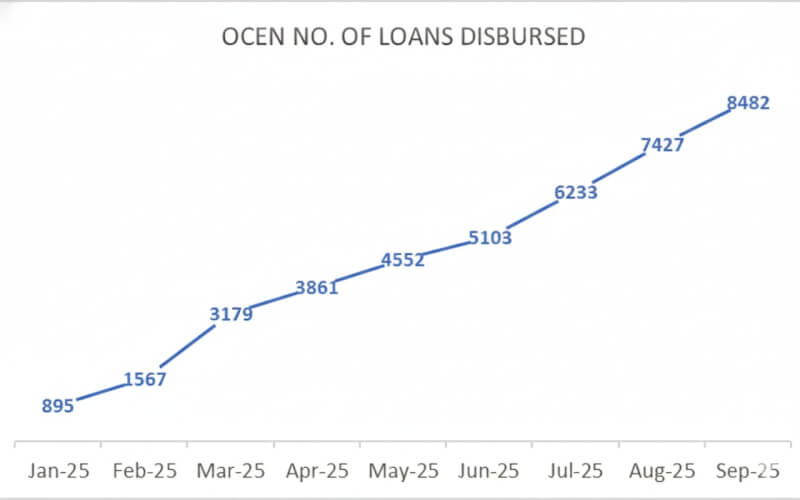
Cash Flow based Lending on OCEN: Fuelling the MSME Growth Engine

The backbone of our economy—the Micro, Small, and Medium Enterprises (MSMEs)—often face a
massive hurdle of securing timely and affordable credit. Cash Flow Based Lending can solve for
millions of creditworthy small businesses which are underserved. For a growing MSME, their true
health lies in their daily or monthly business transactions and cash flow—the consistent stream of
money coming in and going out.
OCEN is built to systematically address the MSME credit gap by standardizing and democratizing
Cash flow based lending. OCEN proves that cash flow-based lending is not only viable but highly
scalable, making small-ticket, short-tenure loans economically feasible for lenders. The rising
numbers reflect it’s growing adoption, making credit accessible, affordable, and instant for MSMEs.

For more information, please visit: http://ocen.dev

Please note: The blog post is authored by our volunteer, Rahul Bhaik
Cash Flow-Based Lending: Unlocking Credit Access for India’s MSMEs

Micro, Small, and Medium Enterprises (MSMEs) are the backbone of India’s economy, driving growth and generating millions of jobs. Yet, despite their importance, MSMEs continue to face a massive credit gap. Traditional collateral-based lending often leaves them underserved, making access to timely and affordable credit one of their biggest challenges.

Over the years, schemes like Mudra Loans, CGTMSE, Capital & Interest Subsidy Programs, and the TReDS (Trade Receivables Discounting System) have contributed meaningfully to MSME financing. TReDS, in particular, has shown encouraging results by enabling invoice-based financing for a segment of MSMEs. However, these efforts only address a part of the problem. The diverse working capital cycles and sector-specific needs of MSMEs demand customised, flexible credit solutions.

This is where Cash Flow-Based Lending (CFL) stands out as a transformative approach. Instead of relying on collateral, CFL assesses an enterprise’s actual business cash flows to determine loan eligibility. This not only expands credit access to previously excluded businesses but also enables lenders to design loan products that align with real business needs.

TReDS has already proven the power of cash flow-linked credit for receivables financing. But its scope is limited. India requires many more frameworks like TReDS, supported by scalable models such as OCEN (Open Credit Enablement Network), which democratise access to small-ticket, customised loans by leveraging digital cash flow data. While TReDS focuses on invoice-backed receivables, OCEN opens new possibilities through embedded finance and digital cash flow data. Both models are built on the same principle—cash flow as the foundation of creditworthiness—and can co-exist to bridge the critical MSME credit gap faster.

For more information, please visit: http://ocen.dev

Please note: The blog post is authored by our volunteer, Rahul Bhaik
OCEN July 2025 Snapshot

MSME Lenders need to start looking beyond AUM to truly value short-term loan pools. OCEN helps minimize loan processing costs and provide easy access to new borrower segments at scale. Specialized roles, including collections partners, help reduce the burden on lenders. Short-term lending products for marketplaces where Loan Agents also control the income-source for the borrower can use escrow-based-repayments to mitigate the collections risk. New datasets enable lenders to make easier underwriting decisions for cash-flow based lending.

Both TReDS and OCEN play critical roles in improving MSME access to credit, albeit for different segments of the market. Unlike TReDS, OCEN eliminates the buyer acceptance bottleneck. Instead, it leverages alternative underwriting models, specialized loan products, and digital collections to offer small‑ticket, short‑tenure working capital loans to MSMEs.

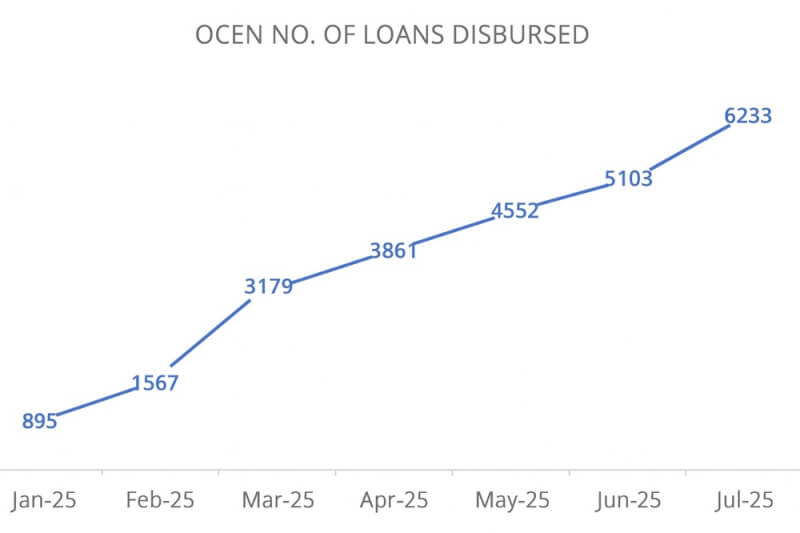
While TReDS will likely continue growing in disbursal volumes and strengthen formal receivables financing, OCEN’s focus on smaller, flexible loans positions it to grow much faster in terms of number of loans disbursed. Though TReDS and OCEN are targeting the same goal, both have its own unique features to succeed and co-exist to meet the common goal faster. OCEN becomes the next choice to solve for smaller businesses with small ticket loan requirements who are beyond the formal credit net and do not fit in the TReDS window. OCEN is growing fast with 30% MoM increase in number of loans due to the framework capabilities.

MetricJan-25Feb-25Mar-25Apr-25May-25Jun-25Jul-25
No. of Loans Disbursed895156731793861455251036233
Disbursement Amount in Lacs2517336713911761390821062113886

For more information, please visit: http://ocen.dev

Please note: The blog post is authored by our volunteer, Rahul Bhaik
OCEN June 2025 Snapshot

Open Credit Enablement Network (OCEN) is designed to serve borrowers across all turnover bands — including micro and small businesses whose buyers are not large enough to qualify for TReDS. This inclusivity enables it to reach segments of the MSME sector that remain underserved by formal credit channels.

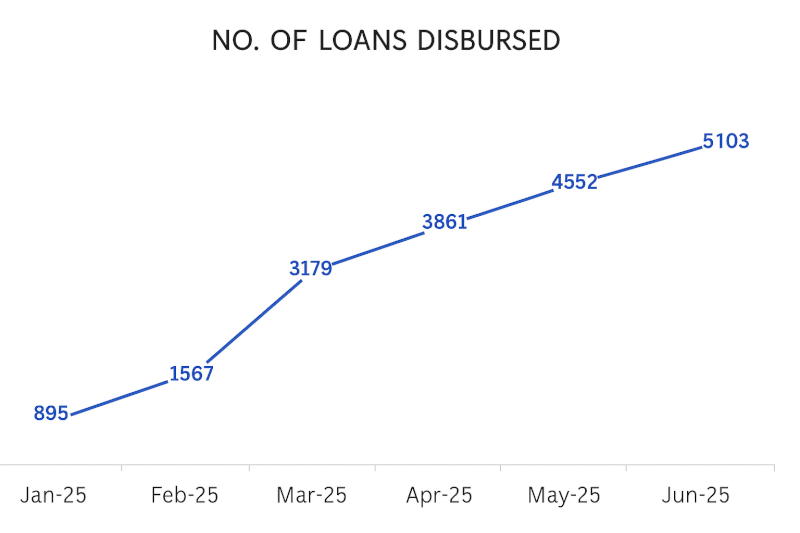
OCEN’s ability to leverage alternative underwriting models, specialized loan products, and digital collections to offer small‑ticket, short‑tenure working capital loans to MSMEs solves for smaller businesses with small ticket loan requirements who are beyond the formal credit net. With this unique framework, OCEN is expected to see a decent growth in number of loans. This growth would be a significant reflection of ensuring access of credit to the underserved who only need smaller loans for shorter tenures and will increase penetration in the new to credit MSME segment. Below is a snapshot of OCEN’s journey for the last 6 months:

MetricJan-25Feb-25Mar-25Apr-25May-25Jun-25
No. of Lenders Live on OCEN777888
No. of Borrower Agents Live666666
No. of Technology Service Providers (TSPs) with active deployment 233333
No. of Loan Products111111121212
No. of Loans Disbursed89515673179386145525103
Disbursement Amount₹25.17 Crore₹33.67 Crore₹139.11 Crore₹76.13 Crore₹90.82 Crore₹106.21 Crore
Average Loan Ticket Size₹2.81 Lakh₹2.14 Lakh₹4.37 Lakh₹1.97 Lakh₹1.99 Lakh₹2.08 Lakh

For more information, please visit: http://ocen.dev

Please note: The blog post is authored by our volunteer, Rahul Bhaik
Empowering India’s Growth Engines: The Critical Role of Credit for MSMEs

June 27 – International MSME Day

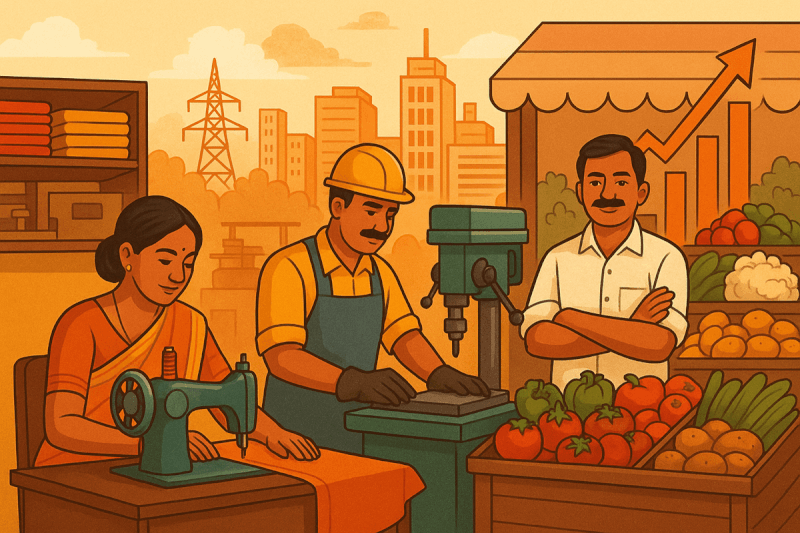
Micro, Small, and Medium Enterprises (MSMEs) are the unsung heroes of India’s economy. Employing over 11 crore people and contributing nearly 30% to the country’s GDP, MSMEs are not just businesses – they are drivers of innovation, inclusion, and local development.

On this MSME Day, we celebrate their resilience and ingenuity. But it’s also a moment to reflect on what holds them back – and how access to credit remains one of the most critical challenges they face. For MSMEs, timely and adequate credit is often the difference between scaling up and shutting down. Credit powers, yet, the reality is stark: a majority of MSMEs in India still rely on informal sources of finance or are denied loans due to lack of collateral or formal credit history.

According to estimates by the IFC, India’s formal MSME credit gap exceeds ₹25 lakh crore. Despite government schemes and fintech innovations, many small businesses struggle to access formal credit. This gap doesn’t just hurt MSMEs – it stifles job creation, reduces GDP growth, and hampers economic inclusivity.

A Shift Towards Cash-Flow-Based Lending

The good news? The ecosystem is evolving.

With initiatives like Account Aggregator, OCEN (Open Credit Enablement Network), and digitization of GST and banking data, lenders are moving towards cash-flow-based lending models. These innovations focus on real-time business performance rather than outdated collateral-based methods.

Such models enable more flexible, faster, and inclusive credit access to deserving MSMEs, especially those in Tier 2 and 3 cities.

To truly empower MSMEs with credit, the following steps are critical:

  • Financial literacy programs to help MSMEs manage credit and build a borrowing track record.
  • Policy support to incentivize banks and NBFCs for lending to first-time or underserved borrowers.
  • Greater public-private collaboration to build robust digital lending infrastructure.
  • Simplification of loan application processes through digital channels.

Celebrating MSMEs, Supporting Their Dreams

On this MSME Day, let’s go beyond celebration. Let’s reaffirm our commitment to unlocking finance for the backbone of our economy.

Whether you’re a policymaker, lender, fintech innovator, or simply a consumer – supporting MSMEs means supporting India’s future.

Because when MSMEs grow, India grows.

For more information, please visit: http://ocen.dev

Please note: The blog post is authored by our volunteer, Rahul Bhaik
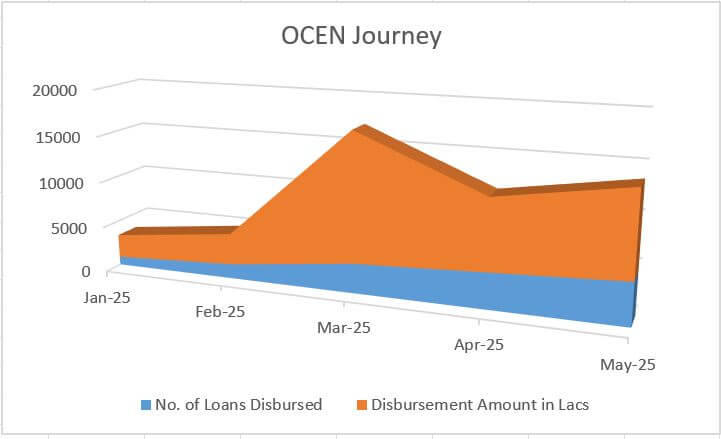
OCEN Ecosystem Progress Snapshot:

The Open Credit Enablement Network (OCEN) post its initial pilot deployment and continuous upgrades and improvements has seen growing participation across the ecosystem. OCEN’s transition from its early stages into the growth phase is now reflecting in its growing volumes and addition of new ecosystem partners. 

Monthly Progress Report: 

With the start of the new financial year, the April-June quarter is usually considered a sluggish season in financial services, more particularly in lending business. Corresponding trend reflects in the April performance on the OCEN traction as well, however April & May are still looking progressive in comparison to Jan & Feb performance, considering March financial year end rush as an exception. As newer products and lenders go live on OCEN, the trendline growth looks promising. 

Here’s a quick look at the latest numbers on the OCEN ecosystem:

MetricJan-25Feb-25Mar-25Apr-25May-25
No. of Lenders Live on OCEN77788
No. of Borrower Agents Live66666
No. of Technology Service Providers (TSPs) with active deployment 23333
No. of Loan Products1111111212
No. of Loans Disbursed8951567317938614552
Disbursement Amount₹25.17 Crore₹33.67 Crore₹139.11 Crore₹76.13 Crore₹90.82 Crore
Average Loan Ticket Size₹2.81 Lakh₹2.14 Lakh₹4.37 Lakh₹1.97 Lakh₹1.99 Lakh

OCEN continues to engage with ecosystem partners to build the momentum for new cash flow lending products for MSMEs.

For more information, please visit: http://ocen.dev

Please note: The blog post is authored by our volunteer, Rahul Bhaik

OCEN: Credit Access for MSMEs continues to grow

The volumes and traction on Open Credit Enablement Network (OCEN) continues to grow month on month. The growing trajectory highlights OCEN’s ability to streamline and democratise credit access for MSMEs by leveraging digital public infrastructure and fostering collaboration among lenders, agents, and technology providers. 

Here is a snapshot of the OCEN ecosystem’s key updates for March:

MetricJan-25Feb-25Mar-25
No. of Lenders Live on OCEN777
No. of Borrower Agents Live666
No. of Technology Service Providers (TSPs) with active deployment 233
No. of Loan Products111111
No. of Loans Disbursed89515673179
Disbursement Amount₹25.17 Crore₹33.67 Crore₹139.11 Crore
Average Loan Ticket Size₹2.81 Lakh₹2.14 Lakh₹4.37 Lakh

As OCEN continues to evolve, it is poised to further bridge the credit gap for MSMEs, enabling faster, more transparent, and more inclusive financial support for this vital sector of the Indian economy.

For more information, please visit: http://ocen.dev

Please note: The blog post is authored by our volunteer, Rahul Bhaik