iSPIRT works to transform India into a hub for new generation software products, by addressing crucial government policy, creating market catalysts and grow the maturity of product entrepreneurs. Welcome to the Official Insights!
The calendar year 2025 has been a transformative period for the Open Credit Enablement Network (OCEN), evolving from a digital protocol into a powerhouse for financial inclusion. During 2025, OCEN successfully facilitated approximately 70,000 loans, resulting in over ₹1,600 Crore in disbursements.
This journey is not just about the numbers; it is about proving that a digital-first, cash-flow-based approach can solve the long-standing credit gap for underserved MSMEs with unparalleled efficiency.
A Year of Relentless Monthly Momentum
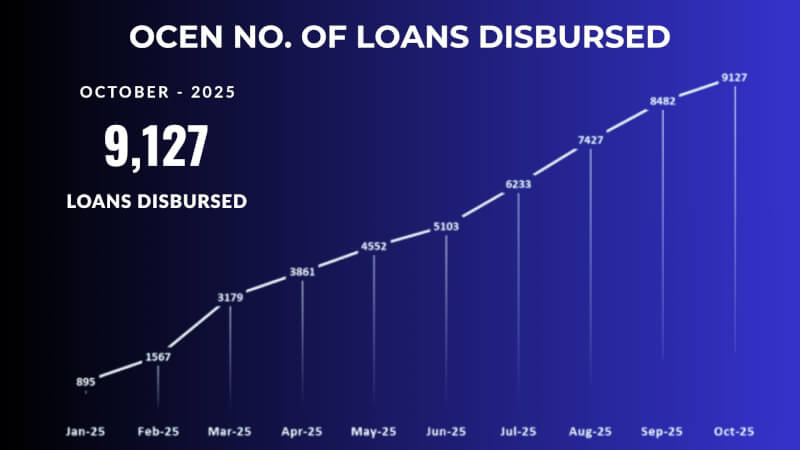
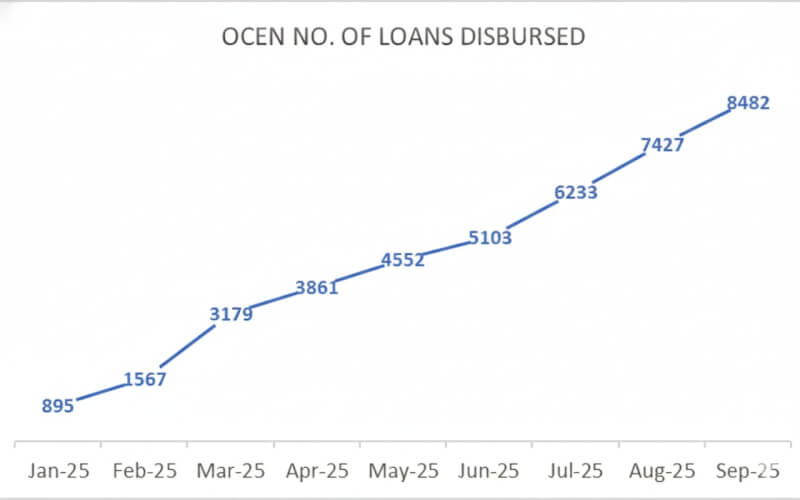
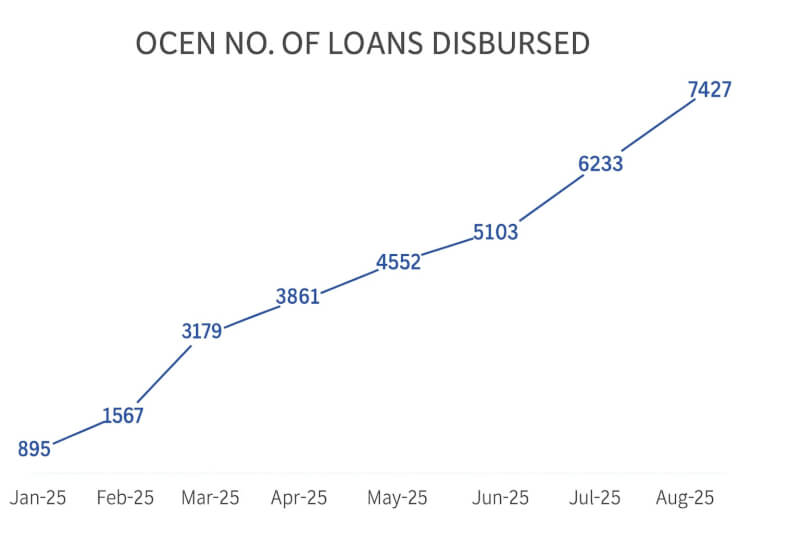
The 2025 journey began with a steady climb and rapidly escalated as more lenders and borrower agents integrated into the ecosystem. The monthly growth in the number of loans disbursed showcases a consistent upward trajectory. This steady monthly rise provided the foundation for the explosive quarterly growth that defined the year.
Consistent Quarterly Growth (QoQ)
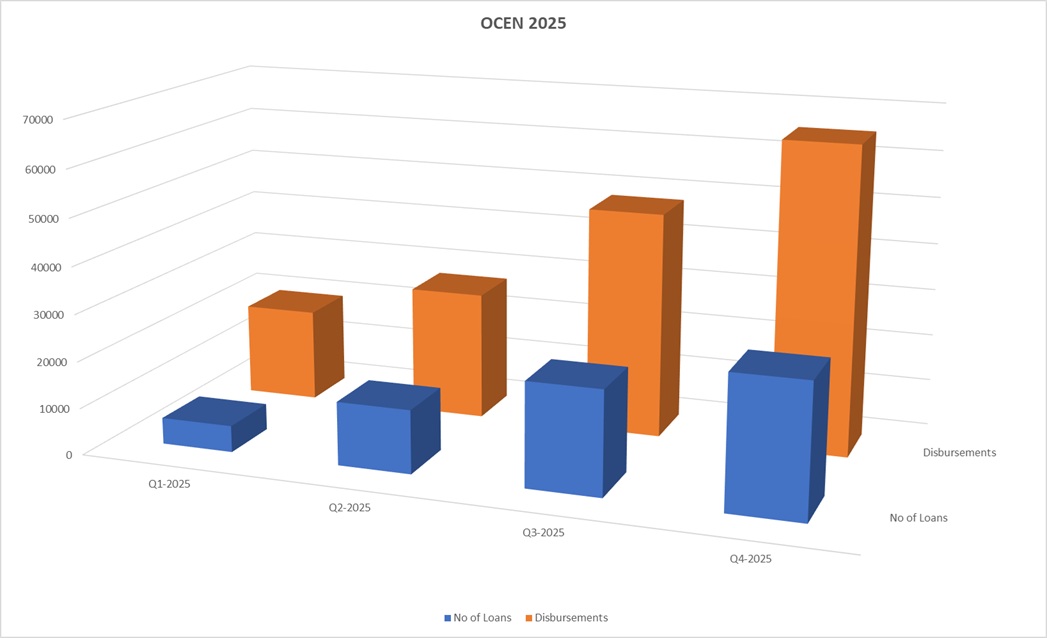
When looking at the 2025 performance on a quarterly basis, the scale of adoption becomes even more evident. The network didn’t just grow; it accelerated every three months.
Period (2025)
No. of Loans
Disbursements (₹ Lakhs)
Quarter 1
5,641
19,795
Quarter 2
13,516
27,316
Quarter 3
22,142
48,092
Quarter 4
28,122
65,275
The jump from Q1 (5,641 loans) to Q4 (28,122 loans) represents an increase of nearly 400% in loan volume within a single year. Similarly, disbursements surged from ₹197.9 Crore in Q1 to over ₹652.7 Crore in Q4, demonstrating the massive appetite for small-ticket, short-tenure credit.
Portfolio Quality: The Ultimate Validator
The most significant achievement of 2025 isn’t just the volume—it’s the quality of the credit. Traditional MSME lending often suffers from high risk and significant non-performing assets (NPAs). OCEN has fundamentally challenged this narrative.
Participating lenders have seen highly encouraging results in portfolio health, characterized by strong performance, minimal portfolio losses and high confidence. The cash-flow-based underwriting model allows lenders to assess real-time business health rather than relying on stale collateral documents. Data-driven, short-tenure lending ensures high repayment rates.
The Future is Cash-Flow Based
OCEN’s 2025 journey proves that when you align technology with the actual business cycles of small enterprises, everyone wins. MSMEs get the “just-in-time” capital they need, and lenders gain access to a high-quality, low-risk asset class. With over ₹1,600 Crore disbursed in 2025, the protocol has set a new benchmark for how India can democratize credit and fuel the next wave of economic growth.
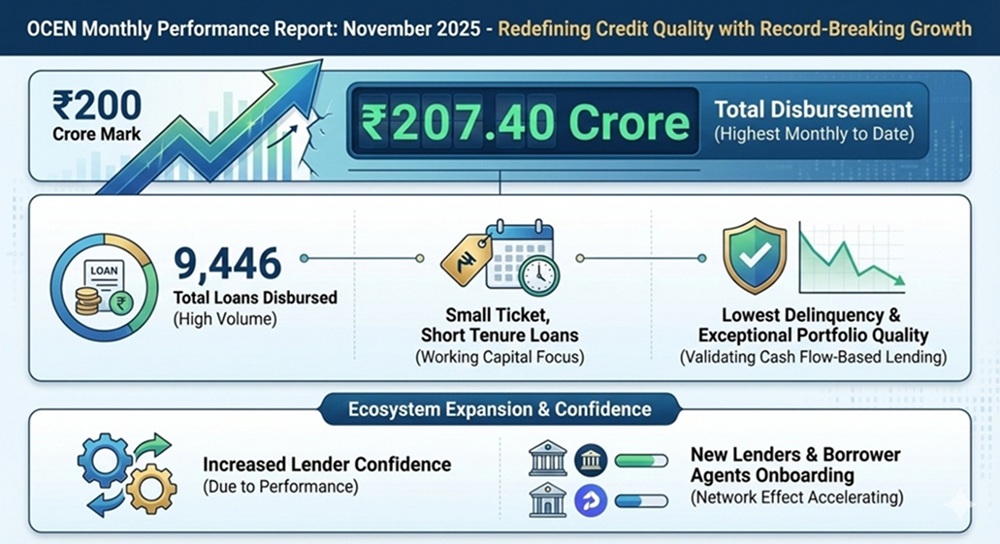
November 2025 has officially set a new standard for the future of cash flow based digital lending for MSMEs in India. For the first time, monthly disbursements through the OCEN protocol have breached the ₹200 Crore mark, proving that the shift toward cash flow-based lending is not just a pilot—it is a powerhouse.
As we move toward the close of 2025, the narrative is shifting from “how much” can be lent to “how well” it is being managed.
November 2025: By the Numbers
The growth trajectory of OCEN continues to follow a healthy curve. The protocol recorded its highest disbursement month to date, characterized by high-velocity, small-ticket lending that reaches the very grassroots of the MSME sector.
Total Disbursement: ₹207.40 Crore
Total Loans Disbursed: 9,446
Primary Loan Profile: Short-tenure, small-ticket working capital
This monthly performance brings the total calendar year disbursement to new heights, reinforcing OCEN’s role as an important digital highway for reducing the MSME credit gap.
The Quality Paradox: High Growth, Lowest Delinquency
In traditional lending, rapid growth often comes at the cost of asset quality. OCEN is turning this logic on its head. Despite the surge in volume, the participating lenders are reporting the lowest delinquency rates in the MSME segment.
The loan portfolio performance on OCEN has been exceptionally better than traditional MSME lending portfolios, which often struggle with high NPAs due to delayed data and static underwriting. By leveraging cash flow transaction data, OCEN allows for precision underwriting enabling the lenders see the actual health of a business today, not six months ago. As the Lenders focus on underwriting a Cash flow transaction rather than underwriting a borrower, the Short-tenure loans ensure that capital is cycled quickly linked to the Cash flow being financed, reducing long-term exposure risk.
This “quality-first” growth has sparked a wave of confidence across the participating lenders. We are currently seeing multiple new lenders and borrower agents at various stages of onboarding onto the OCEN framework. As more entities join, the network effect will only intensify, making credit even more affordable and accessible for the millions of “Rajnis” running small shops and enterprises across India. OCEN is not just lending money; it is building a system of trust where verified data, not just collateral, becomes the currency for growth.
The Micro, Small, and Medium Enterprises (MSME) sector is the engine of the Indian economy, yet for years, it has been choked by a massive credit gap. Traditional, collateral-heavy lending processes simply could not keep pace with the dynamic, short-tenure funding needs of small businesses.
Open Credit Enablement Network (OCEN): Built on the principles of India Stack, this digital protocol is not just facilitating loans; it is fundamentally rewiring the architecture of MSME credit, making it instant, affordable, and accessible. The monthly growth witnessed in the calendar year 2025 proves the model is not just viable, but highly scalable, marking a new era of financial inclusion.
The Power of Cash Flow-Based Lending
OCEN’s disruptive approach lies in shifting the lending paradigm from asset-based to cash flow-based underwriting. For millions of creditworthy small businesses, their true financial health is reflected in their daily or monthly transactions, not in static, year-old balance sheets. By leveraging India’s digital public infrastructure, OCEN allows lenders to assess risk based on real-time, consented data helping them to take faster decisions and making small-ticket, short-tenure credit economically feasible for lenders.
This framework is specifically designed to solve for the underserved, those who need smaller loans for shorter periods but have previously been locked out of formal credit channels.
Demonstrating Growth and Inclusion
OCEN demonstrated its ability to deliver on its promise of democratizing credit. The network has disbursed 50,426 loans and amounting to ₹1142 Crore in total disbursement within the calendar year till October 2025.
October 2025: OCEN saw the highest ever monthly disbursement of 191 Crore across 9127 loans Catering directly to the daily needs of MSMEs. The growth highlights how the protocol’s architecture is perfectly suited for mass-market financial inclusion. The emphasis is clearly on the number of lives touched and the frequency of credit access, rather than just the size of the total loan book.
Validating the Model: Exceptional Portfolio Health
The true testament to OCEN’s cash flow-based underwriting is not just the speed and volume of disbursement, but the quality of the loan book. Crucially, the loans disbursed through the OCEN protocol have demonstrated very minimal Non-Performing Assets (NPAs). This performance is exceptionally better than the NPA figures typically observed in traditional MSME lending portfolios across the industry. This is not just a marginal improvement; it is a fundamental validation of the protocol’s ability to accurately identify and price risk among digitally visible, cash flow-rich MSMEs. By moving beyond outdated collateral requirements and relying on real-time transactional data,
OCEN is proving that digital, embedded credit is inherently safer and more sustainable than conventional lending practices, offering a high-growth, low-risk opportunity for participating lenders.
The backbone of our economy—the Micro, Small, and Medium Enterprises (MSMEs)—often face a massive hurdle of securing timely and affordable credit. Cash Flow Based Lending can solve for millions of creditworthy small businesses which are underserved. For a growing MSME, their true health lies in their daily or monthly business transactions and cash flow—the consistent stream of money coming in and going out. OCEN is built to systematically address the MSME credit gap by standardizing and democratizing Cash flow based lending. OCEN proves that cash flow-based lending is not only viable but highly scalable, making small-ticket, short-tenure loans economically feasible for lenders. The rising numbers reflect it’s growing adoption, making credit accessible, affordable, and instant for MSMEs.
Micro, Small, and Medium Enterprises (MSMEs) are the backbone of India’s economy, driving growth and generating millions of jobs. Yet, despite their importance, MSMEs continue to face a massive credit gap. Traditional collateral-based lending often leaves them underserved, making access to timely and affordable credit one of their biggest challenges.
Over the years, schemes like Mudra Loans, CGTMSE, Capital & Interest Subsidy Programs, and the TReDS (Trade Receivables Discounting System) have contributed meaningfully to MSME financing. TReDS, in particular, has shown encouraging results by enabling invoice-based financing for a segment of MSMEs. However, these efforts only address a part of the problem. The diverse working capital cycles and sector-specific needs of MSMEs demand customised, flexible credit solutions.
This is where Cash Flow-Based Lending (CFL) stands out as a transformative approach. Instead of relying on collateral, CFL assesses an enterprise’s actual business cash flows to determine loan eligibility. This not only expands credit access to previously excluded businesses but also enables lenders to design loan products that align with real business needs.
TReDS has already proven the power of cash flow-linked credit for receivables financing. But its scope is limited. India requires many more frameworks like TReDS, supported by scalable models such as OCEN (Open Credit Enablement Network), which democratise access to small-ticket, customised loans by leveraging digital cash flow data. While TReDS focuses on invoice-backed receivables, OCEN opens new possibilities through embedded finance and digital cash flow data. Both models are built on the same principle—cash flow as the foundation of creditworthiness—and can co-exist to bridge the critical MSME credit gap faster.
MSME Lenders need to start looking beyond AUM to truly value short-term loan pools. OCEN helps minimize loan processing costs and provide easy access to new borrower segments at scale. Specialized roles, including collections partners, help reduce the burden on lenders. Short-term lending products for marketplaces where Loan Agents also control the income-source for the borrower can use escrow-based-repayments to mitigate the collections risk. New datasets enable lenders to make easier underwriting decisions for cash-flow based lending.
Both TReDS and OCEN play critical roles in improving MSME access to credit, albeit for different segments of the market. Unlike TReDS, OCEN eliminates the buyer acceptance bottleneck. Instead, it leverages alternative underwriting models, specialized loan products, and digital collections to offer small‑ticket, short‑tenure working capital loans to MSMEs.
While TReDS will likely continue growing in disbursal volumes and strengthen formal receivables financing, OCEN’s focus on smaller, flexible loans positions it to grow much faster in terms of number of loans disbursed. Though TReDS and OCEN are targeting the same goal, both have its own unique features to succeed and co-exist to meet the common goal faster. OCEN becomes the next choice to solve for smaller businesses with small ticket loan requirements who are beyond the formal credit net and do not fit in the TReDS window. OCEN is growing fast with 30% MoM increase in number of loans due to the framework capabilities.
Open Credit Enablement Network (OCEN) is designed to serve borrowers across all turnover bands — including micro and small businesses whose buyers are not large enough to qualify for TReDS. This inclusivity enables it to reach segments of the MSME sector that remain underserved by formal credit channels.
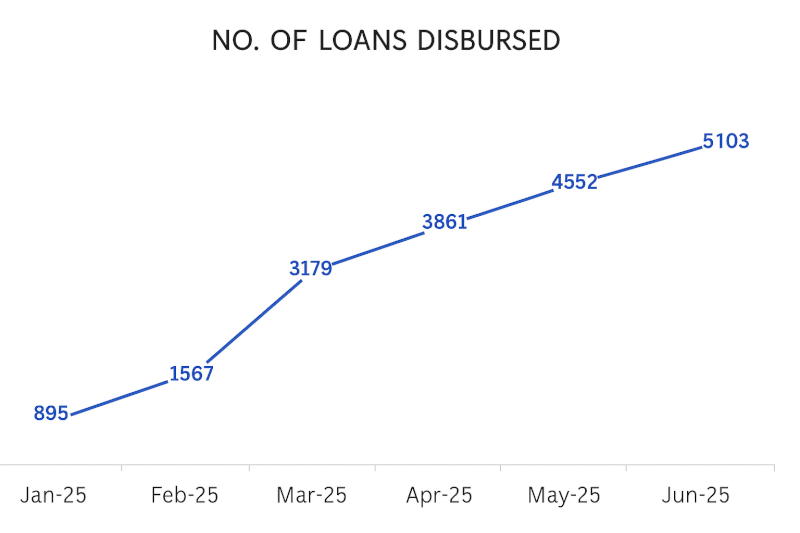
OCEN’s ability to leverage alternative underwriting models, specialized loan products, and digital collections to offer small‑ticket, short‑tenure working capital loans to MSMEs solves for smaller businesses with small ticket loan requirements who are beyond the formal credit net. With this unique framework, OCEN is expected to see a decent growth in number of loans. This growth would be a significant reflection of ensuring access of credit to the underserved who only need smaller loans for shorter tenures and will increase penetration in the new to credit MSME segment. Below is a snapshot of OCEN’s journey for the last 6 months:
Metric
Jan-25
Feb-25
Mar-25
Apr-25
May-25
Jun-25
No. of Lenders Live on OCEN
7
7
7
8
8
8
No. of Borrower Agents Live
6
6
6
6
6
6
No. of Technology Service Providers (TSPs) with active deployment
Micro, Small, and Medium Enterprises (MSMEs) are the unsung heroes of India’s economy. Employing over 11 crore people and contributing nearly 30% to the country’s GDP, MSMEs are not just businesses – they are drivers of innovation, inclusion, and local development.
On this MSME Day, we celebrate their resilience and ingenuity. But it’s also a moment to reflect on what holds them back – and how access to credit remains one of the most critical challenges they face. For MSMEs, timely and adequate credit is often the difference between scaling up and shutting down. Credit powers, yet, the reality is stark: a majority of MSMEs in India still rely on informal sources of finance or are denied loans due to lack of collateral or formal credit history.
According to estimates by the IFC, India’s formal MSME credit gap exceeds ₹25 lakh crore. Despite government schemes and fintech innovations, many small businesses struggle to access formal credit. This gap doesn’t just hurt MSMEs – it stifles job creation, reduces GDP growth, and hampers economic inclusivity.
A Shift Towards Cash-Flow-Based Lending
The good news? The ecosystem is evolving.
With initiatives like Account Aggregator, OCEN (Open Credit Enablement Network), and digitization of GST and banking data, lenders are moving towards cash-flow-based lending models. These innovations focus on real-time business performance rather than outdated collateral-based methods.
Such models enable more flexible, faster, and inclusive credit access to deserving MSMEs, especially those in Tier 2 and 3 cities.
To truly empower MSMEs with credit, the following steps are critical:
Financial literacy programs to help MSMEs manage credit and build a borrowing track record.
Policy support to incentivize banks and NBFCs for lending to first-time or underserved borrowers.
Greater public-private collaboration to build robust digital lending infrastructure.
Simplification of loan application processes through digital channels.
Celebrating MSMEs, Supporting Their Dreams
On this MSME Day, let’s go beyond celebration. Let’s reaffirm our commitment to unlocking finance for the backbone of our economy.
Whether you’re a policymaker, lender, fintech innovator, or simply a consumer – supporting MSMEs means supporting India’s future.
The Open Credit Enablement Network (OCEN) post its initial pilot deployment and continuous upgrades and improvements has seen growing participation across the ecosystem. OCEN’s transition from its early stages into the growth phase is now reflecting in its growing volumes and addition of new ecosystem partners.
Monthly Progress Report:
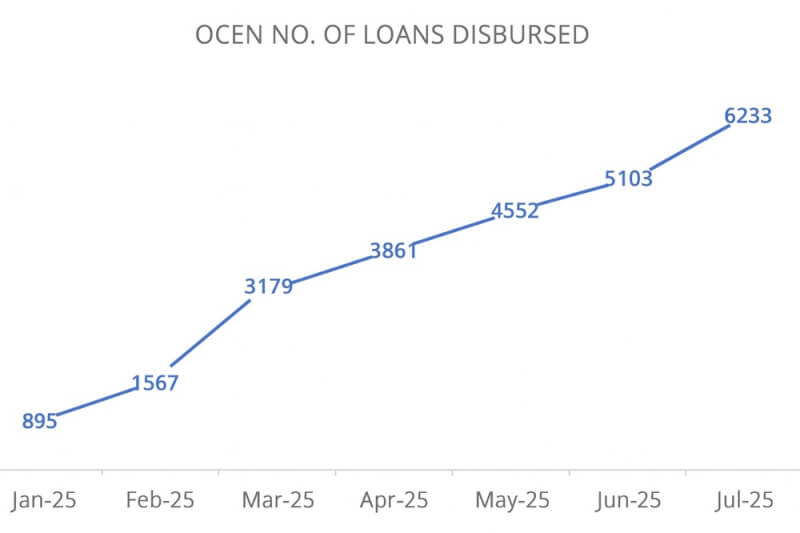
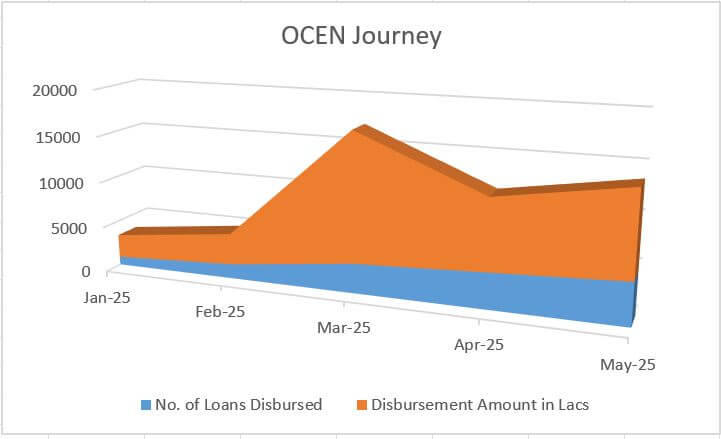
With the start of the new financial year, the April-June quarter is usually considered a sluggish season in financial services, more particularly in lending business. Corresponding trend reflects in the April performance on the OCEN traction as well, however April & May are still looking progressive in comparison to Jan & Feb performance, considering March financial year end rush as an exception. As newer products and lenders go live on OCEN, the trendline growth looks promising.
Here’s a quick look at the latest numbers on the OCEN ecosystem:
Metric
Jan-25
Feb-25
Mar-25
Apr-25
May-25
No. of Lenders Live on OCEN
7
7
7
8
8
No. of Borrower Agents Live
6
6
6
6
6
No. of Technology Service Providers (TSPs) with active deployment
2
3
3
3
3
No. of Loan Products
11
11
11
12
12
No. of Loans Disbursed
895
1567
3179
3861
4552
Disbursement Amount
₹25.17 Crore
₹33.67 Crore
₹139.11 Crore
₹76.13 Crore
₹90.82 Crore
Average Loan Ticket Size
₹2.81 Lakh
₹2.14 Lakh
₹4.37 Lakh
₹1.97 Lakh
₹1.99 Lakh
OCEN continues to engage with ecosystem partners to build the momentum for new cash flow lending products for MSMEs.
The volumes and traction on Open Credit Enablement Network (OCEN) continues to grow month on month. The growing trajectory highlights OCEN’s ability to streamline and democratise credit access for MSMEs by leveraging digital public infrastructure and fostering collaboration among lenders, agents, and technology providers.
Here is a snapshot of the OCEN ecosystem’s key updates for March:
Metric
Jan-25
Feb-25
Mar-25
No. of Lenders Live on OCEN
7
7
7
No. of Borrower Agents Live
6
6
6
No. of Technology Service Providers (TSPs) with active deployment
2
3
3
No. of Loan Products
11
11
11
No. of Loans Disbursed
895
1567
3179
Disbursement Amount
₹25.17 Crore
₹33.67 Crore
₹139.11 Crore
Average Loan Ticket Size
₹2.81 Lakh
₹2.14 Lakh
₹4.37 Lakh
As OCEN continues to evolve, it is poised to further bridge the credit gap for MSMEs, enabling faster, more transparent, and more inclusive financial support for this vital sector of the Indian economy.
The Open Credit Enablement Network (OCEN) is steadily progressing from its early stages into a more robust growth phase. With its current ecosystem participants, OCEN has started facilitating smoother credit delivery to MSMEs. At the same time, numerous other players are integrating into the protocol and developing specialized loan offerings tailored to the needs of MSMEs.
Here’s a snapshot of the OCEN ecosystem’s key updates for February:
Metric
Jan 2025
Feb 2025
No. of Lenders Live on OCEN
7
7
No. of Borrower Agents Live
6
6
No. of Technology Service Providers (TSPs) with active deployment
2
3
No. of Loan Products
11
11
No. of Loans Disbursed
895
1567
Disbursement Amount
₹25.17 Crore
₹33.67 Crore
Average Loan Ticket Size
₹2.81 Lakh
₹2.14 Lakh
OCEN continues to engage with new participants to further expand the ecosystem, adding new products and scaling up efforts to transform credit access for MSMEs on a large scale.
In the evolving landscape of financial inclusion and digital lending, India has introduced several innovative frameworks designed to streamline access to credit, enhance transparency, and create seamless financial ecosystems. Among these, the Unified Lending Interface (ULI), Open Credit Enablement Network (OCEN), and Account Aggregator (AA) stand out as key initiatives aimed at modernizing the way credit and financial data are managed.
While all three initiatives aim to transform the lending sector, each has distinct roles, benefits, and functions. To better understand their unique features and how they interact with one another, we’ve put together a detailed comparison chart.
This side-by-side breakdown helps you identify the core differences between ULI, OCEN, and AA, their respective use cases, and how they collectively contribute to building a more inclusive and tech-driven financial ecosystem in India. Whether you’re a fintech enthusiast, a policy maker, or simply looking to understand the future of credit access, this comparison will offer valuable insights into these transformative frameworks.
ULI(Unified Lending Interface)
OCEN(Open Credit Enablement Network)
AA(Account Aggregator)
Purpose
Standardized API interface for Lending institutions providing borrower’s financial and non-financial data from various sources, including government databases, and financial institutions. Helps financial institutions to reduce friction for accessing the information needed for quick loan underwriting decisions and efficient loan application processing.
OCEN is a framework of application programming interfaces (APIs) for interaction between lenders, loan agents, collection and disbursement partners, derived data providers, and account aggregators OCEN facilitates flow of credit between borrowers, lenders, and credit distributors using a common set of standards. Various participants in the credit ecosystem can seamlessly connect with one another without needing to build customised APIs and infrastructure. OCEN aims to enable cash-flow based unsecured financing for MSMEs as against balance sheet and collateral based financing. Both ULI and AA can be derived data providers in the OCEN ecosystem.
The Account Aggregator (AA) framework allows users to share consent driven financial data across institutions. Users can access their financial information from multiple institutions in one place, and can decide who can access their data, for how long, and for what purpose. The FI Types are managed by ReBIT.
Users
Regulated entities like Lenders, etc
MSME-focused Borrower Agents and Lenders. Other ecosystem participants include Derived Data Providers, Collection Agents, Disbursement Agents and KYC Partners
Financial Information Users which are Regulated entities and Individuals who wish to access their own financial details
Key Functionality
Enabling RE’s and Marketplaces to fetch different types of financial and non-financial data for underwriting using standard interface.
Standard rails to connect various participants in the Cash flow based MSME lending ecosystem. Enabling building customised credit products for MSMEs and empowering the Borrower agent as a lynchpin and a representative of the borrowers.
Providing safe, user-consented sharing of financial information between regulated financial institutions via the Account Aggregator framework. Individuals can have a holistic single source to view financial data across various institutions.
Data Usage
Utilizes borrower data from diverse sources like banks, land records, and financial history.
Utilizes specific business data of MSMEs like invoices, transactions, etc., for the credit product creation. Any kind of data can be passed to the Lender in the form of derived data. For eg. Government e-Marketplace shares borrower performance data with lenders post consent.
Uses consolidated financial data like bank accounts, GST, income, etc., from FIPs.
Role in Ecosystem
Streamline credit access by integrating borrower data from multiple sources for accurate financial assessment, enabling faster loan approvals through advanced analytics, facilitating easy integration with standardized APIs, and providing lenders seamless access to comprehensive borrower information to simplify credit appraisal and reduce documentation
Fosters innovation in MSME credit by enabling tailored loan offerings and faster credit flow thus enabling access to credit to MSMEs which earlier did not have access to the same. Reduce cost of short tenure, low ticket lending and making it viable to give loans to MSMEs which are end use controlled and enable collection control.
Promotes financial inclusion by simplifying financial data sharing and improving credit decision-making. Allowing user to share their data directly with financial institutions in a consented manner removing the data passing through multiple hands.
Technology Backbone
Consent-based data-sharing infrastructure; APIs to connect various data sources with lenders.
API infrastructure based on standard OCEN protocol for credit enablement. Participant and Product registries to enable discovery and standardisation within the ecosystem.
API-driven, centralized consent architecture defined by ReBIT under the RBI framework.
Regulatory Framework
Proposed under RBI’s initiative to enhance digital lending infrastructure.
Digital Public Infrastructure at a mass roll out stage. Once formalised will be managed and regulated as advised by regulators.
Governing law is the RBI’s Account Aggregator framework under the NBFC-AA license.
Use Cases
A farmer applies for a loan to purchase farm equipment. Lender is able to access land records and other non-financial and financial data through ULI interface to underwrite the loan application.
Zomato as a Borrowers agent on behalf of restaurants enrolled on its platform being able to offer custom loan products specifically built for restaurant partners by the participating lenders based on alternate platform data, ability of providing collection control to lenders via cash flow entrapment and acting as a representative of the borrowers instead of agent of lenders. Like Zomato any of platforms or institutions (like FPO) sitting on a Captive database can utilise OCEN to enable lending on their platform benefiting their users.
Individuals being able to share their multiple bank accounts for specific time periods and for specific purposes with the AA framework using consent mechanism. Businesses being able to share GSTN data to RE’s for loan underwriting purpose using consent mechanism.
Implementation Stage
Proposed platform; Some pilot Implementations for certain data sources have been done. Overall the ULI is in a development phase.
Few pilots – GeM Sahay, GST Sahay, Jan Aushadhi Kendra and Private network have been successfully tested. More implementations are underway at various stages and gaining traction.
Well-established under the RBI’s regulatory framework with multiple FIP’s and FIU’s already integrated.
In this insightful dialogue, Sagar Parikh engages with Deepak Sharma to explore the transformative potential of cash flow lending for Indian MSMEs. Deepak underscores the significance of democratizing credit access through short-tenor and small-ticket loans, especially for micro-enterprises that comprise 99% of the MSME sector in India. Drawing from his rich experience in banking and financial services, Deepak Sharma provides invaluable guidance on navigating the complexities of B2B financing, highlighting the critical role of innovative lending models in fostering inclusive growth.
Deepak Sharma delves into the pressing challenges faced by MSMEs in accessing financing, particularly in the realm of B2B transactions. Leveraging his extensive experience and deep insights, he offers a fresh perspective on the traditional lending landscape, emphasizing the need for agile and tailored solutions to empower MSMEs. By advocating for cash flow-based lending and trust-based scoring systems, Deepak Sharma presents innovative approaches to address credit gaps and unlock opportunities for sustainable economic development within India’s dynamic MSME sector.
Deepak Sharma’s perspectives on banking innovation and financial inclusion provide several key learnings for the industry:
Leveraging Technology for Inclusion: Sharma emphasizes the transformative impact of technologies like UPI and Aadhaar in fostering financial inclusion. These initiatives not only revolutionize digital payments but also open doors to credit access for underserved segments like SMEs.
Proactive Engagement with Tech Ecosystem: Deepak advocates for proactive engagement with India’s tech ecosystem, encouraging early adoption of initiatives like IndiaStack. He challenges banks to rethink their approach and prepare for future changes in the financial landscape.
Importance of Early Adoption: Reflecting on his experiences at Kotak, Sharma stresses the importance of early adoption of innovative initiatives. Banks that jump in early can leverage emerging opportunities and drive meaningful change.
Value of Learning from Ventures: Deepak highlights the significance of learning from both successful ventures like OCEN and past failures. This learning process is essential for banks to navigate the evolving tech landscape effectively.
Structured Innovation with the 5C Model: Sharma’s structured approach to innovation, encapsulated in the 5C model, emphasizes critical aspects such as customer acquisition, commercial viability, credit assessment, compliance, and collections. This framework ensures alignment on objectives and risk management strategies.
Startup Mindset and Controlled Pilots: Adopting a startup mindset within traditional banking institutions, Deepak advocates for establishing small, specialized teams focused on data analysis, technology, and risk management. Controlled pilots with defined success metrics enable banks to manage—- risk effectively and drive innovation.
Importance of Trust-Based Scoring: Sharma underscores the importance of trust-based scoring systems and proprietary scorecards for credit assessment. Moving away from traditional methods, these innovative approaches provide a holistic view of creditworthiness, especially for SMEs with limited credit histories.
Optimism about OCEN: Deepak Sharma’s views on OCEN reflect a visionary approach to addressing India’s credit gap. He sees OCEN as a pivotal platform to harness India’s data richness and enable comprehensive credit assessment and lending solutions.
In conclusion, Deepak Sharma’s insights emphasize the necessity of embracing innovation and leveraging technology to drive inclusive growth in the financial services sector. By adopting proactive strategies, banks can navigate the evolving landscape of digital lending and unlock opportunities for underserved segments, contributing to India’s economic development.
OCEN is an initiative to unbundle lending and enable the creation of specialized entities, each specialized at one part of the job. Therefore, we envision the future of lending to be a partnership between multiple firms individually focused on sourcing/distribution, identity verification, underwriting, capital arrangement, recollections, etc. The entities like marketplaces who have high business-connect with their customers (businesses or individuals), can embed credit offerings in their applications now. These entities are referred to as Loan Agents’ (LAs) and were previously referred to as ‘Loan Service Providers’ (LSPs).
OCEN (Open Credit Enablement Network) aims at democratising the lending ecosystem. The core philosophy is using open networks to reach out to maximum borrowers and lenders, with reduced risk, more transparency, strict control on funds (both end use & collections) and thus building a robust lending ecosystem. At the borrower level, using consent driven architecture and personal data as information collateral, any type of borrower (even new to credit or people with poor credit scores), can access financing. The end-to-end digital processes not only reduces the total cost of operations, but also has the advantage of reaching out to anyone and everywhere, without the lender having a physical presence. For example, sitting out of Jaipur, a NBFC has disbursed OCEN loan on GeM Sahay to borrowers operating from Andaman Nicobar Islands, Manipur, Baramullah etc and the smallest loan transaction has been of Rs.160 for business purposes.
OCEN is the right protocol, to bring credit/finance to the bottom of the pyramid and at the same time lenders also make money with this same section of people at the bottom of the pyramid. OCEN not only levels the playing field between incumbents and challengers, but also reduces the concentration risk which comes with size at bigger players. Most MSMEs are working capital intensive businesses that need quick money and do not have collateral securities to put up to banks for conventional Cash Credit limits like financing. For such businesses, this is a tool to grow their businesses, and improve their credit scores.
Lenders see opportunities in not only sourcing new business, but also reduced risk due to high quality data and use of DPI (Digital Pubic Infrastructure), like GSTN, Account Aggregator, Digilocker and its associated APIs, like mobility, Health, Fastag etc.
Why OCEN
Low Cost of Acquisition >> The Borrower Agent brings his borrowers on the network, reducing the cost of acquisition through various channels. OCEN framework benefits the Lenders to gain easy access to borrowers. Not just borrowers of one network, but easy access to multiple sets of borrowers of multiple networks.
Lower Cost of Underwriting >> The Borrower Agent also acts as a Provider of Derived Data along with other Underwriting data from various sources like GSTN and Account Aggregator which helps in lowering the Cost of Underwriting
Digitisation >> OCEN Digitises the whole process which involves various activities like Bureau pull, KYC validation, Account Aggregator data, E-Sign on documentation, e-NACH for repayment etc and reduces the time and effort of processing at reduced costs.
Reduced Cost of Collections >> OCEN provides a large opportunity to Lenders and Borrowers to participate in T4 (Type 4) loan products which have End Use Control and Collections control for ensuring higher portfolio quality and cash flow control as well as reduced Cost of collections
OCEN solves for MSME’s Credit requirements: Small Ticket Short Tenure Loan
Small businesses need loans of smaller amounts and for shorter tenures (15/30/90 days) for their businesses compared to larger businesses to help them navigate through the requirement of day-to-day Working Capital needs.
It also helps Lenders to create Loan books for smaller loans which are granular loan exposure on a rotational basis, compared to large bulky loans. Hence reducing concentration risk.
As these Loans are for short tenure, there is higher predictability and lower risk compared to long tenure loans in which recovery of loans may sometimes be a challenge.
The Loan Agent (LA) model is a departure from the Direct Sourcing Agent (DSA) model and is an ‘agent of the borrower’. The LA explains to borrowers their ‘bill of rights’ ensuring transparency and safeguarding of borrower interests. They educate the borrowers about the various credit product offerings, pricing and more details. They help the borrowers get access to formal, affordable credit at low interest rates and collaborates with lenders to create more tailored offerings for borrowers.
In their simplest form, LAs are a loan marketplace that enables borrowers to compare loan offers from multiple lenders and choose the best one. In a more advanced version, the LAs are akin to a borrower’s financial advisor, looking after their interests, fetching the best offers and advising the customer to make good decisions.
In the longer run, it is envisioned that many more LAs (with apps) will be created. Each of them would focus on distinct borrower pools and build the specialized experiences suited to their customers. This would allow lenders to focus purely on their underwriting and collections logic and cater to diverse collaborations with the LAs.
OCEN 4.0
The OCEN model has been built incrementally in phases, with reinforced learnings from each of the previous pilots. The goal for OCEN 4.0 is to build an ecosystem of participants that creates a Cambrian explosion of cash-flow based loan products across different MSME sectors and different types of borrowers.
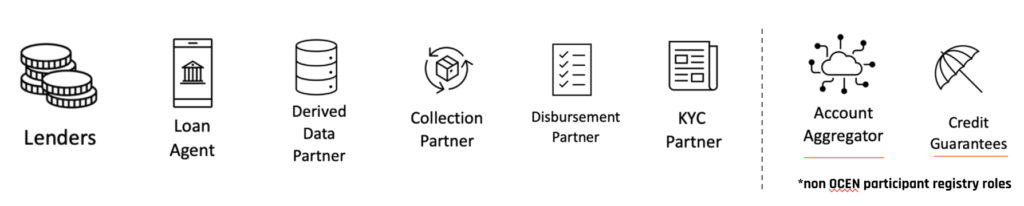
Participant Roles
OCEN 4.0 supports specialized roles for the participants. The purpose of introducing new roles is that it promotes specialization and enhances system efficiency. For example, by establishing a local network of participants, the burden on lenders is reduced, resulting in increased credit accessibility in underprivileged areas.
Role
Description
Lender
Lenders are the regulated entity that create and own the credit products. They work with other participants as part of a Product Network to serve the Borrower. The Loan-agent understands the borrowers’ credit requirements and works with the lenders to create the product.
Loan-Agent (LA)
Agent of the borrower who will help the Borrower to pick up the best loan offer. The Borrowers agent will charge the Borrower a fee for helping them select the best loan. Loan agent is a more inclusive term that encompasses both Borrower Agent (BA) and Lender Service Provider (LSP), spanning across the existing DLG model referred to as LSP and the emerging model in which BA operates as the borrower agent.
Derived Data Partner (DDP)
A derived data provider is a collaborating partner within the network that furnishes supplementary data to the Lender, aiding in enhancing their underwriting engine with additional information.
Collections Partner (CP)
A Collections Partner is a network-affiliated collaborator designated by the Loan Agent (LA) to aid in the collection process. The lender retains the option to either opt for the Collections Partner or continue using their existing collection procedures.
Disbursement Partner (DP)
A Disbursement Partner (DP) is responsible for supporting Purpose Controlled products. This partner will establish integration with suppliers, retrieve their catalog, and facilitate seamless direct payments to suppliers within the OCEN journey.
KYC Partner
A KYC partner is a collaborator selected by the Loan Agent (LA). This partner can be engaged for Assisted KYC or any technology-related specialization available on the network. The lender retains the choice to employ the KYC partner within the network or continue with their existing procedures.
In addition to the participant roles above, OCEN framework also relies on Account Aggregator and Credit Guarantees (CGTMSE) as part of the loan journey.
Participant Onboarding
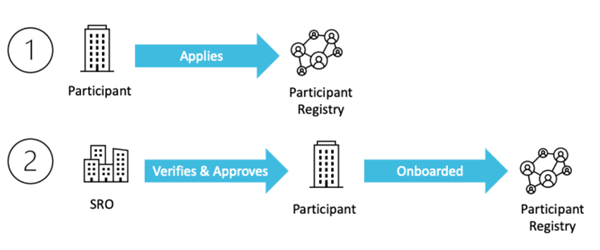
All participants are onboarded to OCEN 4.0 via the participant registry. A standard onboarding process is followed for all participants, and their verification is guaranteed by SROs to ensure that new members receive an equivalent level of trust within the network.
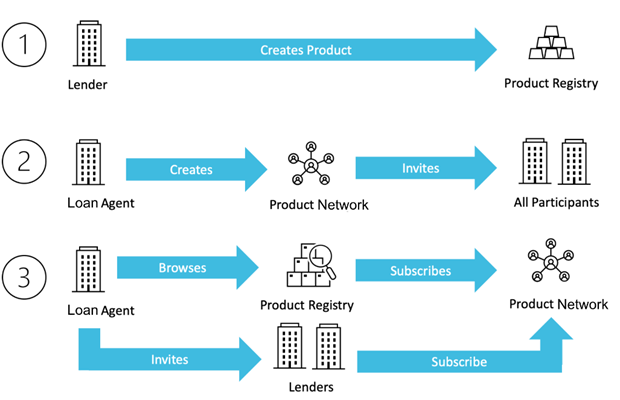
Product and Product Network onboarding
Lender will create & manage the Product and the Loan Agent will create & manage the Product Network to serve that product. All participants in OCEN 4.0 can browse the Products and Product Networks on the Product Registry and subscribe to serve a Product via the Product Networks.
Product Networks
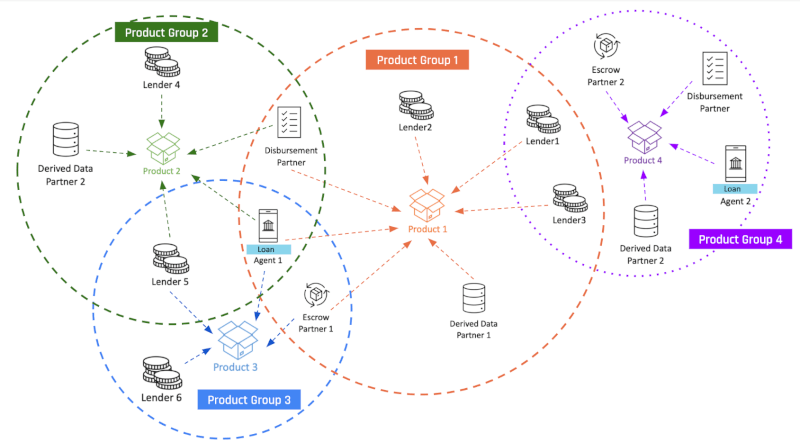
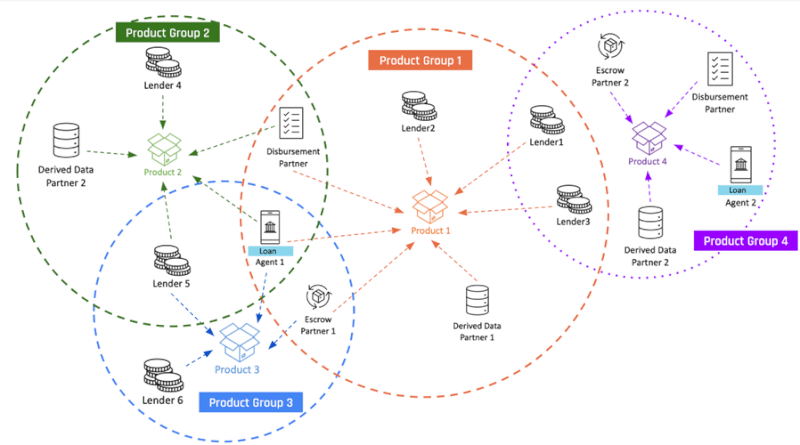
OCEN 4.0 enables a network of product networks that participants can discover, collaborate and serve products to borrowers. See sample example below:
Network begins with Product Network 1
Created by Loan Agent 1 who onboards as network participants – 3 lenders, disbursement partner, collections partner and a derived data partner
Loan agent 1 can serve their borrowers other products as well.
Network expands with Product Network 2
Created by Loan Agent 1 who onboards as network participants – 2 new lenders, the same disbursement partner, and a new derived data partner
Loan agent 1 can continue to serve their borrowers other products as well.
Network expands with Product Network 3
Created by Loan Agent 1 who onboards existing participants and a new lender (Lender 6) to serve the product
Participants can discover products and join the product network
Network expands with Product Network 4
Created by a new LA, Loan Agent 2, who onboards existing and new participants to serve the product to their borrowers
GeM is a short form of one stop, ‘Government e-Marketplace’ where common user goods and services can be procured by various Ministries and agencies of the Government. Government e Marketplace (GeM) offers both products and services as part of its offerings to its registered buyers. GeM facilitates the procurement of a spectrum of Product and Service categories in a way to facilitate Buyer in ease of selection and procurement. GeM SAHAY is an online platform built on the OCEN protocol that provides loans against Purchase Orders to the sellers.
GeM SAHAY is the pilot project on OCEN to validate the idea of cash-flow based lending for MSMEs. In this pilot, GeM (Government e-Marketplace) is the Loan Agent. The Lenders onboarded onto the pilot offer loans to MSMEs on the GeM portal against government purchase orders. The pilot validates that short-tenure, small-ticket size loans enabled via the OCEN network works for all participating parties.
GeM as a Loan Agent allows the Goods and Service Providers on GeM to apply for Loans against Purchase orders received through various Government buyers on the GeM portal.
GeM as a Loan agent helps onboard borrowers for lenders reducing the acquisition cost for the lenders
GeM being a loan agent also acts as a Derived Data Provider as it carries rich data of the participating MSME borrowers in terms of past number of orders, value of orders executed, quality incidences, completion timelines, etc and these data points help the participating Lenders to underwrite the MSME loan application.
GeM facilitates digital loan process for MSMEs on its GeM SAHAY portal by ensuring integration with multiple lending institutions and helps the Borrower MSMEs to receive multiple offers for its loan applications. Allowing the MSME to choose the best suitable loan offer creates a market shift from Lender’s market to Borrower’s market.
GeM also acts as a Collection partner for the Lending institutions as it helps the lender with repayment of the loan for the purchase order though the Escrow account where the payment for the orders executed is credited by the purchasing entities.
A second pilot that expanded on the above is the GST SAHAY pilot project. This pilot uses GST data to enable working capital loans where SIDBI is acting as the Loan Agent. An additional parameter for validation on this pilot was the inclusion of the Account Aggregator data for loan underwriting.
In GST SAHAY, borrowers can seek loans against unpaid B2B Invoices for supply of Goods and Services to other businesses. Any business registered with GSTN and filing the statutory returns on GSTN can seek financing against Invoices where goods or services are supplied on credit period.
Borrower can register on GST SAHAY application and upload Invoices against which it seeks to avail financing.
The GST SAHAY application, after seeking the consent of borrower will pull details available from the GST network for its past invoice transactions filed with GSTN, periodic return filings and share the same with Lenders for evaluation and underwriting and credit decisioning.
Similarly, GST SAHAY application after seeking the consent of the borrower will pull details of the Bank statements available from Account Aggregator framework for its past banking data and share the same with Lenders for evaluation and underwriting and credit decisioning.
Lenders will parallelly also check the Credit Bureau of the borrower to assess credit worthiness and past performance on existing credit facilities from other lenders, if available.
Lending institutions will digitally consume all these data points, along with details available on the Invoice to be financed and by using its proprietary rule engine for underwriting and scoring model, will provide an offer to the borrower for the respective Invoice to be financed.
Borrowers may receive multiple offers (higher loan amount, lesser interest rate, longer tenure) from different Lenders based on their evaluation criteria and will have a choice to select the best suitable offer for seeking the disbursement in a digital way by e-signing the loan agreements, e-Nach / Standing instructions, wherein the amount will be credited to the borrower’s account within few minutes.
There are other OCEN innovative product networks which are at various stages of development and are expected to go live to provide seamless credit to the credit starved MSMEs using OCEN API specifications for communication between the parties (Borrowers, Lenders, Loan Agents and other participants)
In this recent OpenHouse, Sagar Parikh discusses with Dr Ravi Modani how democratizing credit through short-tenor and small-ticket loans can help finance Indian MSMEs, 99% of which are micro-enterprises. Dr Modani shares his insights and invaluable guidance to navigate the complex world of B2B financing for MSMEs.
He also delves deep into the challenges faced by them in accessing financing, particularly in the realm of B2B transactions. Drawing from his extensive experience and research, he offers a fresh perspective on the traditional lending landscape and presents innovative solutions to empower MSMEs.
Key Insights from the Video:
The MSME Financing Dilemma: Dr. Modani highlights the significant hurdles that MSMEs encounter when seeking short-tenor and small-ticket loans. He emphasizes the need for a paradigm shift in lending practices to better serve the unique needs of these businesses.
A New Way Of Financing for MSMEs: Dr. Modani advocates for a pioneering financing approach for MSMEs, highlighting the effectiveness of short-tenor and small-ticket loans. These loans, being revolving in nature throughout the year, allow lenders to disburse a higher volume of loans. Consequently, lenders can potentially amplify their AUM by up to 8 times, surpassing the typical 5-6 times AUM ratio associated with traditional lending practices.
Comparing Financial Platforms: Dr. Modani provides a comprehensive comparison between TReDs and OCEN, offering insights into the advantages of leveraging public networks like OCEN for enhanced interoperability and accessibility.
The Power of Public Networks: Leveraging platforms like OCEN and GeM can significantly reduce operational costs for lenders, ultimately leading to lower lending costs and improved efficiency. Dr. Modani illustrates how these public networks can drive down the cost of lending, benefiting both lenders and borrowers alike.
The Time Sensitivity of MSME Financing: Dr. Modani underscores the time-critical nature of MSME lending and stresses the importance of streamlining the loan journey to ensure timely access to funds for businesses.
His illustrations and learnings help in navigating the complex world of MSME financing by embracing innovative approaches. He believes that leveraging public networks like OCEN will only help lenders unlock new growth and success in today’s lending landscape by opening multifold opportunities to them.