

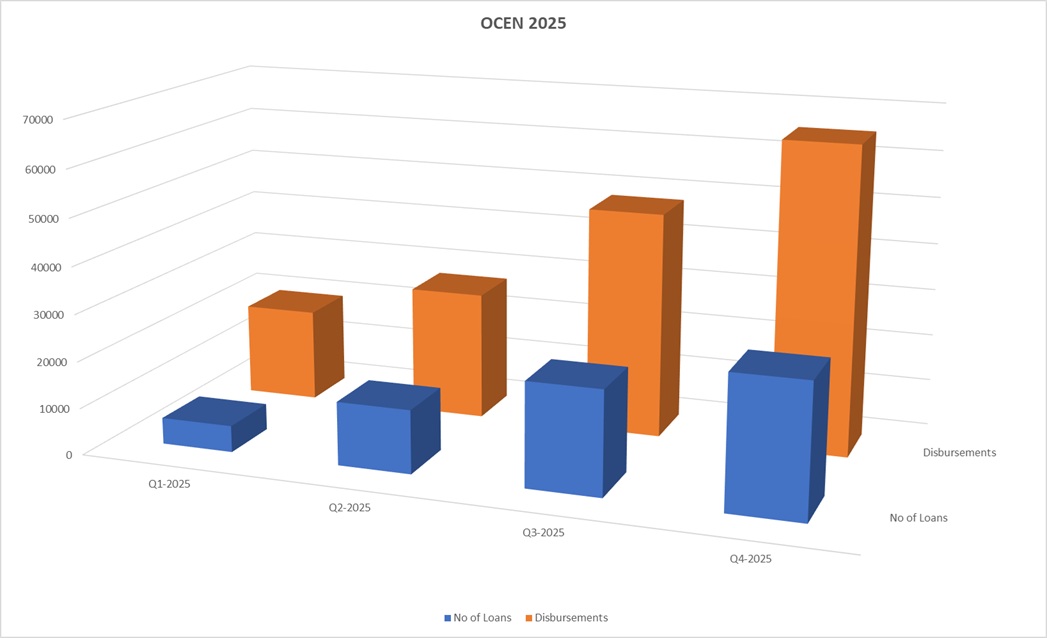
OCEN 2025

The calendar year 2025 has been a transformative period for the Open Credit Enablement Network (OCEN), evolving from a digital protocol into a powerhouse for financial inclusion. During 2025, OCEN successfully facilitated approximately 70,000 loans, resulting in over ₹1,600 Crore in disbursements.

This journey is not just about the numbers; it is about proving that a digital-first, cash-flow-based approach can solve the long-standing credit gap for underserved MSMEs with unparalleled efficiency.

A Year of Relentless Monthly Momentum

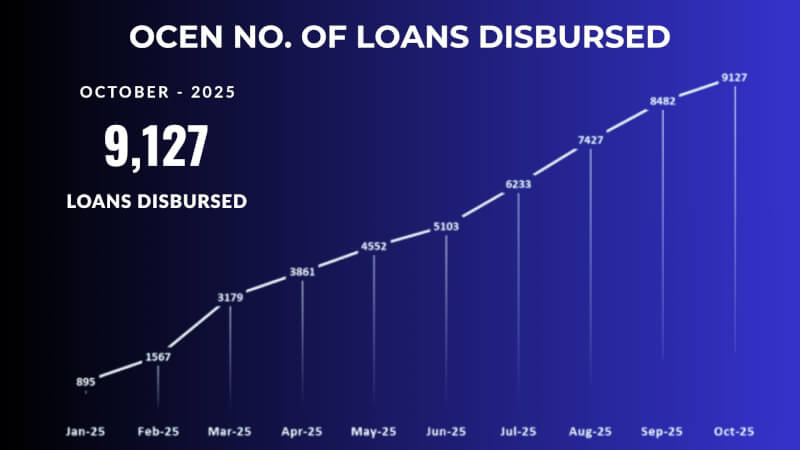
The 2025 journey began with a steady climb and rapidly escalated as more lenders and borrower agents integrated into the ecosystem. The monthly growth in the number of loans disbursed showcases a consistent upward trajectory. This steady monthly rise provided the foundation for the explosive quarterly growth that defined the year.

Consistent Quarterly Growth (QoQ)

When looking at the 2025 performance on a quarterly basis, the scale of adoption becomes even more evident. The network didn’t just grow; it accelerated every three months.

Period (2025)No. of LoansDisbursements (₹ Lakhs)
Quarter 15,64119,795
Quarter 213,51627,316
Quarter 322,14248,092
Quarter 428,12265,275

The jump from Q1 (5,641 loans) to Q4 (28,122 loans) represents an increase of nearly 400% in loan volume within a single year. Similarly, disbursements surged from ₹197.9 Crore in Q1 to over ₹652.7 Crore in Q4, demonstrating the massive appetite for small-ticket, short-tenure credit.

Portfolio Quality: The Ultimate Validator

The most significant achievement of 2025 isn’t just the volume—it’s the quality of the credit. Traditional MSME lending often suffers from high risk and significant non-performing assets (NPAs). OCEN has fundamentally challenged this narrative.

Participating lenders have seen highly encouraging results in portfolio health, characterized by strong performance, minimal portfolio losses and high confidence. The cash-flow-based underwriting model allows lenders to assess real-time business health rather than relying on stale collateral documents. Data-driven, short-tenure lending ensures high repayment rates.

The Future is Cash-Flow Based

OCEN’s 2025 journey proves that when you align technology with the actual business cycles of small enterprises, everyone wins. MSMEs get the “just-in-time” capital they need, and lenders gain access to a high-quality, low-risk asset class. With over ₹1,600 Crore disbursed in 2025, the protocol has set a new benchmark for how India can democratize credit and fuel the next wave of economic growth.

For more information, please visit: http://ocen.dev

Please note: The blog post is authored by our volunteer, Rahul Bhaik
OCEN Crosses the ₹200 Crore Monthly Milestone: Redefining MSME Credit Quality

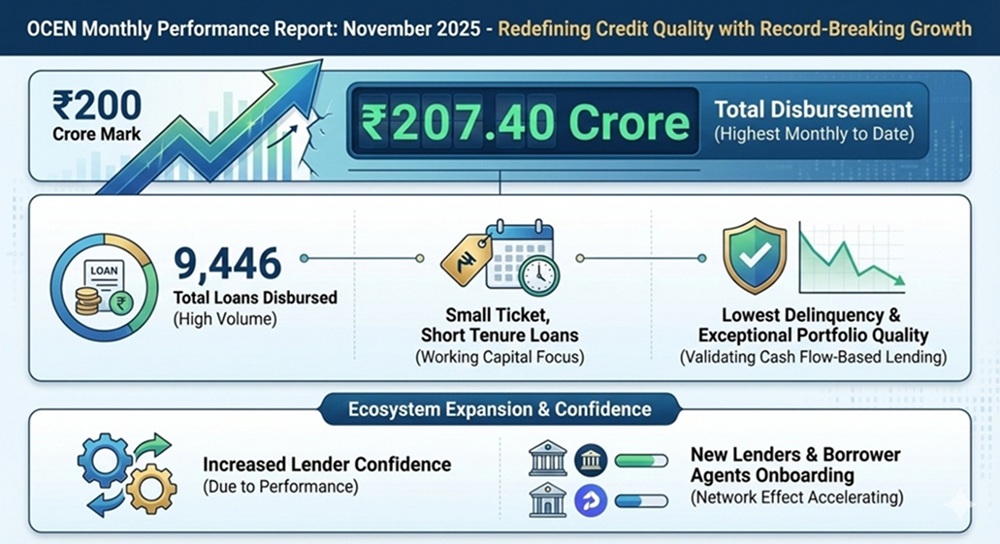
November 2025 has officially set a new standard for the future of cash flow based digital lending for MSMEs in India. For the first time, monthly disbursements through the OCEN protocol have breached the ₹200 Crore mark, proving that the shift toward cash flow-based lending is not just a pilot—it is a powerhouse.

As we move toward the close of 2025, the narrative is shifting from “how much” can be lent to “how well” it is being managed.

November 2025: By the Numbers

The growth trajectory of OCEN continues to follow a healthy curve. The protocol recorded its highest disbursement month to date, characterized by high-velocity, small-ticket lending that reaches the very grassroots of the MSME sector.

  • Total Disbursement: ₹207.40 Crore
  • Total Loans Disbursed: 9,446
  • Primary Loan Profile: Short-tenure, small-ticket working capital

This monthly performance brings the total calendar year disbursement to new heights, reinforcing OCEN’s role as an important digital highway for reducing the MSME credit gap.

The Quality Paradox: High Growth, Lowest Delinquency

In traditional lending, rapid growth often comes at the cost of asset quality. OCEN is turning this logic on its head. Despite the surge in volume, the participating lenders are reporting the lowest delinquency rates in the MSME segment.

The loan portfolio performance on OCEN has been exceptionally better than traditional MSME lending portfolios, which often struggle with high NPAs due to delayed data and static underwriting. By leveraging cash flow transaction data, OCEN allows for precision underwriting enabling the lenders see the actual health of a business today, not six months ago. As the Lenders focus on underwriting a Cash flow transaction rather than underwriting a borrower, the Short-tenure loans ensure that capital is cycled quickly linked to the Cash flow being financed, reducing long-term exposure risk.

This “quality-first” growth has sparked a wave of confidence across the participating lenders. We are currently seeing multiple new lenders and borrower agents at various stages of onboarding onto the OCEN framework. As more entities join, the network effect will only intensify, making credit even more affordable and accessible for the millions of “Rajnis” running small shops and enterprises across India. OCEN is not just lending money; it is building a system of trust where verified data, not just collateral, becomes the currency for growth.

For more information, please visit: http://ocen.dev

Please note: The blog post is authored by our volunteer, Rahul Bhaik
India’s silent Credit Revolution: OCEN Surpasses 50,000 Loans and ₹1100 Crore in 2025

The Micro, Small, and Medium Enterprises (MSME) sector is the engine of the Indian economy, yet for years, it has been choked by a massive credit gap. Traditional, collateral-heavy lending processes simply could not keep pace with the dynamic, short-tenure funding needs of small businesses.

Open Credit Enablement Network (OCEN): Built on the principles of India Stack, this digital protocol is not just facilitating loans; it is fundamentally rewiring the architecture of MSME credit, making it instant, affordable, and accessible. The monthly growth witnessed in the calendar year 2025 proves the model is not just viable, but highly scalable, marking a new era of financial inclusion.

The Power of Cash Flow-Based Lending

OCEN’s disruptive approach lies in shifting the lending paradigm from asset-based to cash flow-based underwriting. For millions of creditworthy small businesses, their true financial health is reflected in their daily or monthly transactions, not in static, year-old balance sheets. By leveraging India’s digital public infrastructure, OCEN allows lenders to assess risk based on real-time, consented data helping them to take faster decisions and making small-ticket, short-tenure credit economically feasible for lenders.

This framework is specifically designed to solve for the underserved, those who need smaller loans for shorter periods but have previously been locked out of formal credit channels.

Demonstrating Growth and Inclusion

OCEN demonstrated its ability to deliver on its promise of democratizing credit. The network has disbursed 50,426 loans and amounting to ₹1142 Crore in total disbursement within the calendar year till October 2025.

October 2025: OCEN saw the highest ever monthly disbursement of 191 Crore across 9127 loans Catering directly to the daily needs of MSMEs. The growth highlights how the protocol’s architecture is perfectly suited for mass-market financial inclusion. The emphasis is clearly on the number of lives touched and the frequency of credit access, rather than just the size of the total loan book.

Validating the Model: Exceptional Portfolio Health

The true testament to OCEN’s cash flow-based underwriting is not just the speed and volume of disbursement, but the quality of the loan book. Crucially, the loans disbursed through the OCEN protocol have demonstrated very minimal Non-Performing Assets (NPAs). This performance is exceptionally better than the NPA figures typically observed in traditional MSME lending portfolios across the industry. This is not just a marginal improvement; it is a fundamental validation of the protocol’s ability to accurately identify and price risk among digitally visible, cash flow-rich MSMEs. By moving beyond outdated collateral requirements and relying on real-time transactional data,

OCEN is proving that digital, embedded credit is inherently safer and more sustainable than conventional lending practices, offering a high-growth, low-risk opportunity for participating lenders.

For more information, please visit: http://ocen.dev

Please note: The blog post is authored by our volunteer, Rahul Bhaik