
Lessons from India’s Digital Public Infrastructure Journey

In just a decade, India has redefined how nations can harness technology for the public good. Through Digital Public Infrastructure (DPI), such as Aadhaar, UPI, and Account Aggregator, followed by newer innovations like OCEN and ONDC, India has shown the world how open, interoperable, and inclusive digital systems when designed as privately provisioned, public infrastructure; can spark innovation, scale rapidly, and empower communities at the grassroots.

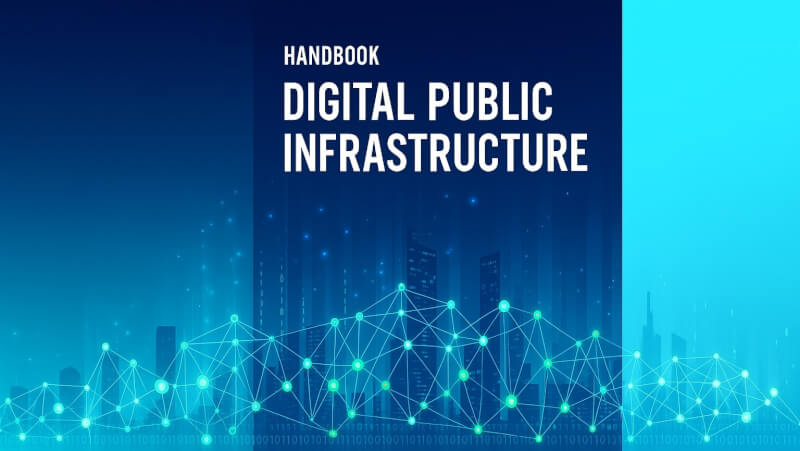
To capture these lessons and provide a practical guide for policymakers, technologists, and global stakeholders, iSPIRT Foundation has contributed to the development of the DPI Handbook: Foundations of Digital Public Infrastructure. This handbook distills a decade of India’s pioneering experience into actionable insights, frameworks, and design principles that can help other nations build their own inclusive and interoperable DPI. The paper is now published on the Research and Information System for Developing Countries (RIS)

This Handbook is not the product of a single author, but rather the culmination of years of dedicated volunteerism at iSPIRT, where technologists, policymakers, entrepreneurs, and thinkers came together to exchange ideas, build prototypes, and debate design choices. Each page reflects this collaborative spirit, proof that when diverse minds work in concert, they can create frameworks that transform entire societies.

We extend our deepest gratitude to the iSPIRT volunteer community, past and present, whose passion and commitment, have been instrumental in shaping India’s DPI journey. Their contributions embody the ethos of building digital public infrastructure as a shared national mission.

We hope the DPI Handbook becomes both a guide and an inspiration, for nations building their own digital public infrastructure, and for all who believe that technology, when designed for the public good, can change the course of societies.

Please note: The blog post is co-authored by our volunteer, Arun Iyer

iSPIRT would like to extend its gratitude to Shri. Rajeev Chawla – IAS, Strategic Advisor and Chief Knowledge Officer- Ministry of Agriculture & Farmer’s Welfare who co-authored this Handbook, for his insightful perspectives. We would also like to thank Shri. Sachin Chaturvedi, Director General – RIS for graciously writing the Preface to this Handbook

OCEN July 2025 Snapshot

MSME Lenders need to start looking beyond AUM to truly value short-term loan pools. OCEN helps minimize loan processing costs and provide easy access to new borrower segments at scale. Specialized roles, including collections partners, help reduce the burden on lenders. Short-term lending products for marketplaces where Loan Agents also control the income-source for the borrower can use escrow-based-repayments to mitigate the collections risk. New datasets enable lenders to make easier underwriting decisions for cash-flow based lending.

Both TReDS and OCEN play critical roles in improving MSME access to credit, albeit for different segments of the market. Unlike TReDS, OCEN eliminates the buyer acceptance bottleneck. Instead, it leverages alternative underwriting models, specialized loan products, and digital collections to offer small‑ticket, short‑tenure working capital loans to MSMEs.

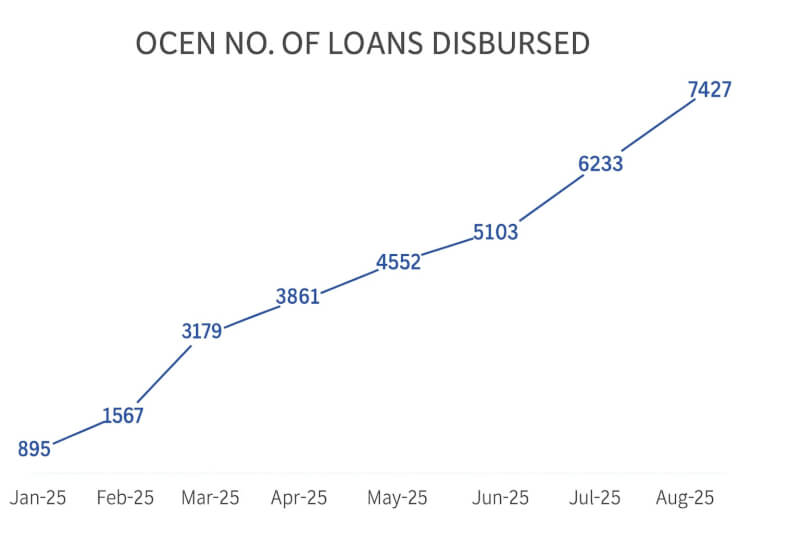
While TReDS will likely continue growing in disbursal volumes and strengthen formal receivables financing, OCEN’s focus on smaller, flexible loans positions it to grow much faster in terms of number of loans disbursed. Though TReDS and OCEN are targeting the same goal, both have its own unique features to succeed and co-exist to meet the common goal faster. OCEN becomes the next choice to solve for smaller businesses with small ticket loan requirements who are beyond the formal credit net and do not fit in the TReDS window. OCEN is growing fast with 30% MoM increase in number of loans due to the framework capabilities.

MetricJan-25Feb-25Mar-25Apr-25May-25Jun-25Jul-25
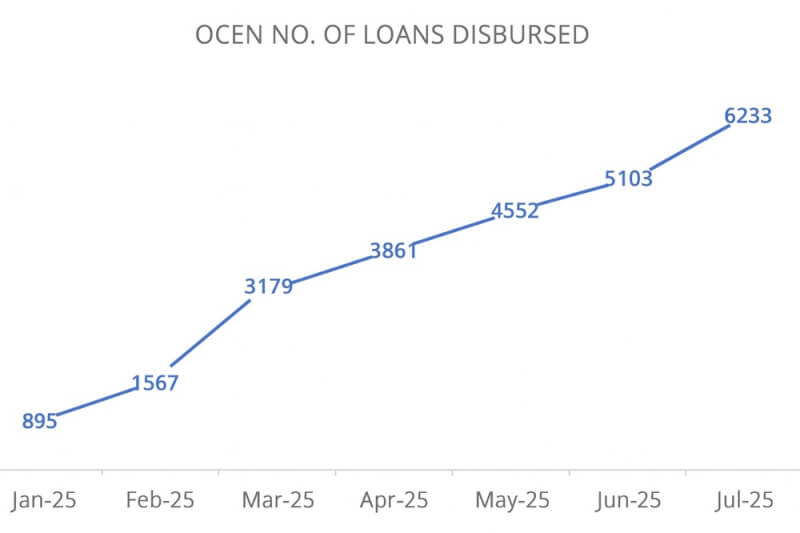
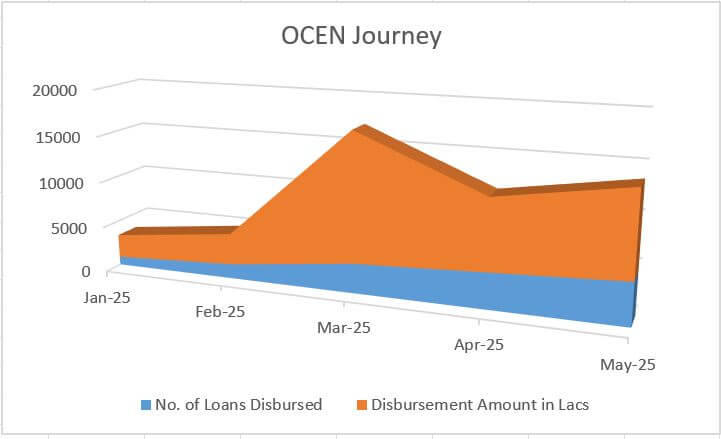
No. of Loans Disbursed895156731793861455251036233
Disbursement Amount in Lacs2517336713911761390821062113886

For more information, please visit: http://ocen.dev

Please note: The blog post is authored by our volunteer, Rahul Bhaik

OCEN June 2025 Snapshot

Open Credit Enablement Network (OCEN) is designed to serve borrowers across all turnover bands — including micro and small businesses whose buyers are not large enough to qualify for TReDS. This inclusivity enables it to reach segments of the MSME sector that remain underserved by formal credit channels.

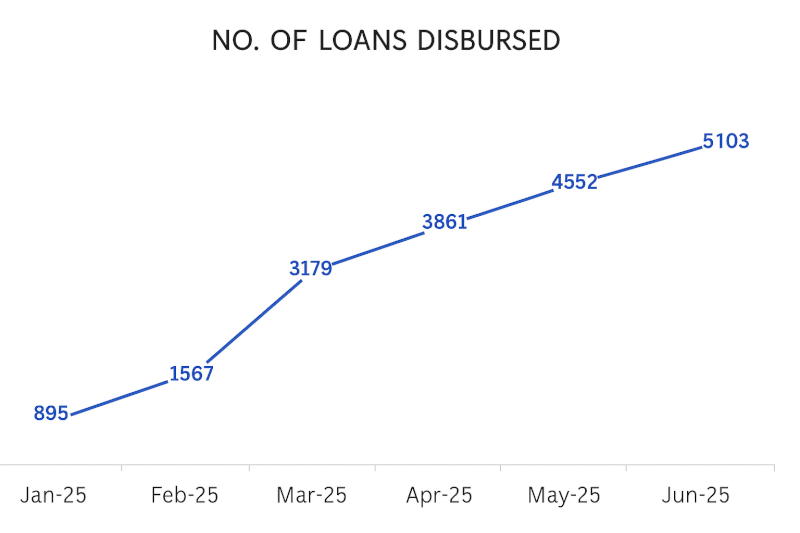
OCEN’s ability to leverage alternative underwriting models, specialized loan products, and digital collections to offer small‑ticket, short‑tenure working capital loans to MSMEs solves for smaller businesses with small ticket loan requirements who are beyond the formal credit net. With this unique framework, OCEN is expected to see a decent growth in number of loans. This growth would be a significant reflection of ensuring access of credit to the underserved who only need smaller loans for shorter tenures and will increase penetration in the new to credit MSME segment. Below is a snapshot of OCEN’s journey for the last 6 months:

MetricJan-25Feb-25Mar-25Apr-25May-25Jun-25
No. of Lenders Live on OCEN777888
No. of Borrower Agents Live666666
No. of Technology Service Providers (TSPs) with active deployment 233333
No. of Loan Products111111121212
No. of Loans Disbursed89515673179386145525103
Disbursement Amount₹25.17 Crore₹33.67 Crore₹139.11 Crore₹76.13 Crore₹90.82 Crore₹106.21 Crore
Average Loan Ticket Size₹2.81 Lakh₹2.14 Lakh₹4.37 Lakh₹1.97 Lakh₹1.99 Lakh₹2.08 Lakh

For more information, please visit: http://ocen.dev

Please note: The blog post is authored by our volunteer, Rahul Bhaik

Empowering India’s Growth Engines: The Critical Role of Credit for MSMEs

June 27 – International MSME Day

Micro, Small, and Medium Enterprises (MSMEs) are the unsung heroes of India’s economy. Employing over 11 crore people and contributing nearly 30% to the country’s GDP, MSMEs are not just businesses – they are drivers of innovation, inclusion, and local development.

On this MSME Day, we celebrate their resilience and ingenuity. But it’s also a moment to reflect on what holds them back – and how access to credit remains one of the most critical challenges they face. For MSMEs, timely and adequate credit is often the difference between scaling up and shutting down. Credit powers, yet, the reality is stark: a majority of MSMEs in India still rely on informal sources of finance or are denied loans due to lack of collateral or formal credit history.

According to estimates by the IFC, India’s formal MSME credit gap exceeds ₹25 lakh crore. Despite government schemes and fintech innovations, many small businesses struggle to access formal credit. This gap doesn’t just hurt MSMEs – it stifles job creation, reduces GDP growth, and hampers economic inclusivity.

A Shift Towards Cash-Flow-Based Lending

The good news? The ecosystem is evolving.

With initiatives like Account Aggregator, OCEN (Open Credit Enablement Network), and digitization of GST and banking data, lenders are moving towards cash-flow-based lending models. These innovations focus on real-time business performance rather than outdated collateral-based methods.

Such models enable more flexible, faster, and inclusive credit access to deserving MSMEs, especially those in Tier 2 and 3 cities.

To truly empower MSMEs with credit, the following steps are critical:

  • Financial literacy programs to help MSMEs manage credit and build a borrowing track record.
  • Policy support to incentivize banks and NBFCs for lending to first-time or underserved borrowers.
  • Greater public-private collaboration to build robust digital lending infrastructure.
  • Simplification of loan application processes through digital channels.

Celebrating MSMEs, Supporting Their Dreams

On this MSME Day, let’s go beyond celebration. Let’s reaffirm our commitment to unlocking finance for the backbone of our economy.

Whether you’re a policymaker, lender, fintech innovator, or simply a consumer – supporting MSMEs means supporting India’s future.

Because when MSMEs grow, India grows.

For more information, please visit: http://ocen.dev

Please note: The blog post is authored by our volunteer, Rahul Bhaik

OCEN Ecosystem Progress Snapshot:

The Open Credit Enablement Network (OCEN) post its initial pilot deployment and continuous upgrades and improvements has seen growing participation across the ecosystem. OCEN’s transition from its early stages into the growth phase is now reflecting in its growing volumes and addition of new ecosystem partners. 

Monthly Progress Report: 

With the start of the new financial year, the April-June quarter is usually considered a sluggish season in financial services, more particularly in lending business. Corresponding trend reflects in the April performance on the OCEN traction as well, however April & May are still looking progressive in comparison to Jan & Feb performance, considering March financial year end rush as an exception. As newer products and lenders go live on OCEN, the trendline growth looks promising. 

Here’s a quick look at the latest numbers on the OCEN ecosystem:

MetricJan-25Feb-25Mar-25Apr-25May-25
No. of Lenders Live on OCEN77788
No. of Borrower Agents Live66666
No. of Technology Service Providers (TSPs) with active deployment 23333
No. of Loan Products1111111212
No. of Loans Disbursed8951567317938614552
Disbursement Amount₹25.17 Crore₹33.67 Crore₹139.11 Crore₹76.13 Crore₹90.82 Crore
Average Loan Ticket Size₹2.81 Lakh₹2.14 Lakh₹4.37 Lakh₹1.97 Lakh₹1.99 Lakh

OCEN continues to engage with ecosystem partners to build the momentum for new cash flow lending products for MSMEs.

For more information, please visit: http://ocen.dev

Please note: The blog post is authored by our volunteer, Rahul Bhaik

OCEN: Credit Access for MSMEs continues to grow

The volumes and traction on Open Credit Enablement Network (OCEN) continues to grow month on month. The growing trajectory highlights OCEN’s ability to streamline and democratise credit access for MSMEs by leveraging digital public infrastructure and fostering collaboration among lenders, agents, and technology providers. 

Here is a snapshot of the OCEN ecosystem’s key updates for March:

MetricJan-25Feb-25Mar-25
No. of Lenders Live on OCEN777
No. of Borrower Agents Live666
No. of Technology Service Providers (TSPs) with active deployment 233
No. of Loan Products111111
No. of Loans Disbursed89515673179
Disbursement Amount₹25.17 Crore₹33.67 Crore₹139.11 Crore
Average Loan Ticket Size₹2.81 Lakh₹2.14 Lakh₹4.37 Lakh

As OCEN continues to evolve, it is poised to further bridge the credit gap for MSMEs, enabling faster, more transparent, and more inclusive financial support for this vital sector of the Indian economy.

For more information, please visit: http://ocen.dev

Please note: The blog post is authored by our volunteer, Rahul Bhaik

OCEN: Advancing Digital Public Infrastructure for MSME Credit Access

The Open Credit Enablement Network (OCEN) is steadily progressing from its early stages into a more robust growth phase. With its current ecosystem participants, OCEN has started facilitating smoother credit delivery to MSMEs. At the same time, numerous other players are integrating into the protocol and developing specialized loan offerings tailored to the needs of MSMEs.

Here’s a snapshot of the OCEN ecosystem’s key updates for February:

MetricJan 2025Feb 2025
No. of Lenders Live on OCEN77
No. of Borrower Agents Live66
No. of Technology Service Providers (TSPs) with active deployment 23
No. of Loan Products1111
No. of Loans Disbursed8951567
Disbursement Amount₹25.17 Crore₹33.67 Crore
Average Loan Ticket Size₹2.81 Lakh₹2.14 Lakh

OCEN continues to engage with new participants to further expand the ecosystem, adding new products and scaling up efforts to transform credit access for MSMEs on a large scale.

For more information, please visit: http://ocen.dev

Please note: The blog post is authored by our volunteer, Rahul Bhaik

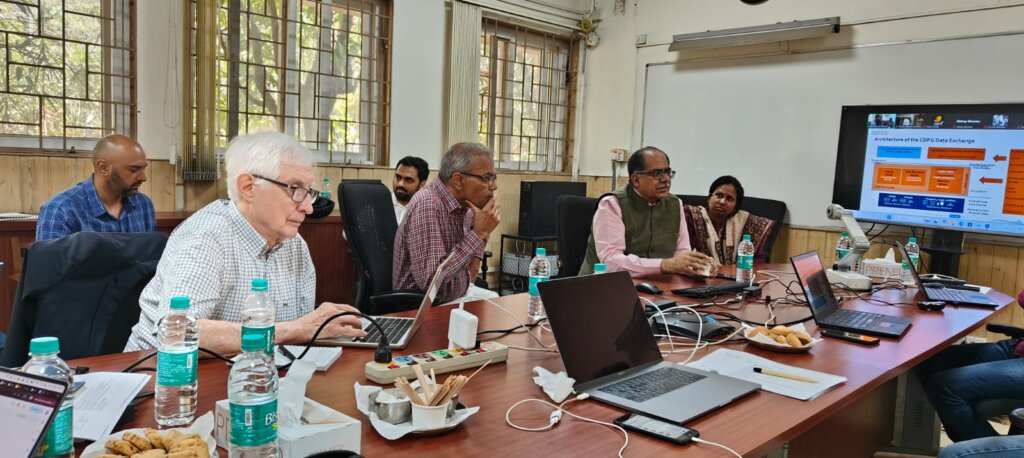
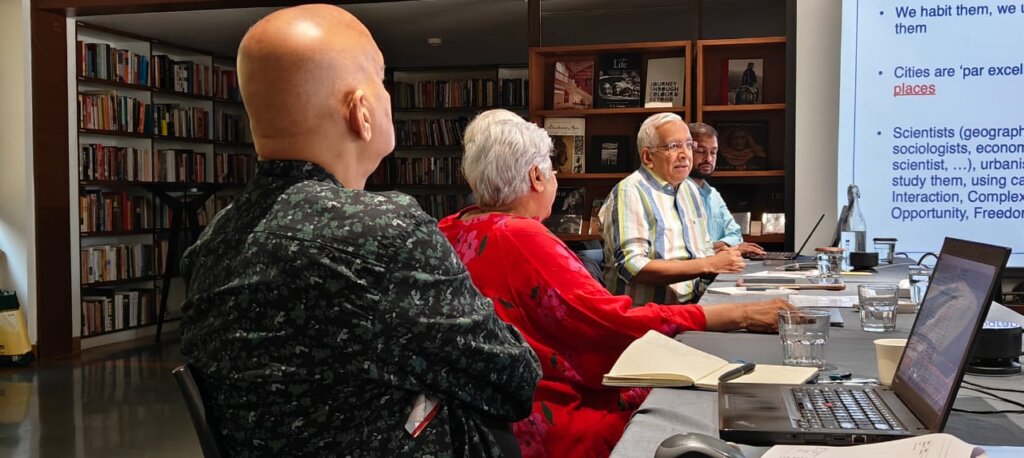
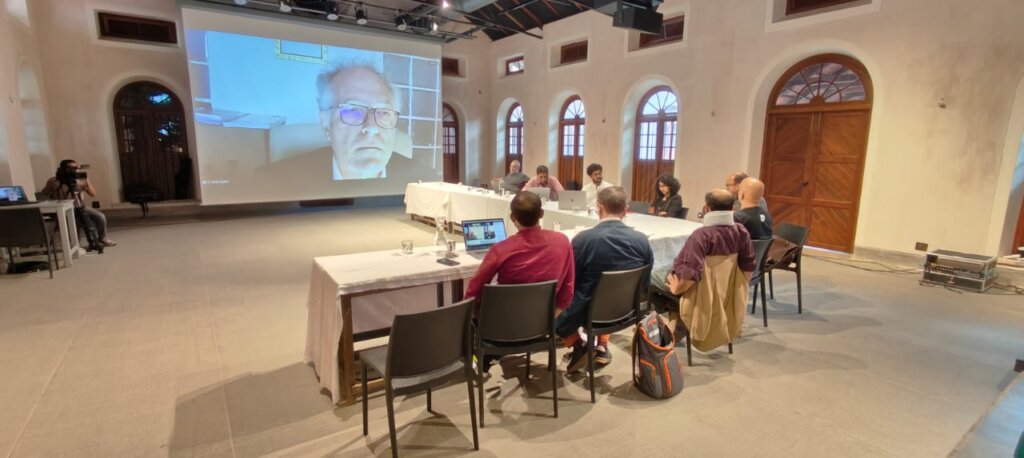
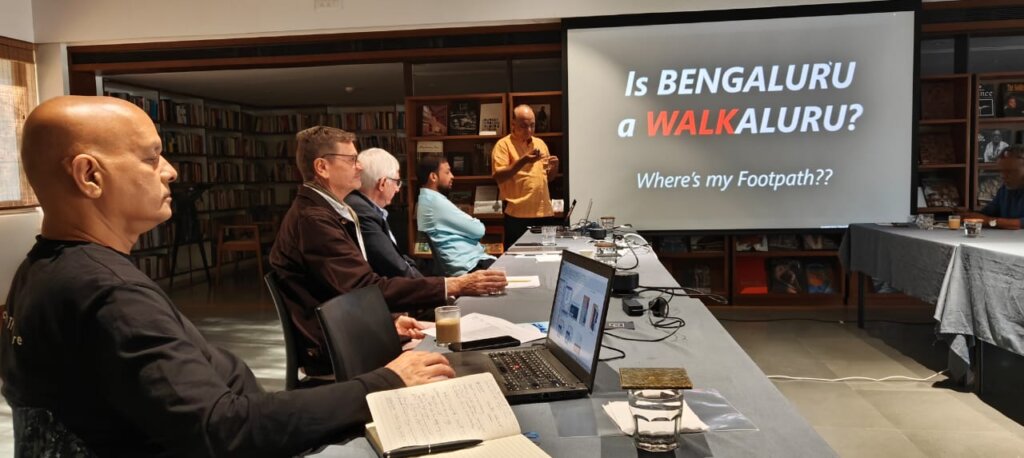
Imagining Indian Cities: #1 ‘Creative Bangalore’

There is a need for a continuous conversation about the best way to shape the future of Indian cities. This conversation will take place across multiple cities, with learnings from each other.

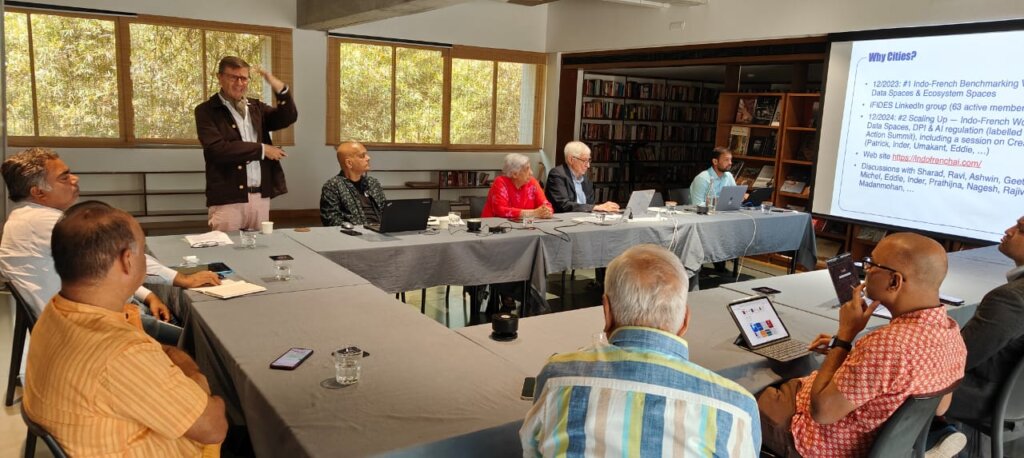
Therefore, it is proposed to hold an ‘Imagining Indian Cities’ Workshop annually in different Indian places. The first of those took place in Bangalore from 10 to 15 March 2025, with the next two planned for Chennai and Pune.

These Workshops will gather academics, practitioners and urban innovators in multi-day get-together. Half of each conference will focus on the host city, and the other half will be for learnings from elsewhere.

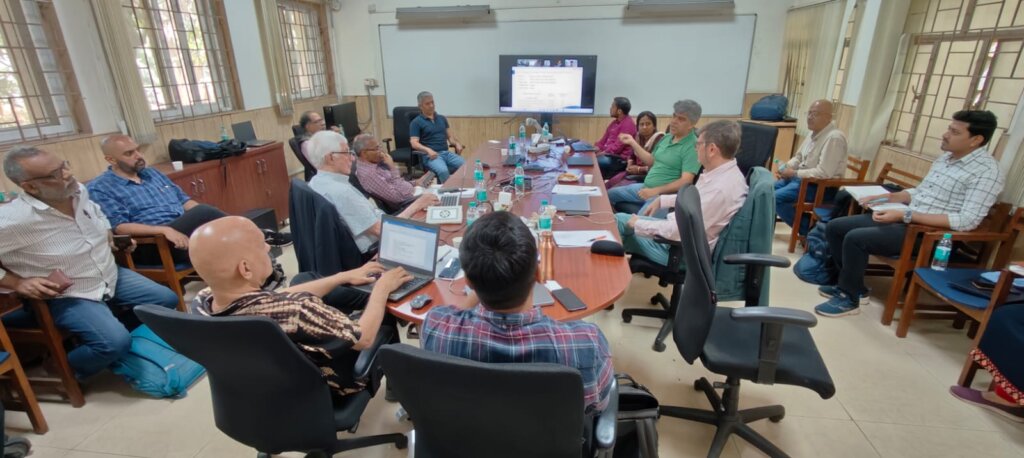
This ‘Creative Bangalore’ Workshop was organised by the Indian think tank iSPIRT Foundation and supported by IISc/IUDX, IIHS and Dassault Systèmes, for bringing together various participants, chosen to form a sustainable collective capable of shedding light on a certain number of key questions and moving towards increasingly measurable contributions.
Initial key questions were:

  1. Genericity and reproducibility of the Creative Cities model developed by Patrick Cohendet
  2. Digital Urban Data, Digital Public Infrastructure (DPI) and territorial intelligence
  3. Placement of (Digital) Commons
  4. Digital representations of culture
  5. Digital representations of Wicked Problems

Results:

  • 5 full days, hosted by Bangalore International Centre (D1), IISc/India Urban Data Exchange (D2), Sabha (D3), Indian Institute of Human Settlement (D4) and Dassault Systèmes (D5);
  • More than 50 speakers, in person or online;
  • A rich repository of content, including speaker presentations, slides and Photos https://drive.google.com/drive/folders/1lxnbuhna3Hz_t49BOGvZG15_0dByi9Ki

OCEN: Enabling Credit for MSMEs with Digital Public Infrastructure

The Open Credit Enablement Network (OCEN) built on open network principles, unbundles MSME lending into specialized components, creating an ecosystem where different entities excel in one specific part of the lending process. These specialized entities focus on various tasks such as sourcing, distribution, identity verification, underwriting, capital arrangement, and collections. The result? A seamless, scalable model for MSME lending, made possible by OCEN 4.0.

Since its initial pilot deployment, the OCEN protocol has undergone continuous upgrades and improvements. Based on invaluable feedback and insight from ecosystem participants, the latest specifications address key challenges such as incentive alignment, dispute resolution, and network settlements through robust techno-legal frameworks. With these improvements, OCEN has already transitioned from its early stages and is now entering the growth phase.

OCEN Ecosystem Progress Snapshot:

We are now starting to publish monthly numbers of the OCEN ecosystem to build a trendline of progress.

As of January 2025, here’s a quick look at the latest numbers on the OCEN ecosystem:

MetricMonth – Jan 2025
No. of Lenders Live on OCEN7
No. of Borrower Agents Live6
No. of Technology Service Providers (TSPs) with active deployment 2
No. of Loan Products11
No. of Loans Disbursed895
Disbursement Amount₹25.17 Crore
Average Loan Ticket Size₹2.81 Lakh

As the OCEN network grows, it is actively engaging with new participants to expand the ecosystem and scale up with additional products. As new products and partnerships are developed, we are excited to witness how OCEN will continue to evolve and transform credit access for MSMEs at scale.

For more information, please visit: http://ocen.dev

Please note: The blog post is authored by our volunteer, Rahul Bhaik

A Budget with Good Intentions but lacks drive to realize Viksit Bharat & EODB

iSPIRT Foundation, a technology think-and-do tank, believes India’s hard problems can be solved only by leveraging public technology for private innovation. iSPIRT, as a think-and-do-tank, pioneered the concept of Digital Public Infrastructure (DPI)

Industry watched and waited to see if this budget will have bold, strategic announcements with long-term vision, aiming for Viksit Bharat 2047. Instead the budget has become more a tactical prescription for handling short-term economic correction.

Three themes capture our attention in the 2025 budget: The Investment in Innovation, Regulatory Reforms and MSME Credit.

Given our Product Nation initiative at iSPIRT, we were looking for bold steps in two major areas: Private sector R&D funding and Ease of Doing Business.

The funding for R&D made incremental progress in this budget. Under the theme ‘Investing in Innovation” the Finance Minister announced Rs. 20,000 Crore to be allocated from the policy announcement of 1 Lakh Crore made in previous budgets. There is no major decision or clarity on how this funding will be routed. In addition, intent is expressed to explore a Deep-Tech fund in the future.

Similarly two welcome announcements towards achieving strategic autonomy are, an outlay for 20,000 crore to develop Small Modular Reactors (SMR) and operationalise at least five indigenously developed SMRs by 2033 and, a National Geospatial Mission to develop foundational geospatial infrastructure and data.

There is a marked improvement in intent to solve the Ease of Doing Business (EoDB) problem in the budget made evident by yesterday’s Economic Survey.

We have been pursuing the Government of India (GOI) on EoDB to implement a comprehensive three-pronged approach, to bring India into the top 5 or 10 EoDB countries. This includes decriminalising 1200 provisions; rationalising multiple laws and implementing a National Regulatory Compliance grid at the center and then extending it to states. Our approach gels with the “Whole of Nation” thinking given by the Honorable Prime Minister.

The GOI appears to reflect this thinking in the statement, “A light-touch regulatory framework based on principles and trust will unleash productivity and employment. Through this framework, we will update regulations that were made under old laws. To develop this modern, flexible, people-friendly, and trust-based regulatory framework appropriate for the twenty-first century…”.

However, the specific action of forming a High-Level Committee for regulatory reforms that “will be set up for a review of all non-financial sector regulations, certifications, licenses, and permissions”, is welcome but appears to be incremental in nature and a slow-moving approach.

The Janvishwas 2.0 announcement has also been repeated stating 100 items to be taken up instead of 1200 reported by us.

Sudhir Singh, iSPIRT’s policy expert volunteer said, “The concept of digital transformation through National Regulatory Compliance Grid (NRCG) has been ignored in the budget. However, another idea of “Digital Port”, pursued by iSPIRT for more than two years now, on digital transformation of cross border trade has received attention and GoI seems to have framed it as ‘BharatTradeNet’ in the budget 2025.”

The budget speech states, “a digital public infrastructure, ‘BharatTradeNet’ (BTN) for international trade will be set-up as a unified platform for trade documentation and financing solutions”. This indeed is an important and welcome announcement.

The Finance Ministry’s move to separate R&D funding and Startup funding is encouraging. The startup-related announcements reflect the government’s continued support to startups.

The government has taken several steps to boost credit enablement for SME and Nano enterprises, a significant part of Priority Sector Lending. Some good announcements were made such as the Kisan Credit Card (KCC) limit increasing from INR 3 lakh to 5 lakh, which in three states – Karnataka, Maharashtra and Uttar Pradesh – is based on Open Credit Enablement Network (OCEN), an initiative of iSPIRT. Other welcome announcements include an increase in credit guarantee cover for MSMEs from INR 5 crores to 10 crores, introduction of customized credit cards for MSMEs, and capital infusion into select public sector banks.

A new Fund-of-Funds with a fresh contribution of another 10,000 crore has been announced. It is encouraging to see the time limit for u/s 80-IAC to avail income tax exemption benefit for startups has been extended by 5 years to 01.04.2030. Another announcement of interest for startups is an extension of credit credit availability with a guaranteed cover of INR 10 crores to 20 crores, with the guarantee fee being moderated to 1 per cent for loans in 27 focus sectors important for Atmanirbhar Bharat.

iSPIRT cofounder Sharad Sharma said, “It is heartening to see private sector R&D funding rolling out with a 20,000 crore fund allocation. Formation of Ease of Doing Business (EoDB) committee is also welcome. However, there is a need to take big moves and expedite these steps to meet 2047 deadlines. BharatTradeNet is a welcome announcement and we hope there will be a thorough and transparent industry consultation on it. Overall we are missing bold and specific actions on Strategic Autonomy and Product Nation. “

About iSPIRT Foundation – We are a non-profit think-and-do tank that builds public goods for Indian product startups to thrive and grow. iSPIRT aims to do what DARPA or Stanford University did in Silicon Valley for startups. iSPIRT builds four types of public goods – technology building blocks (aka India Stack), startup-friendly policies, market access programs like M&A Connect, and Playbooks that codify scarce tacit knowledge for product entrepreneurs of India. For more, visit www.ispirt.in.

For further queries please reach out via email: [email protected] , [email protected] , or [email protected]

Comparing Key Frameworks in the Digital Lending ecosystem: ULI, OCEN, and AA

In the evolving landscape of financial inclusion and digital lending, India has introduced several innovative frameworks designed to streamline access to credit, enhance transparency, and create seamless financial ecosystems. Among these, the Unified Lending Interface (ULI), Open Credit Enablement Network (OCEN), and Account Aggregator (AA) stand out as key initiatives aimed at modernizing the way credit and financial data are managed.

While all three initiatives aim to transform the lending sector, each has distinct roles, benefits, and functions. To better understand their unique features and how they interact with one another, we’ve put together a detailed comparison chart.

This side-by-side breakdown helps you identify the core differences between ULI, OCEN, and AA, their respective use cases, and how they collectively contribute to building a more inclusive and tech-driven financial ecosystem in India. Whether you’re a fintech enthusiast, a policy maker, or simply looking to understand the future of credit access, this comparison will offer valuable insights into these transformative frameworks.

 ULI (Unified Lending Interface)OCEN (Open Credit Enablement Network)AA (Account Aggregator)
PurposeStandardized API interface for Lending institutions providing borrower’s financial and non-financial data from various sources, including government databases, and financial institutions. Helps financial institutions to reduce friction for accessing the information needed for quick loan underwriting decisions and efficient loan application processing.  OCEN is a framework of application programming interfaces (APIs) for interaction between lenders, loan agents, collection and disbursement partners, derived data providers, and account aggregators OCEN facilitates flow of credit between borrowers, lenders, and credit distributors using a common set of standards. Various participants in the credit ecosystem can seamlessly connect with one another without needing to build customised APIs and infrastructure. OCEN aims to enable cash-flow based unsecured financing for MSMEs as against balance sheet and collateral based financing. Both ULI and AA can be derived data providers in the OCEN ecosystem.  The Account Aggregator (AA) framework allows users to share consent driven financial data across institutions. Users can access their financial information from multiple institutions in one place, and can decide who can access their data, for how long, and for what purpose. The FI Types are managed by ReBIT.
UsersRegulated entities like Lenders, etcMSME-focused Borrower Agents and Lenders. Other ecosystem participants include Derived Data Providers, Collection Agents, Disbursement Agents and KYC Partners  Financial Information Users which are Regulated entities and Individuals who wish to access their own financial details
Key FunctionalityEnabling RE’s and Marketplaces to fetch different types of financial and non-financial data for underwriting using standard interface.Standard rails to connect various participants in the Cash flow based MSME lending ecosystem. Enabling building customised credit products for MSMEs and empowering the Borrower agent as a lynchpin and a representative of the borrowers.  Providing safe, user-consented sharing of financial information between regulated financial institutions via the Account Aggregator framework. Individuals can have a holistic single source to view financial data across various institutions.  
Data UsageUtilizes borrower data from diverse sources like banks, land records, and financial history.Utilizes specific business data of MSMEs like invoices, transactions, etc., for the credit product creation. Any kind of data can be passed to the Lender in the form of derived data. For eg. Government e-Marketplace shares borrower performance data with lenders post consent.  Uses consolidated financial data like bank accounts, GST, income, etc., from FIPs.
Role in EcosystemStreamline credit access by integrating borrower data from multiple sources for accurate financial assessment, enabling faster loan approvals through advanced analytics, facilitating easy integration with standardized APIs, and providing lenders seamless access to comprehensive borrower information to simplify credit appraisal and reduce documentation  Fosters innovation in MSME credit by enabling tailored loan offerings and faster credit flow thus enabling access to credit to MSMEs which earlier did not have access to the same. Reduce cost of short tenure, low ticket lending and making it viable to give loans to MSMEs which are end use controlled and enable collection control.Promotes financial inclusion by simplifying financial data sharing and improving credit decision-making. Allowing user to share their data directly with financial institutions in a consented manner removing the data passing through multiple hands.
Technology BackboneConsent-based data-sharing infrastructure; APIs to connect various data sources with lenders.    API infrastructure based on standard OCEN protocol for credit enablement. Participant and Product registries to enable discovery and standardisation within the ecosystem.API-driven, centralized consent architecture defined by ReBIT under the RBI framework.
Regulatory FrameworkProposed under RBI’s initiative to enhance digital lending infrastructure.Digital Public Infrastructure at a mass roll out stage. Once formalised will be managed and regulated as advised by regulators.  Governing law is the RBI’s Account Aggregator framework under the NBFC-AA license.
Use CasesA farmer applies for a loan to purchase farm equipment. Lender is able to access land records and other non-financial and financial data through ULI interface to underwrite the loan application.Zomato as a Borrowers agent on behalf of restaurants enrolled on its platform being able to offer custom loan products specifically built for restaurant partners by the participating lenders based on alternate platform data, ability of providing collection control to lenders via cash flow entrapment and acting as a representative of the borrowers instead of agent of lenders. Like Zomato any of platforms or institutions (like FPO) sitting on a Captive database can utilise OCEN to enable lending on their platform benefiting their users.  Individuals being able to share their multiple bank accounts for specific time periods and for specific purposes with the AA framework using consent mechanism.   Businesses being able to share GSTN data to RE’s for loan underwriting purpose using consent mechanism.
Implementation StageProposed platform; Some pilot Implementations for certain data sources have been done. Overall the ULI is in a development phase.    Few pilots – GeM Sahay, GST Sahay, Jan Aushadhi Kendra and Private network have been successfully tested. More implementations are underway at various stages and gaining traction.Well-established under the RBI’s regulatory framework with multiple FIP’s and FIU’s already integrated.

For more information, please visit: http://ocen.dev

Please note: The blog post is authored by our volunteer, Rahul Bhaik

Digital Public Infrastructures

This workshop was organized by the Indian think tank iSPIRT Foundation, French Embassy in India, Consulate General of France in Bangalore, and La French Tech in India, based on the following principles:

  • Gathering high level contributors from India and France: industrials, transdisciplinary academics, diplomats, officials, business founders, think tank members, technology makers;
  • Pushing a Workshop format (not an event, not a round table, not a scientific conference), organizing 3 different days with 3 different viewpoints:
    • Philosophical/epistemological/ human sciences,
    • Economical/techno-legal/social sciences/adoption,
    • Application domains and use cases (Health, Culture, Creative Cities, Agriculture);
  • Targeting recommendations toward the AI Action Summit (Paris, February 2025).

Results:

  • More than 80 speakers, 100 participants in person (in Bangalore or in Paris), 200 participants online;
  • 14 different countries represented all over the world (India, France, Canada, USA, Mexico, Guatemala, Brazil, Germany, Netherland, Italia, Spain, Portugal, Belgium, Thailand);
  • An opening session figuring the Ambassador of India to France H.E. Mr. Jawed Ashraf, the French Digital Affairs Ambassador H.E. Mr. Henri Verdier, the Consul general of France in Bangalore Mr. Marc Lamy;
  • A rich repository of content, including speaker presentations, slides and recordings (https://drive.google.com/drive/folders/1eTDbRgw1g8EOBtXS7uRim9I6gtQRbCZB).

8th Open House Session- Ballon Volunteers

Thank you so much for your patience…

Many of you asked when the volunteer programme would be available to apply, and here we are again. We do have some changes, though, so please pay attention.

This application process will be available only for the next couple of months and close by December 20th, 2024. It’s on a rolling basis, so apply immediately.

Many of you are already familiar with iSPIRT and its activities; this is your chance to join this volunteer movement. So take some time to review the programmes listed and watch the videos, not just the current ones but also the previous ones, to better understand the journey. Also, please read the Playground Coda and the Volunteer Handbook.

Are there tools we can help build to solve privacy issues, or what kind of packets will help get the internet to remote parts of India? Do you have a better solution to some pressing matters discussed in the videos? Then, you need to apply. Some legacy options and some new options are also available.

Is there some project that strikes your fancy, some part that calls out to you, and you know you can do it? To apply, click this link and follow the process.

I am reminding you again that the deadline is December 20th, 2024.

A journey with iSPIRT is also about the journey with yourself.

What’s India’s cultural factor that can propel us towards becoming a Product Nation?

A gathering of iSPIRT volunteers in Bangalore turned into an interesting discussion: How does India become a Product Nation by espousing values that are inherent and ingrained in us as Indians?

Here are some answers from that meeting. We hope this gets you thinking on how to draw inspiration from familiar cultural concepts while building for India!

In any culture where people have performed well in achieving a goal, that culture has encouraged training one’s mind. Mental performance therefore is key.

For example, Americans athletes do well at the Olympics. If you look at American culture, it champions working hard, winning, and training your mind to focus on winning.

You have the Japanese concept of Ikigai, where purpose gives you a reason to live a long, happy life. The authors who wrote a book on Ikigai shares a Japanese proverb that says, “Only staying active will make you want to live a hundred years”.

Or let’s take the theory of Flow. It’s a state of mind where we are so immersed in the joy of our work “that nothing else seems to matter”. In a state of flow the mind is trained to focus and enjoy a task, even the challenges that come with it. As iSPIRT volunteer Rinka Singh says his best work happens when he is having fun framing questions and thinking through challenging problems.

So, what of our culture do you think can help us train our minds to be disciplined and dedicated? And can teach us to enjoy our work even in tough times? Here are some examples iSPIRT volunteers shared at the meeting:

After all the culture we have grown up in has cultivated some great skills in us. To give you real life examples, look at the artist who is capable of creating exquisite, complex Rangoli designs or take the Indian programmer who is a whiz with math and logic.

Or take the Bhagavad Gita teaching us not to be attached to an outcome but simply focus on doing your tasks well. The less resources your mind spends obsessing about an outcome, the more time and focus your mind has to work on completing tasks really well. In addition, when you are not attached to an outcome, your mind can deal with failure much better. It becomes easier to retrain your mind to learn from failures and simply try again.

As iSPIRT volunteer Girish Elchuri says, “no greed, no glory” is the basic theme of thinking beyond self. It helps to expand your view beyond you to help find good solutions that can benefit those around you.

Or for example take how Indian culture also values family time, food and meditation or prayer. These could potentially create a better balanced healthy mind that can focus longer, and is less prone to burnout and depression.

iSPIRTer Shoaib Ahmed believes the powerful action of placing palms together and greeting each other Namaste is truly us saying, ‘the divinity in me recognizes the divinity in you’. This invisible force of divinity running through us all connects us and lays a sound foundation for Indian product builders to collaborate at a soul level.

Referring to the Bhagavad Gita, iSPIRTer Sharad Sharma reasoned that the essence of Gita is having confusion in your life and that having confusion in your life is not a bad thing, as long as you can take a step back to look at it philosophically and figure out the answer. What Indians are good at is reframing the problem. Gita is about reframing the problem and saying ‘don’t look at it the way it looks to you now. Let me tell you an alternative way of looking at the problem and that alternative way will help the answer to reveal itself.’

“Indians succeed because we can reframe the question at a higher level of abstraction and find answers, which to me is R&D. We can be the best R&D nation in the world”, is Sharad’s learning from what he has learned from the Gita.

iSPIRT’s Hari Subramanian feels the one core part of India’s culture over the centuries has been to question and constantly learn, seek knowledge. Hari feels this ability to question will propel India’s current generation of young builders to make us a Product Nation.

As Hari puts it, “The essence of Gita is, you are born to do something. Do that and don’t be tied down to what the outcome may be. Do what you are born to do, day in, day out and excellence will follow.”

To conclude, we have a golden opportunity to change India for the better by combining the ethos of US, Japan, and India. Let’s not miss it.

Let us take the YOLO spirit of the US. Let us learn from Japan that doing your tasks well means to master it. Then let us embrace the Indian principle of not worrying about the outcome but only focusing on your work and allowing excellence to follow. If we combine all this maybe magic can happen.

What more would you add to this list?

Please note: The blog post is authored by our volunteer, Regina Mihindukulasuriya 

Driving Financial Inclusion: Leveraging Cash Flow Lending for MSMEs | Expert Insights with Deepak Sharma

In this insightful dialogue, Sagar Parikh engages with Deepak Sharma to explore the transformative potential of cash flow lending for Indian MSMEs. Deepak underscores the significance of democratizing credit access through short-tenor and small-ticket loans, especially for micro-enterprises that comprise 99% of the MSME sector in India. Drawing from his rich experience in banking and financial services, Deepak Sharma provides invaluable guidance on navigating the complexities of B2B financing, highlighting the critical role of innovative lending models in fostering inclusive growth.

Deepak Sharma delves into the pressing challenges faced by MSMEs in accessing financing, particularly in the realm of B2B transactions. Leveraging his extensive experience and deep insights, he offers a fresh perspective on the traditional lending landscape, emphasizing the need for agile and tailored solutions to empower MSMEs. By advocating for cash flow-based lending and trust-based scoring systems, Deepak Sharma presents innovative approaches to address credit gaps and unlock opportunities for sustainable economic development within India’s dynamic MSME sector.

Deepak Sharma’s perspectives on banking innovation and financial inclusion provide several key learnings for the industry:

  1. Leveraging Technology for Inclusion: Sharma emphasizes the transformative impact of technologies like UPI and Aadhaar in fostering financial inclusion. These initiatives not only revolutionize digital payments but also open doors to credit access for underserved segments like SMEs.
  2. Proactive Engagement with Tech Ecosystem: Deepak advocates for proactive engagement with India’s tech ecosystem, encouraging early adoption of initiatives like IndiaStack. He challenges banks to rethink their approach and prepare for future changes in the financial landscape.
  3. Importance of Early Adoption: Reflecting on his experiences at Kotak, Sharma stresses the importance of early adoption of innovative initiatives. Banks that jump in early can leverage emerging opportunities and drive meaningful change.
  4. Value of Learning from Ventures: Deepak highlights the significance of learning from both successful ventures like OCEN and past failures. This learning process is essential for banks to navigate the evolving tech landscape effectively.
  5. Structured Innovation with the 5C Model: Sharma’s structured approach to innovation, encapsulated in the 5C model, emphasizes critical aspects such as customer acquisition, commercial viability, credit assessment, compliance, and collections. This framework ensures alignment on objectives and risk management strategies.
  6. Startup Mindset and Controlled Pilots: Adopting a startup mindset within traditional banking institutions, Deepak advocates for establishing small, specialized teams focused on data analysis, technology, and risk management. Controlled pilots with defined success metrics enable banks to manage—- risk effectively and drive innovation.
  7. Importance of Trust-Based Scoring: Sharma underscores the importance of trust-based scoring systems and proprietary scorecards for credit assessment. Moving away from traditional methods, these innovative approaches provide a holistic view of creditworthiness, especially for SMEs with limited credit histories.
  8. Optimism about OCEN: Deepak Sharma’s views on OCEN reflect a visionary approach to addressing India’s credit gap. He sees OCEN as a pivotal platform to harness India’s data richness and enable comprehensive credit assessment and lending solutions.

In conclusion, Deepak Sharma’s insights emphasize the necessity of embracing innovation and leveraging technology to drive inclusive growth in the financial services sector. By adopting proactive strategies, banks can navigate the evolving landscape of digital lending and unlock opportunities for underserved segments, contributing to India’s economic development.

For more information, please visit: http://ocen.dev

❓Questions? Submit your questions here.
📩Contact? Reach the OCEN 4.0 team at [email protected]

Please note: The blog post is authored by our volunteer, Sagar Parikh