

The EDF Backlash Is a Symptom of a Bigger Systemic Silos Problem in Government

EDF Backlash

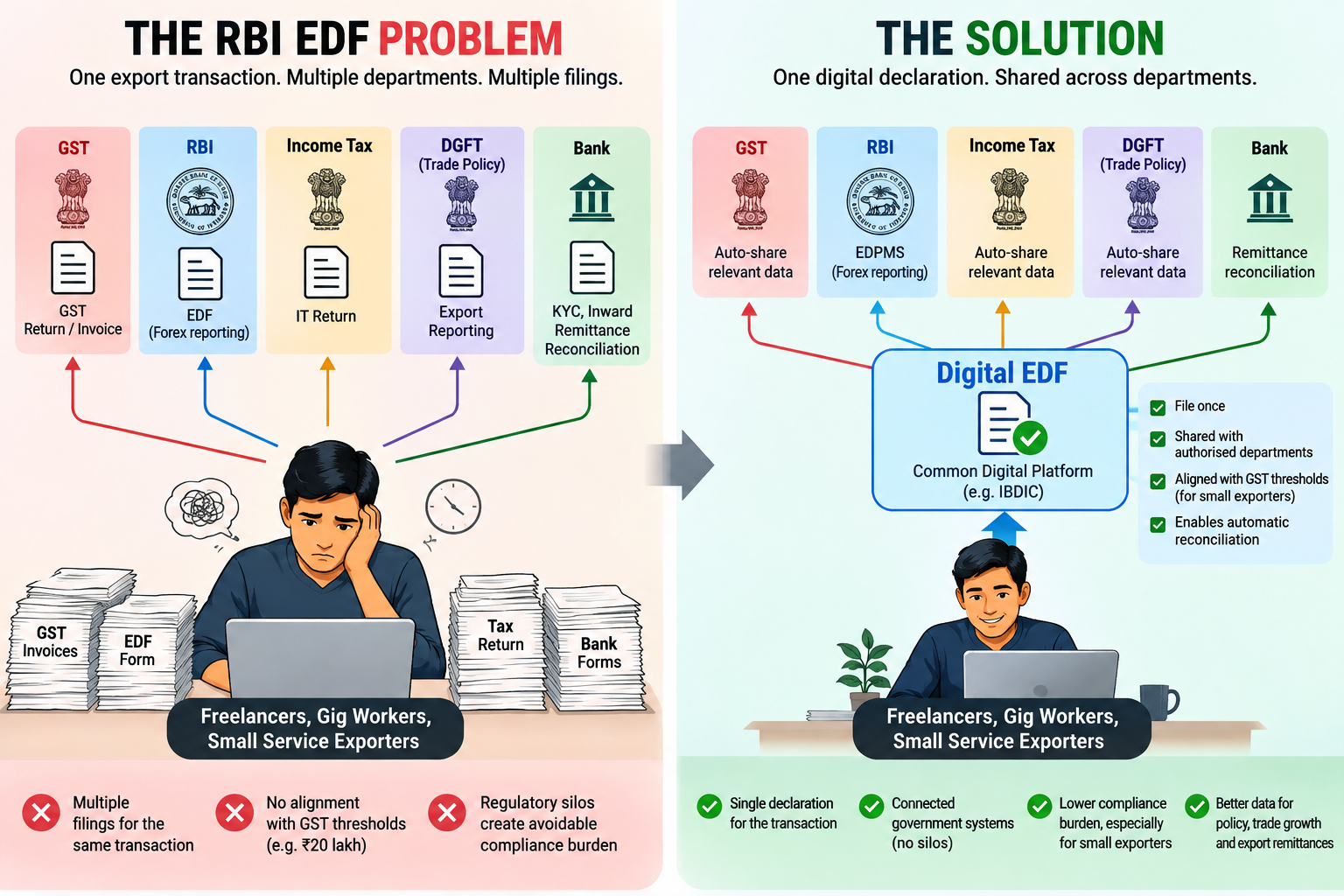
There is a strong backlash over the Reserve Bank of India’s new Export Declaration Form (EDF), particularly from freelancers, gig workers and small service exporters, which deserves attention, not simply because of the compliance burden it may create, but because it exposes a larger problem in how the government regulates the economy.

The EDF form is an export declaration form under RBI’s Notification No. FEMA 23(R)/2026-RB, January 13, 2026. This notification was announced to remove Softex form and make export declaration f uniform across Software and other services. However, it resulted in trapping small exporters who were not filing Softex earlier becuase they were not exporting Software or were exporting Software that falls in to P802 purpose code. Many of these are Gig Workers (Freelancers) doing small exports and receiving foriegn exchange either directly or through some freelancer aggregator platform or from content platforms. All these were in some form providing data to RBI when remittance acceeptance and purpose code declaration is done. Hence, introduction of one more filing requirement in form of EDF created uproar in this category of exporters. This category may be small in export size but important for Gig economy.

An exporter does not operate under FEMA alone. Had RBI considered the other laws affecting exporters of all sizes, from smallest to largest, before preparing this new FEMA notification, the problem would not have arisen. 

This is not an argument against regulation. RBI has a legitimate responsibility to monitor foreign exchange and export realisation. But regulation designed in isolation can create unintended compliance costs and, more importantly, undermine the larger government’s Ease of Doing Business objective. 

The systemic problem is that one regulator does not consider or interact with other regulators. 

RBI can adopt a simple solution to the EDF problem

In the short run, RBI can consider exempting small exporters earning below 20 lakhs from GST registration. For exporters earning above 20 lakhs, RBI (through IBDIC) should create a digital EDF on common infrastructure, accessible to authorised banks and relevant government systems, with the necessary information flowing into EDPMS.

In the long run, everyone should be brought under this data capture and not abandon EDF. But make its implementation fully digital. For goods, exporters submit to ICEGATE; the EDF is auto-generated from the submitted data. Similarly, for Services and Intangibles, EDF can be auto-generated from data submitted by exporters to 

  1. From GSTR-1, from data submitted to GSTN for those registered with GST Or
  2. Banker at the time of remittance for those not registered with GST

This would also solve a problem for banks. Banks ultimately need to reconcile export proceeds and close the transaction in the regulatory system. If the export declaration, payment and realisation information are digitally connected, much of this reconciliation can move from manual compliance to straight-through processing.

The principle is simple: Declare once. Reconcile automatically. Share the information with every authorised government consumer.

Ensuring cross-regulatory sanctity and ease of doing business.

The exporter sees one transaction. The government sees multiple regulatory transactions because each department sees the transaction through its own statute.

The larger lesson from the EDF episode is that whole-of-government cannot mean merely asking departments to coordinate after a regulation has been designed.

Whole-of-government must begin at the design stage of regulation itself.

Before creating a new compliance requirement, the regulator should ask: Which other laws apply to this transaction? Which other departments regulate it? What thresholds already exist? What information has already been submitted? Which government system already holds it? Can the new requirement be fulfilled through an existing digital system rather than through another form?

These questions should become part of the regulatory design process.

The EDF episode is therefore a small but important warning.

Government must stop designing regulation department by department when businesses operate transaction by transaction.

The next generation of Ease of Doing Business will not come merely from removing regulations. It will come from making different regulations work together.

For this, the Government must pursue a Unified Digital Trade system. This requires a genuine whole-of-government approach—and, eventually, the Connected Digital Public Infrastructure (Digital Port) to make it possible.

Digital Port as a Unified Cross-Border Trade System

Digital Port

A connected DPI system is needed as a solution

“Digital colonisation” is no longer theoretical. A handful of large US-based technology companies have dominated, but with AI, that colonisation can be completely disastrous. India remains primarily a consumer of foreign digital products and services. The need for “Sovereign AI” recognition alone is recent and very late. AI can flip our services trade, which accounts for over 40% of India’s exports, from export surplus to import surplus.

Digital trade governance is a challenge.

No one knows today how much businesses and individual consumers use ChatGPT or Claude. We lack the systems needed even to measure, track, or govern the consumption of foreign digital products. 

Reason → The system is broken – India’s trade governance architecture remains overwhelmingly goods-centric. Physical goods move through ports and customs checkpoints, but Digital products move through communication networks and “electronic transmissions” undetected. 

3  Corollaries arise from here 

  • Intuitively, what is digital must ultimately be governed through digital means. 
  • India has demonstrated its capability to build sovereign-scale digital infrastructure by creating DPI like UPI and Account Aggregator-led FinTech.
  • Trade governance can’t be done in regulatory silos in the data-driven AI era. 

Cross-border digital trade now requires a similar strategic intervention.

We need a reimagined trade management architecture. A unified digital framework for both goods and services. 

The digital silos of GST, DGFT, ICEGATE, and RBI must be connected to form a connected systems DPI. A unified DPI across these systems enhances trade governance for both goods and services. It helps manage the movement of physical goods through ports, as well as intangible assets like services and intellectual property, by positioning them as a “digital port”.  

The challenge is not a lack of data, but fragmented systems that don’t share it. The power of connected systems DPI is that it can be built:

  1. Without centralising data, and
  2. Departmental boundaries remaining intact

Gains from Digital Port are multiple: some early, some advanced.

  • Export Financing: GSTN has emerged as the primary source of truth for export invoices. The consequences are significant. Small exporters struggle to access export credit on time. GSTN and ICEGATE sharing invoices for verification will remove double-dipping of Invoices.
  • Unified Trade filing: Export and Import filing can become seamless if GSTN reconciles export invoices online with bank remittances. 
  • Domestic value addition (local content) measurement can be done for every firm and product. 
  • Cross-border digital e-commerce: presently, B2C digital trade leaks revenue. 
  • Fraud detection remains inefficient because visibility is fragmented.
  • Unified duty-free import schemes can be digitised and integrated. Proposed industrial parks and manufacturing corridors can offer a healthy mix of manufacturing and digitally managed export zones with integrated bond management systems.

This transformation is no longer optional.

BTN was announced in 2025. An effective way to achieve foolproof BTN is to connect DGFT, GSTN, ICEGATE, and RBI systems. This can evolve into a “Digital Port” or BTN++.

Conclusion – Overcome Slios & adopt Whole of Govt Approach

The Honourable Prime Minister has called for overcoming silos in Government and adopting a whole-of-government approach. Connected Systems DPI helps achieve this. The Concept of Digital Port is based on the same approach.

DGFT has taken up BTN development. However, a) BTN is limited to export financing for now, and b) it seems the approach is still to build BTN as another digital Silo and limit development within DGFT’s walls. 

  1. → BTN should not become another digital silo.
  2. → It should become the connective tissue of India’s trade architecture.
  3. → Establish a ‘Trade DPI’ Institution (or SPV) Quickly

Create or designate a neutral Trade DPI body, analogous to the role played by GSTN, to steward common standards, APIs, the interoperability layer, and the ecosystem.

With the formation of a three-member Secretary Committee, the Government of India has already made data sharing one of its top priorities. Government has to rally behind the concept to build a “Digital Port”. Data Sharing by GST, Customs and RBI is a necessity; any hurdles in the way must be removed.

This connected-systems DPI in foreign trade can be built as a vertical, as most of the systems are already digital in the set of GST, ICEGATE, RBI (EPDMS and IPDMS), and DGFT.

This would position India to build one of the world’s first “Digital Ports” for the Digital economy in the AI era, while also including physical goods. Our DPI can then be used across the entire Global South. This can be another milestone in our DPI journey and global DPI positioning, while strengthening our economy internally through frictionless trade and ease of doing business.