

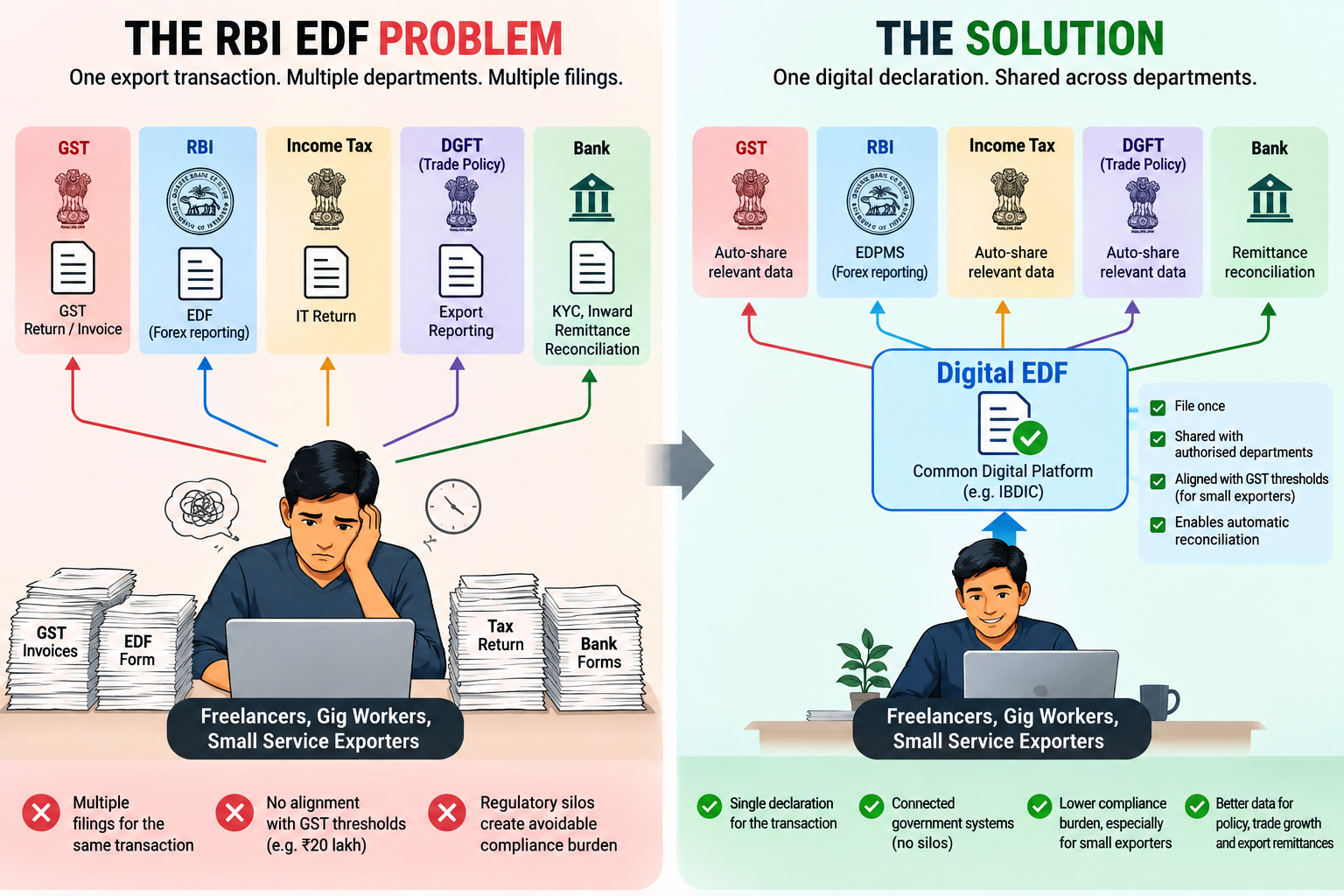
There is a strong backlash over the Reserve Bank of India’s new Export Declaration Form (EDF), particularly from freelancers, gig workers and small service exporters, which deserves attention, not simply because of the compliance burden it may create, but because it exposes a larger problem in how the government regulates the economy.
The EDF form is an export declaration form under RBI’s Notification No. FEMA 23(R)/2026-RB, January 13, 2026. This notification was announced to remove Softex form and make export declaration f uniform across Software and other services. However, it resulted in trapping small exporters who were not filing Softex earlier becuase they were not exporting Software or were exporting Software that falls in to P802 purpose code. Many of these are Gig Workers (Freelancers) doing small exports and receiving foriegn exchange either directly or through some freelancer aggregator platform or from content platforms. All these were in some form providing data to RBI when remittance acceeptance and purpose code declaration is done. Hence, introduction of one more filing requirement in form of EDF created uproar in this category of exporters. This category may be small in export size but important for Gig economy.
An exporter does not operate under FEMA alone. Had RBI considered the other laws affecting exporters of all sizes, from smallest to largest, before preparing this new FEMA notification, the problem would not have arisen.
This is not an argument against regulation. RBI has a legitimate responsibility to monitor foreign exchange and export realisation. But regulation designed in isolation can create unintended compliance costs and, more importantly, undermine the larger government’s Ease of Doing Business objective.
The systemic problem is that one regulator does not consider or interact with other regulators.
RBI can adopt a simple solution to the EDF problem
In the short run, RBI can consider exempting small exporters earning below 20 lakhs from GST registration. For exporters earning above 20 lakhs, RBI (through IBDIC) should create a digital EDF on common infrastructure, accessible to authorised banks and relevant government systems, with the necessary information flowing into EDPMS.
In the long run, everyone should be brought under this data capture and not abandon EDF. But make its implementation fully digital. For goods, exporters submit to ICEGATE; the EDF is auto-generated from the submitted data. Similarly, for Services and Intangibles, EDF can be auto-generated from data submitted by exporters to
- From GSTR-1, from data submitted to GSTN for those registered with GST Or
- Banker at the time of remittance for those not registered with GST
This would also solve a problem for banks. Banks ultimately need to reconcile export proceeds and close the transaction in the regulatory system. If the export declaration, payment and realisation information are digitally connected, much of this reconciliation can move from manual compliance to straight-through processing.
The principle is simple: Declare once. Reconcile automatically. Share the information with every authorised government consumer.
Ensuring cross-regulatory sanctity and ease of doing business.
The exporter sees one transaction. The government sees multiple regulatory transactions because each department sees the transaction through its own statute.
The larger lesson from the EDF episode is that whole-of-government cannot mean merely asking departments to coordinate after a regulation has been designed.
Whole-of-government must begin at the design stage of regulation itself.
Before creating a new compliance requirement, the regulator should ask: Which other laws apply to this transaction? Which other departments regulate it? What thresholds already exist? What information has already been submitted? Which government system already holds it? Can the new requirement be fulfilled through an existing digital system rather than through another form?
These questions should become part of the regulatory design process.
The EDF episode is therefore a small but important warning.
Government must stop designing regulation department by department when businesses operate transaction by transaction.
The next generation of Ease of Doing Business will not come merely from removing regulations. It will come from making different regulations work together.
For this, the Government must pursue a Unified Digital Trade system. This requires a genuine whole-of-government approach—and, eventually, the Connected Digital Public Infrastructure (Digital Port) to make it possible.