iSPIRT Balloon Volunteering Open House #4 – Opportunities in Technology

Building on the previous Balloon Volunteering Open House Sessions, we will give a flavour of available volunteering opportunities in the Technology space.

In the fourth Session, we have Dr Pramod Varma, Chief Architect of Aadhaar and IndiaStack, giving you an insight into what it takes to volunteer in iSPIRT. He describes our design principles for building digital public infrastructure and gives you a peek into the thought process of an architect in iSPIRT. Finally, he breaks down how we are redefining the approach towards solving societal problems. We are playground builders. We orchestrate or create a playground so that market players can bring out an array of solutions.

iSPIRT is addressing solvability. We have a multi-decade horizon as a mission-oriented volunteer-based Think-and-Do-Tank. 

As part of this session, we have some of our volunteers explaining the technical challenges you can embrace as new volunteers at iSPIRT Foundation. The problems that we are tackling require a thought process that is new and innovative. We use cutting-edge technology.

In addition to the new technical volunteering options outlined in this session, other policy-related and ecosystem-building volunteer options also exist. Apply now on https://volunteers.ispirt.in.

How do you build using Lego Blocks? Watch the recording to learn more.

iSPIRT Balloon Volunteering Open House Session #4 – Opportunities in Technology [30 June 2021] from ProductNation/iSPIRT

iSPIRT’s Third Balloon Volunteering Open House Summary

Following the success of our previous two sessions, we are back again. We are presenting this next session of our open house on the theme of Market Mavens and Market Architecture.

Please find attached the video, which will talk about the available opportunities and what it means to be a volunteer at iSPIRT.

There are many volunteering challenges available. So, if in the past you wanted to volunteer but couldn’t, please do check out the additional challenges listed here. We are adding to the existing challenges that we are working towards. So go ahead and choose any of the options that resonate with you.

This Balloon Volunteering process takes anywhere from 3-4 weeks to start. Also, to get a better idea please do read our Volunteer Handbook and Playground Coda here https://volunteers.ispirt.in/

iSPIRT Volunteering is about being mission-oriented and being self-motivated, for there is no glory here. So if you have the bandwidth and want to write the new India script, please reach out to us.

iSPIRT’s Official Response to Non-Personal Data Governance Framework

A Committee of Experts under the Chairmanship of Shri. Kris Gopalakrishnan has been constituted vide OM No. 24(4)2019- CLES on 13.09.2019 to deliberate on Non-Personal Data Governance Framework. Based on the public feedback/suggestions, the Expert Committee has revised its earlier report and a revised draft report (V2) has been prepared for the second round of public feedback/suggestions. iSPIRT had provided a past response to the previous report and in this blog post contains a response to the revised report

At the iSPIRT Foundation, our view on data laws stems from the following fundamental beliefs: 

  1. Merits of a data democracy (that is, the user must be in charge)
  2. Competitive effects must be well understood, for creation of a level playing field amongst all Indian companies, and some ring-fencing must exist to protect against global data monopolies
  3. Careful design enables both high compliance and high convenience

It is with these perspectives that we have analyzed the revised Non-Personal Data report in our response.

Key Sources of Ambiguity in the NPD Report 

The key sources of ambiguity in the report are: 

  1. Purpose of techo-legal framework for Non Personal Data: The non personal data framework is meant to provide the right legal and technology foundations for world class artificial intelligence to be created out of India for the betterment of financial, health, and other socio-economically important services. The current version of the report sidesteps this completely by constraining the applicability to only “public good” purposes rather than taking a holistic approach to “business & public good purposes” 
  2. Data Business entities need a harmonised definition (given the interplay with data fiduciaries as proposed in the MeitY Personal Data Protection Bill) and clear incentives for participation. The current report relies excessively on regulation & processes for data businesses to achieve the outcome. 
  3. Institutional structure for Data Trustees: The report restricts Data Trustees to government agencies and non-profit organisations; however, in a domain consisting of fast evolving technology by excluding the private sector in offering the base infrastructure creates a severe limitation on the ecosystem of modellers that can be created. 
  4. Technology Architecture: The illustrated technology architecture is unclear around the public infrastructure (through the form of open standards, public platforms, and others) that need to be created & adopted to bring to life the non-personal data ecosystem in an accelerated manner. 

Conclusion

While we’re aligned with the vision of the committee, it’s critical that the above ambiguities are resolved in order to create a strong non-personal data ecosystem created in India. Till these ambiguities are resolved, the recommendations of the Report should not be operationalized.


For any press or further queries, please drop us an email at [email protected]

iSPIRT’s Second Open House on Balloon Volunteering

We had our second Open House session on Balloon Volunteering on 14th December over Zoom Conference. Do watch the session video to decide if you would like to explore volunteering with iSPIRT.

Till recently, all our new volunteers (aka Balloon Volunteers) came in through referrals from existing volunteers. Eight weeks back, on 20th Sep, we experimented with an open process in the first Open House session (https://pn.ispirt.in/balloon-volunteering).

We explained the process of Balloon Volunteering and shared a few volunteer challenges. Dozens of people registered. We spoke to each of them and worked with them on the next steps. Three applicants have been accepted as Balloon Volunteers so far. This has given us the confidence to go further in opening up our Balloon Volunteering process.

As you know, iSPIRT is a mission-based non-profit technology think tank. In this second Open House session, we talk about this mission so that you can ask yourself if our cause and theory of change animates you. To understand what volunteers do and how they work, you can read our Volunteer Handbook and Playground Coda. Pointers to these documents are on our new Volunteering page https://volunteers.ispirt.in

If our mission motivates you and volunteering is your passion, see if one of the open volunteering challenges resonates with you. You can then apply using one of the forms on the webpage.

However, keep in mind, volunteering is not for everybody. So, don’t be disheartened if you aren’t able to become a Balloon Volunteer right now. All of us grow with time. Volunteering may be the right thing for you a few years down the line. iSPIRT sticks with hard problems for 20-30 years, so you can be sure that there will be many volunteer opportunities in the future!

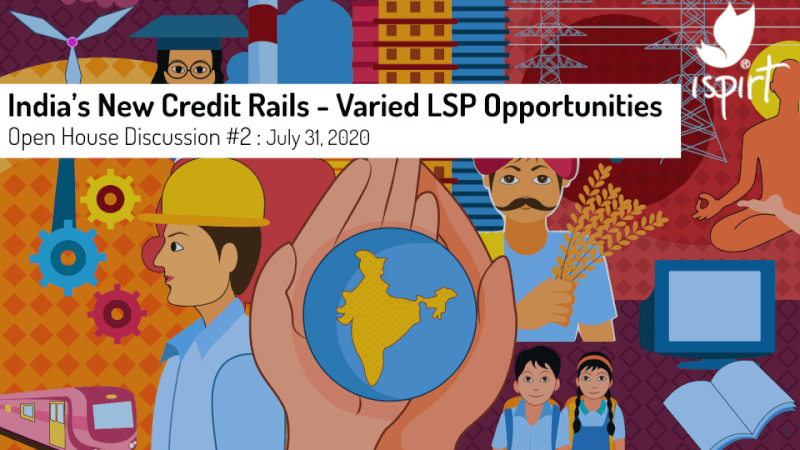
iSPIRT Second Open House on OCEN: Varied LSP Possibilities

On 31st July we hosted the second open house discussion on Open Credit Enablement Network (OCEN). This week’s session covered several potential Loan Service Provider (LSP) products and business cases, and answers to questions that came up following last week’s introductory presentation.

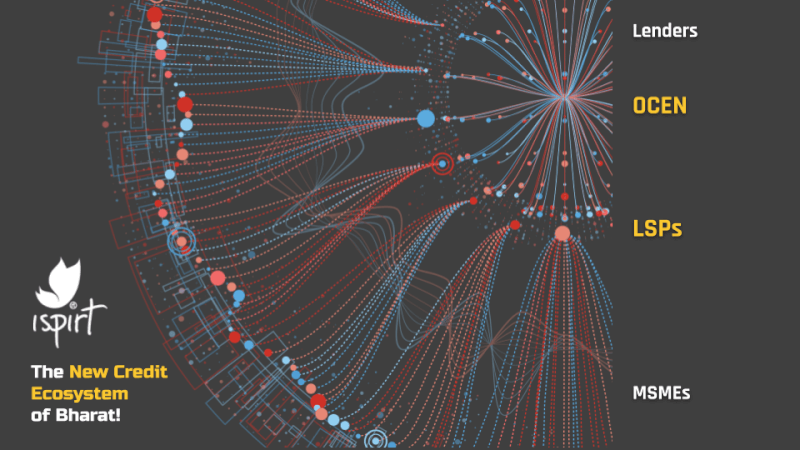
To recap, OCEN is a new paradigm for credit that seeks to provide a common language for lenders and marketplaces to build innovative, financial credit products at scale. OCEN seeks to reimagine the lending ecosystem so that any service provider that interfaces with consumers and MSMEs can become a Fintech-enabled credit marketplace, or more specifically, a Loan Service Provider.  

The discussion this week centred around what kind of role LSPs could play in an OCEN-enabled cash flow lending value chain. OCEN APIs can enable lending products for both consumers and businesses, and for both capital and operating expenses. They are designed to allow for several different types of LSPs and financial products to flourish. 

To build this new credit economy, we need to move from the ‘Lend and Forget’ mindset of traditional lenders to the holistic ‘Lend, Monitor and Collect’ model allowed by the myriad of service providers and marketplaces in our tech ecosystem. These platforms not only have insightful data into their user’s commercial activity but they have an ongoing interface and interaction with potential borrowers.

With OCEN standardisation, LSPs can improve and contribute to all the five aspects of lending i.e. acquisition, underwriting, ROI, collections and monitoring. Tailored credit products can be plugged in at every stage in a typical supply chain (from ‘Procurement to Pay’) to help ease liquidity concerns and ensure business continuity. 

Our volunteers illustrated this with two examples:
1) A seller on the Government e-marketplace (GeM) obtaining invoice financing through the Sahay GeM LSP

2) A truck owner availing of Business-Vehicle Trip Financing through a logistics company performing the role of an LSP

OCEN is also enabling the creation of a new type of credit product that is digitally applied for and disbursed, where the end use of the loan is identified and paid for, and where repayment of the loan is enabled by the locking of incoming cash-flow.

Every participant in our fintech ecosystem is incentivised to take part in this new open credit economy enabled by OCEN. There is an opportunity here for lenders, service providers, aggregators and tech providers to all play their role in bridging India’s credit gap and giving our people and businesses the support they need.

The second session on OCEN covered the following topics broadly, and the entire webinar is also available on our official Youtube channel:

  • By Siddharth Shetty
    • An introduction to iSPIRT and our values
  • By Ankit Singh
    • Recap of what OCEN is, and how LSPs fit in to the framework
    • Recap of Sahay, the reference app for OCEN (and the first LSP)
    • Becoming an LSP (and the role of CredAll)
  • By Nipun Kohli
    • Examples of different cash-flow-lending products enabled by OCEN
    • Key differences between traditional lending and credit products on OCEN
    • How LSPs can participate across the lending value chain
    • ‘Procurement to Pay’ credit products
    • Product example 1: GeM – Procurement to Pay
    • Product example 2: Business-Vehicle Trip Financing
  • By Praveen Hari
    • Building new credit products on OCEN
    • The Type 4 loans

After the presentation our volunteers answered some questions from the community including:
– How is Sahay different from TReDS?
– How does the underwriting take place for LSP-enabled loans?
– How can risk be managed between the LSP and the lender?

We will be hosting weekly open house sessions to keep diving deeper into OCEN. The next such event will take place at 5 pm on 7 August 2020


Readers who wish to learn more about OCEN are encouraged to share this post and sign up now for the session below or click
here.

As always, in order to successfully create a new credit ecosystem for Bharat it will take the collaborative effort of participants from every corner of our fintech ecosystem.

If you’re interested in participating as a:

  • Loan Service Provider
  • Lender
  • Technology Service Provider

please drop us an email at [email protected]

Readers may also submit any questions about the OCEN to the same email address. We shall do our best to answer these questions during next Friday’s open house discussion. 

If you would like to know more about becoming an LSP, please check out www.credall.org (CredAll is a collective of lending ecosystem players to drive cash flow based lending)

About the Author: The post is authored by Rahul Sanghi

Recommended Reading:

Chapter 7 and 8 in RBI UK Sinha MSME committee report: https://www.rbi.org.in/Scripts/PublicationReportDetails.aspx?UrlPage=&ID=924

Introduction to India Stack’s fourth layer – Data Empowerment & Protection Architecture: https://www.youtube.com/watch?v=mW__azI8_ow

NHS Open House on OHSN & PHR Business Model Postponed

The Open house session scheduled for 25th July 2020 has been postponed again. Instead, iSPIRT is hosting today’s topics separately in the coming week and we request you to please sign up again here.


New Schedule
Open House #5 – 11:30 am 31st July
– Open Health Service Network (OHSN), a layer of the health stack which will help enforce transparency, trust, and convenience in accessing health services. 

Open House #6 – 11:30 am 1st August 
– Business Model of PHR, the layer of the stack which will give patients greater control over their longitudinal health records. 


Some of the presenters joining next week are:
–  Anuraag Gutgutia, VP, WorldQuant
–  Ajit Narayanan, CTO of mFine
–  Dr Pramod Varma, Chief Architect of Aadhaar and UPI

If you have any specific questions you would like to have answered by the speakers, please send add them here: https://bit.ly/NHS-QAForm.

iSPIRT First Open House on OCEN: Summary and Next Steps

“The ‘Landline to Mobile’ leapfrog for MSME credit is here.”

On Friday evening we hosted the first open house discussion on the new Open Credit Enablement Network (OCEN). It is the next chapter of the ‘India Stack’ story, one that has provided the building blocks for public digital infrastructure in our country.

The past decade has seen us widen the net for financial inclusion in India on the back of open infrastructure for digital identity (Aadhaar, eKYC, eSign) and payments (UPI, AEPS). This year will also see the launch of the Account Aggregator framework, ushering in a new era for data governance in India. Similarly, OCEN is a new paradigm for credit that seeks to provide a common language for lenders and marketplaces to build innovative, financial credit products at scale.

The first session on OCEN covered the following topics broadly

  • By Sharad Sharma
    • An introduction to iSPIRT and our values
    • An overview of India Stack and where OCEN fits in
  • By Siddharth Shetty
    • A product demo of Sahay, the reference app for OCEN
  • By Ankit Singh
    • The reason for the credit gap in India
    • The challenges for lenders and prospective credit marketplaces
    • A reimagined credit ecosystem with OCEN and Loan Service Providers (LSPs)
    • The roles of LSPs
    • A new cash flow-based lending paradigm
    • The opportunity for market participants with OCEN
    • Release of OCEN APIs, Check them on Github: https://github.com/iSPIRT/lsp-lender-protocol-specification
  • Brief Q/A – Nipun Kohli

Why do we need this?

Access to credit is a crucial part of any flourishing economy. It is safe to say that India’s economic engine has not yet gotten out of second gear because of our inability to guide formal credit into the hands of the people and businesses that need it most. The unit economics of our current lending set-up are broken, and don’t suit the needs of either borrowers or lenders. The challenges range from high costs of customer discovery to lack of trustworthy data for underwriting, and an overall mismatch in ticket size, tenure and interest rates of loans. This has resulted in a whopping MSME credit gap of over $330 bn.

OCEN is an effort to recognise that the touchpoints for delivering financial products to individuals and MSMEs extends beyond traditional lenders. In order to democratize access to credit in India, OCEN reimagines an ecosystem where every service provider can become a Fintech-enabled credit marketplace. 

This means that whether you’re an aggregator, a payment gateway, a software provider or any other company that interfaces with consumers, you can now fill in a crucial role in India’s lending value chain. OCEN will allow you to effectively ‘plug in’ lending capabilities into your existing product or service offerings, enabling you to play the role of a Loan Service Provider (LSP) in this framework.

At one end this will simplify and reduce the cost of acquiring and analysing new customers. Working in tandem with the Account Aggregator framework it will also allow applicants to leverage different data sources so that lending can become a Cash flow based operation instead of the existing balance sheet focus. Overall these open standards will enable lenders to accelerate the disbursal of formal credit while allowing LSPs to holistically serve their existing customers.

India’s new credit rails are ready to be laid out, and we look forward to working with our spirited fintech ecosystem participants over the coming months.

We will be hosting weekly open house sessions to keep diving deeper into OCEN. The next session will focus on Open Credit Enablement Network (OCEN) APIs at 5 pm IST on 31st July 2020.

Readers who wish to learn more about OCEN are encouraged to share this blog post and sign up again for the session here: https://bit.ly/LSPOpenHouse (same embedded below)

As always, in order to successfully create a new credit ecosystem for Bharat  it will take the collaborative effort of participants from every corner of our fintech ecosystem.

If you’re interested in participating as a:

  • Loan Service Provider
  • Lender
  • Technology Service Provider

please drop us an email at [email protected]

Readers may also submit any questions about OCEN on the google form: https://bit.ly/LSPQA. We shall do our best to answer these questions during next Friday’s open house discussion.

About the Author: The post is authored by our volunteer Rahul Sanghi.

Recommended Reading

Chapter 7 and 8 in RBI UK Sinha MSME committee report: https://www.rbi.org.in/Scripts/PublicationReportDetails.aspx?UrlPage=&ID=924

Introduction to India Stack’s fourth layer – Data Empowerment & Protection Architecture: https://www.youtube.com/watch?v=mW__azI8_ow

Technical Standards of the Personal Health Records (PHR) component of the National Health Stack

We have an exciting announcement for you all today!

We are publishing a draft of the technical standards of the Personal Health Records (PHR) component of the National Health Stack (NHS)!

As a refresher, these standards govern the consented sharing of health information between Health Information Providers (HIPs) – like hospitals, pathology labs, and clinics –  and Health Information Users (HIUs) like pharmacies, medical consultants, doctors, and so on. The user’s consent to share their health data is issued via a new entity called a Health Data Consent Manager (HDCM). 

This is a big deal. The problem today is that the electronic health records listed in one app or ecosystem are not easily portable to other systems. There is no common standard that can be used to discover, share, and authenticate data between different networks or ecosystems. This means that the electronic medical records generated by users end up being confined to many different isolated silos, which can result in frustrating and complex experiences for patients wishing to manage data lying across different providers. 

With the PHR system, a user is able to generate a longitudinal view of their health data across providers. The interoperability and security of the PHR architecture allows users to securely discover, share, and manage their health data in a safe, convenient, and universally acceptable manner. For instance, a user could use a HDCM to discover their account at one hospital or diagnostic lab, and then select certain electronic reports to share with a doctor from another hospital or clinic. The flow of data would be safe, and the user would have granular control over who can access their data and for how long. Here is a small demo of the PHR system in action. 

The standards document released today offers a high level description of the architecture and flows that make this possible. You can find version 0.5 of the document embedded below.

Health Information Flows Technical Standards – V 0.5 from ProductNation/iSPIRT.

All the exciting progress we are making on this new digital public infrastructure for healthcare is all thanks to you, the community. We are grateful for your support and look forward to engaging with you further!

The blogpost is co-authored by our volunteers Aaryaman Vir, Saurabh Panjwani and Graphics by Dharmesh BA.

Bending India’s COVID-19 Curve Through Science & Data-Led Models

Powered by data-led scientific rigor, the India COVID-19 SEIR Model delivers early infection trends for every district in India. The model is geared to help Indians from all walks of life plan life and work decisions around their region’s projected trends over the next 15-30 days. Hospitals can use the model to plan for a surge in demand for resources (beds, ICUs, ventilators); local and national level leaders across private and public sectors can use the model to decide how best to contain the spread of the disease and re-open safely. Epidemiologists can use the model to define how different behavioural and environmental factors affect disease transmission. We introduce 3 use cases in this blog post—the first in a series aimed at promoting scientific and modelling capability. 

Wherever the Coronavirus curve has bent to our will, it has happened on the back of behaviour changes based on data-led insights. Everywhere, simple shifts in behavior—staying at home, wearing masks, sanitizing hands—have been informed by predictive models that showed us the mirror to a dystopian future if we didn’t edit our lifestyles. As a digital public good for a billion Indians, the value of the India COVID-19 SEIR Model lies in its reach and widespread use. 

Until a vaccine is developed, we have to make sense of today’s numbers in the context of all our tomorrows. Individuals, policymakers—and everyone in between—can make smarter decisions if they know the evolving shape of the outbreak, and the India COVID-19 SEIR Model aims to do just that by enabling identification of potential trends and patterns in the next 15-30 days. 

The approach taken by the model provides flexibility and utilisation from both a view of trends as core model adoption/enhancement.

We can all use it to bend India’s curve. That’s the ultimate use case, really — where the model tells us where it’s going and we, in turn, steer it in an entirely other direction. Models will change and that’s a good thing. It means we are responding. The power of models and data science in this particular moment is the ability to assist a very scientific approach to scenario planning during an ongoing pandemic.

We can turn the course of this pandemic and transform what this model tells us, every 24 hours. We are already watching the shape-shifting in real-time. It’s in your hands. Go on, try it. 

Use Cases

User — Individuals & Businesses (PDF format)

User — Scientists (PDF format)

User — Policy-Makers (PDF format)

About the contributors: The blog post is co-authored by our volunteers Yashvi Jaju, Nikhila Natarajan and Srikar V Cintalagiri

Covid19 Crisis: Sharpen the Saw with Marginal Costing

When reality changes, it’s important for the firms to acknowledge and adjust to the new situation. This is the time to remember the mantra ‘Revenue is Vanity, Profit is Sanity, Cash is Reality’.

The Covid-19 crisis is much written about, debated and analyzed. If there is one thing everyone can agree about on the future, it is that there is no spoiler out there for this suspense. The fact is that no one knows the eventual shape of the business environment after the pandemic ends. 

When revenue momentum slows down or even hits a wall as it is happening in the current scenario, costs take centre stage even as every dollar of revenue becomes even more valuable for the firms. So, enterprises need an arsenal of strategic weapons to operate and survive, maybe even thrive, in this period of dramatic uncertainty. The same old-same old, push-push methods will not move the needle of performance. 

As an entrepreneur and CEO, I have always found the theory of Marginal Costing (MC) to be practically powerful over the years. Let me tell you why.

At the best of times, MC is a useful tool for strategic and transactional decision making. In a downturn or a crisis, it is vital for entrepreneurs and business leaders to look at their businesses through the MC filter to uncover actionable insights.

Using MC-based pricing, the firm can retain valuable clients, win new deals against the competition, increase market share in a shrinking market and enhance goodwill by demonstrating dynamism in downmarket.

As the firm continues to price its products based on MC, the idea is to continually attempt to increase the price to cover the fixed costs and get above the Break-Even Point (BEP) to profitability. However, this happens opportunistically and with an improving environment. 

Pricing for outcomes is more critical during these times and playing around with your costing models can go a long way in determining the most optimal outcome-based pricing approaches. 

Steps to Get the Best Out of MC:

1. Determine bare minimum Operating level

Estimate the bare minimum operating level or fixed costs you will need to bear to stay afloat and capitalize on revenue opportunities. This is the BEP of the business. This estimate can include:

  • Facilities, machines, materials, people and overheads. 
  • All R&D expenses required to support product development
  • Necessary support staff for deployment and maintenance of products/services.

2.  Ascertain the variable costs

Identify the incremental costs involved in delivering your business solutions to fulfil contractual and reputational expectations to both existing and new customers. These costs are the variable costs in your business model. Try to maximize capacity to flexibly hire, partner or rent variable costs as needed, based on incremental revenues.

3. Distinguish between fixed costs and transactional variable costs.

Take your fixed costs at your operating level as costs for a full P&L period. Let’s say, the fiscal year. Take your variable costs as what it takes to fulfil the Revenues that you can book. Make sure you only take the direct, variable costs. Note that if Revenues less Variable costs to fulfil the revenues is zero, then you are operating at MC.

4. Sweat the IP already created.

For every rupee or dollar you earn over and above the MC, you are now contributing to absorbing the fixed costs. Do bear in mind that all historical costs of building the IP are ‘sunk’, typically to be amortized over a reasonable period. Hence, it doesn’t figure in the current level of fixed costs. The idea now is to ‘sweat’ the IP already created. 

5. Peg the base price at marginal cost.

Start at the level of marginal cost, not fully absorbed costs. Then, try and increase the price to absorb more and more of the fixed costs. The goal is to get to BEP and beyond during the full P&L period. At the deal level, be wary of pricing based on the fully-loaded costs (variable and fixed costs, direct and indirect).

6. Close the deal to maximize cash flows

Price your product at marginal cost + whatever the client or market will bear to get the maximum possible advance or time-linked payments. This is a simple exchange of cash for margins wherever possible and an effective way to maximize the cash flows. Many clients, especially the larger ones, worry more about budgets than cash flow. 

Let’s look at a high-level illustration. 

Assume a software product company providing a learning and development platform to the enterprise marketplace. Let’s call this company Elldee.

Elldee has a SaaS business model that works well in terms of annuity revenues, steady cash flows and scale. Clients prefer the pay-as-you-model representing OpEx rather than CapEx. Investors love the SaaS space and have funded the company based on the future expectations of rapid scale and profitability.

However, given the ongoing crisis condition, Elldee needs to take a good re-look at the licensing model. By applying MC filters, it may make more market and financial sense to maximize upfront cash by doing a longer-term `licensing’ deal for the software-as-a-service at even a deep discount, with back-ended increments in price. The variable costs of on-boarding a client are similar to a SaaS deal yet the revenue converts to contribution to absorb fixed costs quickly to help survival and longer runway for future growth. So the client pays lesser than what they would have for a three year SaaS deal but Elldee is able to sweat its IP while maximizing cash flows.

Elldee can even move its existing SaaS clients to this model to capture more revenues upfront by being aware of MC and figuring out the right pricing models to get to the BEP of the business or product. Outcome-based pricing can also be designed to deliver margins beyond the MC, contributing to the absorption of fixed costs more aggressively.

Elldee is now in a position to address different types of markets, clients and alliances. It can calibrate higher and higher margins as the environment improves and client relationships deepen. Over the next two years, Elldee would come out stronger with a more loyal client base, higher market share and a growth trajectory aligned with its pre-Covid19 business plans.

Yes, this is a simplified example but many variations to the theme can be crafted, based on a firm’s unique context.

Remember that a strong tide lifts all boats but a downturn separates the men from the boys. Marginal costing techniques, when customized for sector-specific operating models, delivers a competitive edge at a time from which will emerge stronger winners and weaker losers. Be a winner.

About the contributor: Sam Iyengar is a PE investor, mentor and advisor focused on Innovation and Impact. He can be reached at [email protected].

iSPIRT Open House Sessions on NHS: Summary & Next Steps

Yesterday afternoon, we hosted our first Open House Session in partnership with Swasth Alliance on the National Health Stack (NHS). For those unfamiliar with this infrastructure, it is helpful to picture the NHS as a multi-layer cake designed to elevate the capacity of the Indian healthcare ecosystem.

At the base layer is a set of generic building blocks. These building blocks, which include bank accounts, digital identities, and mobile numbers, form the basic rails needed to identify, transact with, and communicate with individuals and businesses. Many components of IndiaStack – such as eSign and DigiLocker – leverage and augment these building blocks. 

The next layer of the NHS is the ‘plumbing layer’. This layer contains fundamental pillars needed to enable simple, intelligent, and secure healthcare solutions. The three main pillars of the NHS plumbing layer are electronic registries, a personal health record framework, and a claims engine. A brief summary of these pillars is provided below:

  1. Electronic Registries: these registries  allow for efficient discovery and authentication of doctors, hospitals, and other healthcare providers
  2. Personal Health Records System (PHR): a system that allows individuals to enjoy a longitudinal view of all their healthcare data and exercise granular control over how this data is stored and accessed
  3. Claims Engine: a software engine that reduces the cost of processing insurance claims, enabling insurers to cover more kinds of healthcare procedures, such as preventive checkups, walk-in consultations, and other low-cost but high-value procedures that are currently excluded from Indian insurance policies

The third layer of the NHS is an augmentation layer which is intended to utilize the three pillars of the NHS to bring greater efficiency to the Indian healthcare ecosystem. The doctor: patient ratio in this country is relatively low, and cannot be changed overnight.

Having said that, increasing the efficiency of each doctor would have a similar effect to increasing this doctor: patient ratio. The augmentation layer of the NHS is designed to drive up doctor efficiency through the use of technology. Examples of this kind of technology could include a matching engine to pair patients with the most relevant doctor, or a system to help doctors securely and remotely monitor the bio-markers of their patients. Unlike the plumbing layer, the augmentation layer of the NHS is not close to completion, but we do envisage the augmentation layer playing an important role in the ascent of Indian healthcare quality. Both the plumbing layer and the augmentation layer are designed as open, standardized interfaces. These layers serve as digital public infrastructure accessible to public and private entities wishing to build atop them.

That brings us to the fourth and final layer of the NHS: the application layer. This layer comprises all the government and private sector applications that aim to serve the diverse needs of Indian patients. The first three layers of the NHS exist so that the innovators and change-makers of the fourth layer are optimally empowered to organize, access, and process the data that they need to deliver the best service to their users.

National Health Stack Overview

The first session on the NHS followed this schedule and published the entire webinar on our official Youtube channel:

  •  An introduction to iSPIRT and our values
  • An overview of the NHS
  • A deep-dive into and demonstration of the PHR pillar of the plumbing layer
  • A question-answer session with the audience

The objective of the session was to drive awareness of the NHS components, objectives, timelines, and design philosophies. We want participants from all walks of healthcare to be engaged with the NHS and take part in building it.

In keeping with this objective, we will be hosting weekly open house sessions to keep diving deeper into the National Health Stack. The next such event will take place on Saturday (30th May) at 11:30 am. The focus of this second session will be on another pillar of the plumbing layer – the electronic registry system. More specifically, the session will focus upon the doctor registry. 

Readers who wish to learn more about the NHS are encouraged to share this post and sign up now for the session below or click here.

Readers may also submit questions about the NHS to [email protected] We shall do our best to answer these questions during next Saturday’s open house discussion. 

About the Author: The post is co-authored by our volunteers Aaryaman Vir, Siddharth Shetty and Karthik K S.

Further Reading

iSPIRT Playgrounds Coda

As you may have heard from us or read about in our publications, iSPIRT takes the long view on problems. We call ourselves 30 year architects for India’s hard problems. The critical insight to a 30-year journey of success is that it requires one to be able to work with and grow the ecosystem, rather than grow itself. An iSPIRT with more than 150 volunteers would collapse under its own weight. Instead we work tirelessly to build capacity in our partners and help them on their journeys. We remain committed to being in the background, taking pride in the success of our partners who are solving for India’s hard problems.

However, many people think we’re trying to square a circle here. Why would anybody, that too, folks in Tech jobs who get paid tremendously well, volunteer their time for the success of others? 

The motivation for volunteering is hard to explain to those who have not experienced the joy volunteering brings. Our story is not unique. Most famously, when the Open source movement was taking root, Microsoft’s then CEO, Steve Ballmer, called Open Source “cancer”.

We have published all of our thinking on our model as and when it crystallised. However, we realised a compendium was needed to put our answers to the most commonly expressed doubts about iSPIRT in one place. This is that compendium for our volunteers, partners, donors and beyond.

1. What is iSPIRT?

a) iSPIRT is a not-for-profit think tank, staffed mostly by volunteers from the tech world, who dedicate their time, energy and expertise towards India’s hard problems.

b) iSPIRT believes that India’s hard problems are larger than the efforts of any one market player or any one public institution or even any one think-tank like ourselves. These societal problems require a whole-of-society effort. We do our part to find market players and government entities with the conviction in this approach and help everyone work together.

c) In practical terms, this means that the government builds the digital public infrastructure, and the market participants build businesses on top of it. We support both of them with our expertise. We have iterated this model and continue to improve and refine this model.

d) To play this role we use our mission to align with the Government partners, Market partners and our own volunteers. We believe those who have seen us work up close place their trust in us to work towards our mission. Our long-term survival depends on this trust. All our actions and processes are designed to maintain this trust, and so far if we have any success at all, it can only be seen as a validation of this trust.

2. What is our volunteering model?

a) Anyone can apply to be a balloon volunteer, and we work with them to see if there is a fit.

b) The ideal qualities of a volunteer are publicly available in our Volunteering Handbook, the latest one was published in December 2017.

c) We require every volunteer to declare their conflicts, and ask them to select a pledge level. This pledge level determines their access to policy teams and information that can lead to potential conflict of interest. For every confirmed volunteer, we make available this pledge level publicly on our website.

d) We are often asked what’s in it for our volunteers. We let all our volunteers know this is “No Greed, No Glory” work. Wikipedia is maintained by thousands of volunteers, none of them get individual author credits. What volunteers get is the joy of working on challenging problems a sense of pride in building something useful for society a community of like-minded individuals who are willing to work towards things larger than themselves

e) There are not too many people who would do this for no money, but it does not take a lot of people to do what we do. All of this is given in much greater detail in our Volunteer Handbook.

3. How does iSPIRT decide the initiatives it works on?

a) We have seen success due to the quality of our work and the commitment to our mission. We only take on challenges related to societal problems where technology can make a difference.

b) Even within those problems, our expertise and focus is in solving the subclass of problems where the hard task of coordination between State and Market, between public infra and private innovation is crucial to the task at hand.

4. How does it work with State and Market partners

a) On the hard problems we select in #3 above we assemble a team of volunteers. These volunteers outline a vision for the future. We begin by sharing this vision in multiple forums and creating excitement around them. Examples of these forums are: 

  1. 2015: Whatsapp moment of India. Nandan Nilekani presentation on the future of finance and many articles written about it
  2. 2016: Startup India Launch – Jan 2016 13th. India Stack unveiled as part of official program of Digital India (Public event)
  3. 2017: Cash Flow Lending – DEPA launch 2017 August – Carnegie India Nandan Nilekani and Siddharth Shetty Presentation
  4. Many different public appearances by Pramod Varma, Sharad Sharma, Sanjay Jain, Nikhil Kumar
  5. 2019: Siddharth Shetty explaining AA at an event at @WeWork Bangalore
  6. 2019 Sahamati Launch with a presentation by Nandan Nilekani and representatives from MeiTY, SEBI, multiple Bank CEOs, and AA entrepreneurs.

b) On market partners

i. We work with any market partner who shows conviction towards the idea, and are willing to commit their own resources to take the vision forward. Previous and current partners include banks, startups, tech product and service companies. These early adopter partners form part of our Wave 1 cohort. 

ii. We dive deeper with this wave 1 cohort and iterate together to build on the “private innovation” side of the original vision with their feedback. This is developed with the mutual commitment to sharing our work in the public domain, for public use, once we have matured the idea. We work with them and iterate till we surface a MVP for wider review.

iii. At iSPIRT, we don’t like mission capture. There are no commercial arrangements between iSPIRT and any individual market participants. 

iv. We never recommend specific vendors to any of our partners.

v. New infrastructure/ new frameworks often require the creation of a new type of entity. We engage with these through domain specific organizations such as Sahamati for Account aggregators, as an example.

vi. After Wave 1 partners co-create an MVP, we open up for wider public review and participation. We make public all of our learnings to help the creation of Wave 2 of market participants.

vii. The mental model you should have for iSPIRT Vision/Wave 1/ Wave 2 is those of Alpha/closed Beta/public Beta in the tech world.

c) On government partners

i. We work together with any government partners who show conviction towards the idea, and are willing to commit their own resources to take the vision forward. Previous partners have been RBI, NPCI, MeiTY, TRAI, etc.

ii. We dive deeper with these partners and iterate together to build on the “public infrastructure” side of the original vision with their feedback. As part of the government process, many authorities have their own process to finalize documents, etc. Many of these involve publishing drafts, APIs etc. for feedback, and potential improvement from market participants. We publish the work we do together and invite public comments. Examples: UPI Payment Protocol; MeITY Electronic Consent Artefact; ReBIT Account Aggregator specifications

iii. We only advise government partners on technology standards and related expertise. 

iv. There are no commercial arrangements between iSPIRT and government partners, not even travel expenses.

v. We never recommend any specific market players for approval towards any licenses or permissions. Both iSPIRT and our partners would suffer greatly if this process was tarnished.

  1. With UPI we did not recommend any individual PSPs for inclusion in the network. This was entirely RBI and NPCI prerogative.
  2. Similarly for AA, RBI alone manages selection of AAs for approvals of licenses.

vi. We also respond to public comments wherever they are invited. The following are some examples of our transparent engagement on policy issues.

  1. iSPIRT Public Comments & Submission to Srikrishna Privacy Bill
  2. iSPIRT Public comments to TRAI Consultations
  3. Support to RBI MSME Committee Report
  4. Support to RBI Public Credit Registry Report

5. How does iSPIRT make money?

a) iSPIRT’s expenses includes a living wage for some of its full-time volunteers, travel expenses and other incidental expenses related to our events. This is still a relatively small footprint and we are able to sustain entirely on donations.

b) These donations come from both individuals and institutions who want to support iSPIRT’s long-term vision for India’s hard problems. Sometimes, donor institutions include our market partners who have seen our work up close.

c) Partnerships do not require donations. We engage with many more market partners who are NOT donors than donors who are market players.

6. How does iSPIRT protect against conflict of interest?

We see two avenues of conflict of interest, and have governance mechanisms to protect against both

a) First is Donor Capture. We try to structure donation amounts and partners such that we are not dependent on any one source of funds and can maintain independence

i. We maintain a similar separation of concerns as do many news organizations with their investors.

ii. Our volunteers may have a cursory knowledge of who our donors are. However, this knowledge makes no difference to their outcomes.

b) Second is Volunteer conflicts, where they may get unfair visibility or information to make personal gains.

i. We screen for this risk extensively in the balloon volunteering period.

ii. We have hard rules around this that are strictly enforced and constantly reminded to all our volunteers in all our meetings.

iii. For volunteers who need advice whether a potential interaction could constitute conflict we provide an easy avenue through our Volunteer Fellows Council. The council will advise on whether there is conflict and if yes, how to mitigate it.

iv. To prevent a “revolving door” situation, we require that volunteers from the policy team leaving to continue their careers in the industry undergo a “cooling-off” period.

To volunteer with us, visit: volunteers.ispirt.in


The post is authored by our core volunteers, Meghana Reddyreddy and Tanuj Bhojwani. They can be reached at [email protected] and [email protected]

Announcement: iSPIRT Foundation & Japan’s IPA to work together on Digital Public Platforms

Information-technology Promotion Agency, Japan (IPA), Japan External Trade Organization (JETRO), and the Indian Software Product Industry Roundtable (iSPIRT) have shared common views that (i) our society will be transformed into a new digital society where due to the rapid and continued development of new digital technologies and digital infrastructure including digital public platforms, real-time and other data would be utilized for the benefit of people’s lives and industrial activities, (ii) there are growing necessities that digital infrastructure, together with social system and industrial platforms should be designed, developed and utilized appropriately for ensuring trust in society and industry along with a variety of engaged stakeholders and (iii) such well-designed digital infrastructure, social system and industrial platforms could have a great potential to play significant roles to improve efficiencies of societal services, facilitate businesses, realize economic development and solve social issues in many countries. 

Today, we affirm our commitment to launching our cooperation and collaboration through the bringing together of different expertise from each institution in the area of digital infrastructure, including mutual information sharing of development of digital infrastructure, in particular, periodic communication and exchange of views to enhance the capability of architecture design and establishment of digital infrastructure. We further affirm that as a first step of our cooperation, we will facilitate a joint study on digital infrastructure, such as (i) the situation of how such digital infrastructures have been established and utilized in India, Japan and/or other countries in Africa or other Asian regions (the Third Countries) as agreed among the parties, (ii) how the architecture was or can be designed for digital infrastructure as a basis for delivering societal services in the Third Countries and (iii) what kind of business collaboration could be realized, to review and analyze the possibility of developing digital infrastructure in the Third Countries through Japan-India cooperation. We may consider arranging a workshop or business matching as a part of the joint study to figure out realistic use cases.

Our cooperation is consistent with the “Japan-India Digital Partnership” launched between the Ministry of Economy Trade and Industry, Government of Japan and the Ministry of Electronics and Information Technology, Government of India in October 2018. We will work closely together and may consider working with other parties to promote and accelerate our cooperation if necessary.

For any clarification, please reach out to [email protected]