

From Lending Infrastructure to an Ecosystem for MSME Growth
India’s Micro and Small Enterprises (MSEs) need timely working capital to buy inventory, pay suppliers, fulfil orders and sustain daily operations. Yet, many businesses remain underserved – not necessarily because they lack business activity, but because traditional lending models struggle to assess their creditworthiness and serve them economically.
The momentum is building
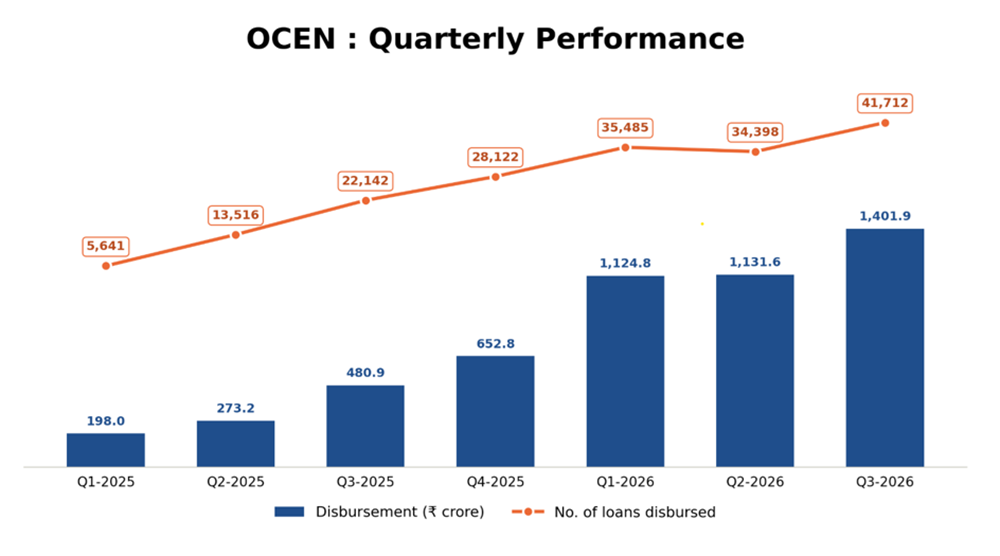
OCEN’s quarterly performance reflects growing momentum. Loan disbursements have increased from 5,641 loans worth ₹197.95 crore in Q1 2025 to 41,712 loans worth ₹1,401.91 crore in Q3 2026. This progress demonstrates the growing potential of digital lending programmes built on common infrastructure.
Beyond invoice financing
TReDS has established an important channel for financing eligible MSME trade receivables. However, businesses also need working capital for inventory, future orders, operating expenses and cash-flow gaps that may not be covered by eligible invoices.
This is where OCEN can complement existing financing channels. By enabling lenders to work with digital platforms and Loan Service Providers (LSPs), OCEN helps build pathways to serve businesses whose credit needs extend beyond invoice discounting.
Building an ecosystem around data-driven credit
OCEN is not a lender; it is an ecosystem builder. Through standardised digital interfaces, it enables lenders, LSPs and technology providers to collaborate, connect with borrowers and develop contextual lending products.
With appropriate consent and verification, business information- such as bank transactions, sales, collections and marketplace activity – can help lenders assess cash flows and repayment capacity. Data is not collateral in the legal sense, but it can strengthen credit assessment and help unlock lending opportunities for businesses with limited conventional collateral.
An opportunity for the entire ecosystem
Priority Sector Lending (PSL) requirements reinforce the policy objective of ensuring adequate credit reaches eligible MSMEs, including micro enterprises. Achieving this requires not just capital, but scalable distribution, better information and viable lending models.
Today, participants ranging from public sector banks to smaller NBFCs are live on OCEN, with more lenders working towards integration and scale. For lenders, this offers new distribution opportunities; for LSPs, access to participating credit providers; and for technology providers, the opportunity to build reusable services across the network.
TReDS demonstrated the potential of common infrastructure for invoice financing. OCEN is building on the broader opportunity to extend digital lending to MSMEs beyond that channel. Its journey today can be compared, in terms of ecosystem maturity, to where TReDS stood in 2019 – as a reminder of what sustained ecosystem participation can make possible.
The next chapter of MSME finance will be built through collaboration. OCEN provides the rails; lenders, LSPs and technology partners can turn them into meaningful credit access for millions of businesses.
For more information, please visit: https://ocen.dev
Please note: The blog post is authored by our volunteer, Rahul Bhaik