

Artificial intelligence (AI) is poised to transform how governments make decisions, deliver public services and address complex policy challenges. But realising this potential requires more than access to powerful AI models. India must ensure that its government departments can harness AI without surrendering control over their data or the hard-won institutional intelligence accumulated over decades.
This raises a fundamental question: how can a public institution use data to adopt AI while retaining control over how it is accessed, used and governed? The answer goes beyond where data is stored or whether an AI provider promises not to use it for model training without proper authorisation. It is a question of sovereignty: who sets the rules, how those rules are enforced, and whether compliance can be verified.
Data sovereignty goes beyond provider assurances and data residency
Leading AI providers have introduced policies for enterprise customers to address concerns around how their data is used. Providers offer enterprise customers options to determine where their data is stored, and in certain cases, where AI workloads are processed during training and inferencing. For instance, OpenAI offers eligible enterprise and API customers data residency in India. OpenAI also states that it does not use business and API customer data to train its models by default. Anthropic makes a similar commitment for its commercial products. Google and Microsoft also offer protections for enterprise data through specified services.
These assurances and offerings from AI providers are a start. However, a promise not to train on customer data, on its own, does not establish that every use of data can be independently verified or that contractual obligations are actually enforced through technical controls. Similarly, a guarantee of data residency, i.e., storing data within national borders does not, by itself, determine who can access it, where AI workloads involving it are processed during training and inferencing, or whether restrictions on its use are technically enforced. Crucially, data can be compromised even when no data-sharing violation has occurred. Access to individual records, sensitive data elements or system logs may be sufficient to expose information, without transferring datasets elsewhere or using them for model training.
Data sovereignty is ultimately about institutions retaining effective and meaningful control over their data—not merely determining where it resides or relying on the assurances of those who process it. This understanding matters particularly for governments. Public institutions hold sensitive citizen information, confidential administrative records, and data of strategic importance to national security and sovereign interests. They need more than assurances about how a model provider handles their data, where it is stored, or whether it remains within national borders. They need enforceable rules governing how their data can be used, with mechanisms to verify compliance and establish accountability when those rules are breached. This is where India’s Data Empowerment and Protection Architecture (DEPA) Private AI Training and Inferencing frameworks come into play.
From contractual promises to enforceable safeguards
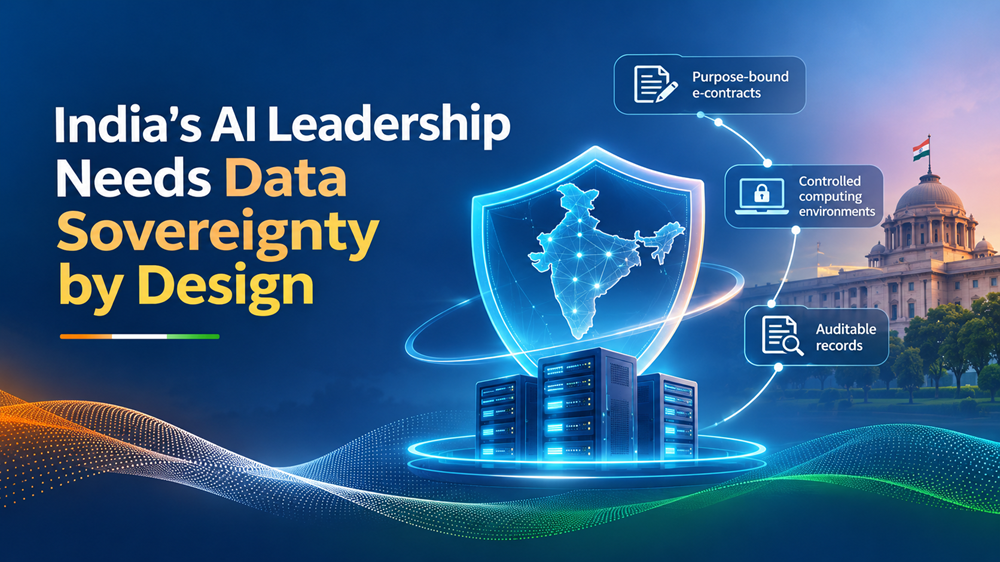
DEPA Private AI Training and Inferencing frameworks embody India’s DPI-centric techno-legal approach to AI regulation, which binds legal obligations to technical controls, enabling institutions to develop and use AI without surrendering control over their data. Rather than relying solely on legal guarantees of appropriate use, the frameworks seek to establish technological safeguards that constrain the ability to misuse data in the first place. They achieve this by embedding governance into the architecture through:
- purpose-bound e-contracts that encode what data may be used, for what purposes and under what conditions;
- controlled computing environments and privacy-enhancing safeguards that constrain how data is accessed and processed and reducing unnecessary exposure of sensitive information; and
- auditable records that provide evidence of permissions, transactions and relevant decisions to support verification, oversight and accountability.
Together, these mechanisms provide a foundation for making compliance demonstrable and obligations enforceable by design. Their value lies in connecting legal rules to technical controls and records that can be examined by third-party auditors.
The way forward
The Indian government need not reject foreign AI providers or mandate that every AI system run on domestic hardware. It needs the capacity to choose, collaborate and compete without becoming dependent on any single provider’s infrastructure, policies, or rules. DEPA Private AI Training and Inferencing frameworks lay the groundwork for this vision. They are designed to enable institutions to unlock data for AI development with built-in safeguards for security, confidentiality, and accountability, ensuring effective and meaningful institutional control over data access and use.
India’s AI leadership will be determined not only by the models it builds, but also by whether it controls the infrastructure governing the data those models learn from. With this infrastructure now in place, the critical imperative is to operationalise it, enabling India to turn its strategic data assets into a source of enduring AI leadership without compromising its data sovereignty. This also means building the domestic knowledge and capabilities to independently operate and derive value from these assets, rather than relying on foreign actors. Building government personnel’s data and AI literacy will be essential to ensuring they can make informed decisions about data access and AI use.
Please note: The blog post is authored by Raj Shekhar, with inputs from Sunu Engineer, both volunteers with iSPIRT.