

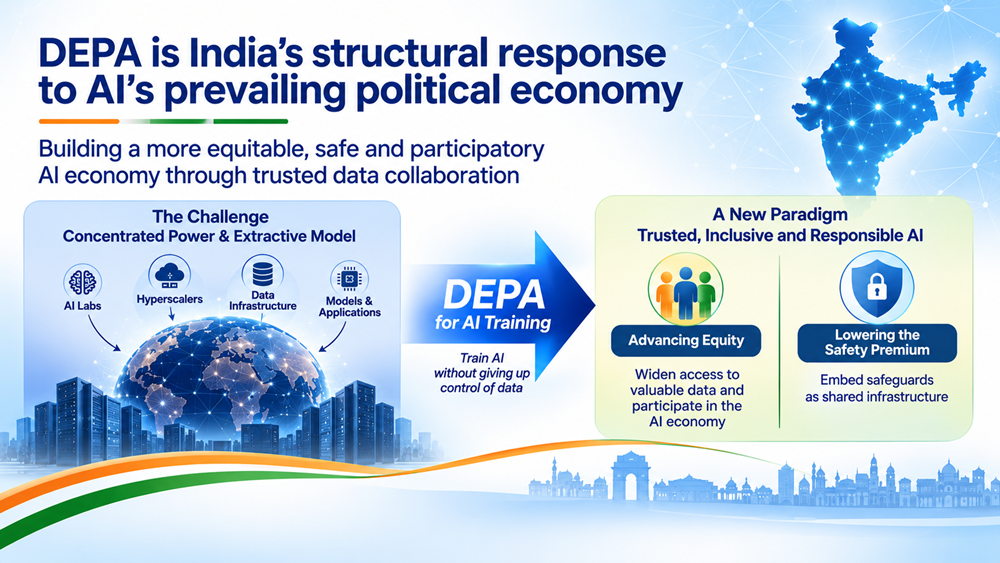
The prevailing political economy of AI development and use is characterised by highly concentrated power and extractive economic models. By making access to valuable data and its responsible use for AI development less dependent on the scale and bargaining power of a handful of dominant market players, India is beginning to reshape who gets to participate in the AI economy, on what terms, and who benefits. The recent launch of DEPA for AI Training Handbook by the Ministry of Electronics and Information Technology marks India’s concrete step towards laying the foundations for a more equitable, safe and participatory AI economy.
The global artificial intelligence (AI) economy is taking shape around an unprecedented concentration of capabilities. A handful of frontier AI labs, hyperscalars, and advanced economies exercise disproportionate control over critical layers of the AI value chain, spanning energy, compute, data infrastructure, models and applications. This concentration is shaping not only who develops AI, but also who captures its economic value and sets the terms of participation, often through extractive models of value creation. This presents a fundamental political economy challenge. At its core, among other questions, is who controls and can access the data needed to develop AI.
Much of the high-value data needed to develop contextually relevant AI resides with hospitals, banks, universities, businesses and public institutions. Yet existing arrangements for accessing and using it often require institutions to risk compromising control over sensitive information, navigate cumbersome and expensive bilateral agreements or forgo participation altogether. At the same time, rising expectations around the enforcement of privacy, data rights and accountability in AI development and use are placing greater demands on AI developers—not that this is undesirable; these safeguards are crucial. However, the infrastructure and expertise needed to meet these expectations remain concentrated among well-resourced incumbents, potentially turning safety into another barrier to entry and reinforcing their unfair advantage.
The challenge is therefore to democratise the conditions for AI participation: making critical inputs accessible, enabling adaptation to local needs and embedding safeguards without concentrating control or imposing prohibitive costs on new market entrants.
Reimagining the economics of data access
India’s Data Empowerment and Protection Architecture (DEPA) for AI Training is a structural intervention in the prevailing political economy of AI. It seeks to decouple access to valuable institutional data for AI training from the need to surrender control over it. Rather than requiring institutions to transfer their underlying datasets, DEPA for AI Training enables models to be trained where the data resides. Confidential clean rooms, privacy-enhancing technologies such as differential privacy, machine-enforceable contracts and auditable records provide the safeguards to make this possible. Multiple institutions, both within and across borders, can therefore collaborate on training models within controlled environments without exposing or relinquishing custody of their respective datasets.
This changes the economics of AI participation in two important ways:
First, it advances equity by widening access to the inputs needed to build AI. Valuable institutional datasets become usable without data owners relinquishing privacy, confidentiality, or institutional control. Common infrastructure and reusable safeguards reduce the costs of trusted collaboration, enabling resource-constrained developers and researchers to access data and participate in AI innovation on a more equitable footing alongside established players. Traceable data use, attribution and appropriate economic arrangements can also allow data providers to participate more meaningfully in the value generated from their contributions. DEPA for AI Training thus begins to shift the data economy from extraction and concentrated control towards rights-respecting access and distributed participation.
Second, it lowers the premium on safety by making safeguards part of the shared infrastructure. As the universe of AI trust and safety requirements expand and become more demanding, the cost of independently developing and demonstrating trustworthy AI risks becoming another market barrier, disproportionately favouring well-resourced incumbents. By embedding safeguards for privacy, data rights and accountability into shared digital public infrastructure, DEPA for AI Training can reduce this burden and make responsible AI development more accessible. Safety thus becomes an enabler of wider participation rather than a market barrier that favours only those with the resources to meet its rising costs.
In summary, DEPA for AI Training has laid the foundations for a more inclusive political economy of AI—one that broadens access to data for beneficial AI innovation and local adaptation, preserves institutional control for data custodians and rights holders, and makes responsible AI development accessible beyond well-resourced incumbents.
Please note: The blog post is authored by Raj Shekhar, a volunteer with iSPIRT.