
DEPA is India’s structural response to AI’s prevailing political economy

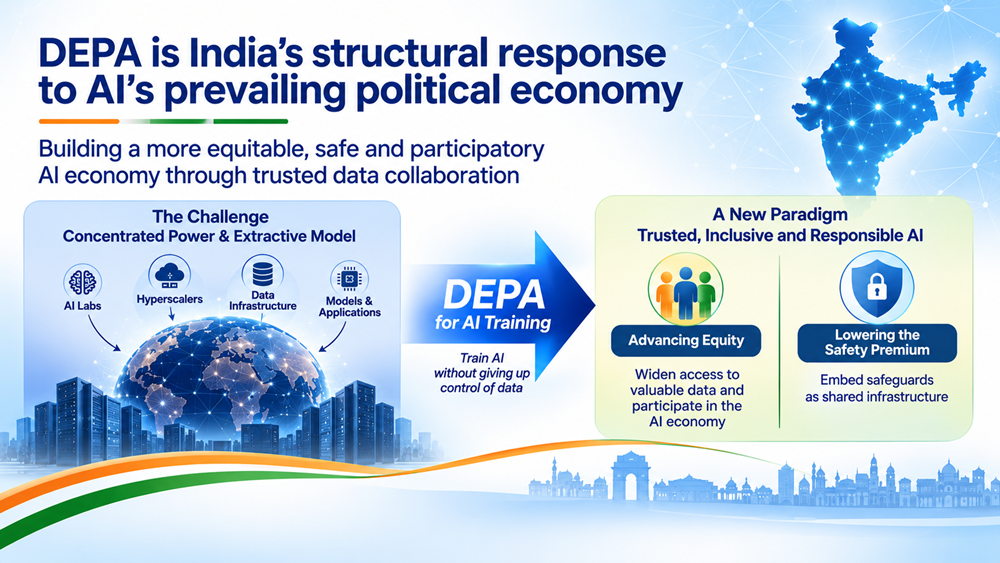
The prevailing political economy of AI development and use is characterised by highly concentrated power and extractive economic models. By making access to valuable data and its responsible use for AI development less dependent on the scale and bargaining power of a handful of dominant market players, India is beginning to reshape who gets to participate in the AI economy, on what terms, and who benefits. The recent launch of DEPA for AI Training Handbook by the Ministry of Electronics and Information Technology marks India’s concrete step towards laying the foundations for a more equitable, safe and participatory AI economy.


The global artificial intelligence (AI) economy is taking shape around an unprecedented concentration of capabilities. A handful of frontier AI labs, hyperscalars, and advanced economies exercise disproportionate control over critical layers of the AI value chain, spanning energy, compute, data infrastructure, models and applications. This concentration is shaping not only who develops AI, but also who captures its economic value and sets the terms of participation, often through extractive models of value creation. This presents a fundamental political economy challenge. At its core, among other questions, is who controls and can access the data needed to develop AI.

Much of the high-value data needed to develop contextually relevant AI resides with hospitals, banks, universities, businesses and public institutions. Yet existing arrangements for accessing and using it often require institutions to risk compromising control over sensitive information, navigate cumbersome and expensive bilateral agreements or forgo participation altogether. At the same time, rising expectations around the enforcement of privacy, data rights and accountability in AI development and use are placing greater demands on AI developers—not that this is undesirable; these safeguards are crucial. However, the infrastructure and expertise needed to meet these expectations remain concentrated among well-resourced incumbents, potentially turning safety into another barrier to entry and reinforcing their unfair advantage.

The challenge is therefore to democratise the conditions for AI participation: making critical inputs accessible, enabling adaptation to local needs and embedding safeguards without concentrating control or imposing prohibitive costs on new market entrants.

Reimagining the economics of data access

India’s Data Empowerment and Protection Architecture (DEPA) for AI Training is a structural intervention in the prevailing political economy of AI. It seeks to decouple access to valuable institutional data for AI training from the need to surrender control over it. Rather than requiring institutions to transfer their underlying datasets, DEPA for AI Training enables models to be trained where the data resides. Confidential clean rooms, privacy-enhancing technologies such as differential privacy, machine-enforceable contracts and auditable records provide the safeguards to make this possible. Multiple institutions, both within and across borders, can therefore collaborate on training models within controlled environments without exposing or relinquishing custody of their respective datasets. 

This changes the economics of AI participation in two important ways:

First, it advances equity by widening access to the inputs needed to build AI. Valuable institutional datasets become usable without data owners relinquishing privacy, confidentiality, or institutional control. Common infrastructure and reusable safeguards reduce the costs of trusted collaboration, enabling resource-constrained developers and researchers to access data and participate in AI innovation on a more equitable footing alongside established players. Traceable data use, attribution and appropriate economic arrangements can also allow data providers to participate more meaningfully in the value generated from their contributions. DEPA for AI Training thus begins to shift the data economy from extraction and concentrated control towards rights-respecting access and distributed participation.

Second, it lowers the premium on safety by making safeguards part of the shared infrastructure. As the universe of AI trust and safety requirements expand and become more demanding, the cost of independently developing and demonstrating trustworthy AI risks becoming another market barrier, disproportionately favouring well-resourced incumbents. By embedding safeguards for privacy, data rights and accountability into shared digital public infrastructure, DEPA for AI Training can reduce this burden and make responsible AI development more accessible. Safety thus becomes an enabler of wider participation rather than a market barrier that favours only those with the resources to meet its rising costs.

In summary, DEPA for AI Training has laid the foundations for a more inclusive political economy of AI—one that broadens access to data for beneficial AI innovation and local adaptation, preserves institutional control for data custodians and rights holders, and makes responsible AI development accessible beyond well-resourced incumbents.

Please note: The blog post is authored by Raj Shekhar, a volunteer with iSPIRT.
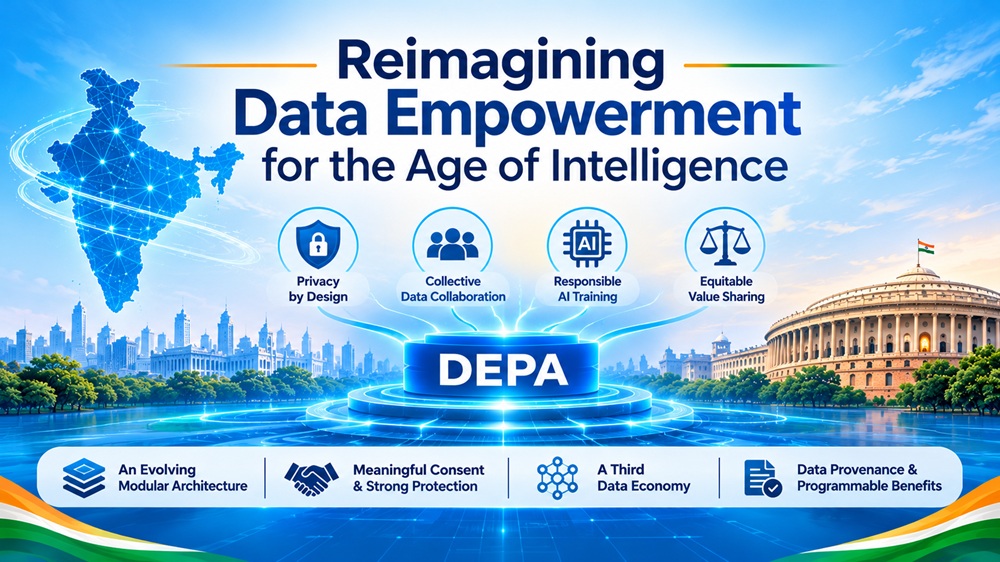
Reimagining Data Empowerment for the Age of Intelligence

The recent publication of the DEPA for AI Training Handbook has invited a necessary and rigorous public debate. Because the Handbook is explicitly a draft for discussion, this kind of sharp feedback is not just welcome, but essential for co-creation.

The debate raises two important questions: whether individual consent alone can adequately protect people in the context of AI training; and whether the presence of existing cryptographic primitives necessarily diminishes the architectural ingenuity of Digital Public Infrastructure (DPI).

An Evolvable, Modular Architecture

From its inception, DEPA was never conceived as a single product or a static specification. When iSPIRT first conceptualized DEPA in 2016, and NITI Aayog published the draft discussion paper in August 2020, it was explicitly framed as the final layer of India Stack—an evolving architectural philosophy aimed at resolving a singular paradox: How do we empower citizens and unlock the societal value of data without compromising privacy or concentrating market power?

Even the 2020 NITI Aayog paper anticipated going beyond consent, explicitly stating: “It goes without saying that consent alone cannot be the only backstop to prevent data misuse… Mechanisms that enable consent can exist on a spectrum.”

What launched in 2021 as the Account Aggregator (AA) rail was merely the first instantiation of DEPA—built using the primitives available at the time to solve for 1-to-1 retail data portability. Like previous digital public infrastructures, DEPA’s core mission of empowerment and protection remains invariant, even as its cryptographic primitives modularly expand to include Confidential Clean Rooms, Electronic Contracts, and Differential Privacy to solve for the age of AI.

This evolution can be understood through three complementary pathways: DEPA with consent, enabling individual data sharing through Account Aggregators; DEPA with informed consent, enabling privacy-preserving computation across institutional boundaries through Private Inferencing; and DEPA for AI Training, enabling collective data use for AI training. These pathways are complementary, not competing or sequential, and together support information flows at individual, institutional and industrial scales, while preserving Protection and enabling Empowerment.

The Genealogy and Limits of Digital Consent

“Notice and Choice” was designed for a 1-to-1 bilateral relationship where the user understands the exact deterministic outcome of sharing a record—such as porting a bank statement to secure a loan. Consent was always a means to an end; the primal goal is privacy itself.

When applied to modern machine learning, elevating individual consent above all other safeguards can lead to systemic failures. In 2004, the Canadian Stroke Network mandated that hospitals obtain individual, opt-in consent from every patient before their de-identified records could enter a national registry. Participation rates collapsed, and the resulting dataset was fatally skewed. In-hospital mortality among the “consented” patients was 6.9%; among the unconsented patients, it was 21.7%. By treating individual consent as the sole gateway to collective medical knowledge, the system produced a dataset that was scientifically blind to the very patients most at risk.

This illustrates a broader paradox: an over-reliance on individual consent can reduce empowerment to repeatedly clicking through consent requests without meaningful understanding or control, while excluding people from the benefits of collective data use. It can also introduce selection biases that leave vulnerable populations underrepresented. If India requires every rural clinic patient to execute a real-time retail portability flow before their de-identified clinical outcomes can inform a national oncology or tuberculosis model, its poorest citizens risk being statistically erased from the medical intelligence of the future. In trying to preserve individual agency through consent alone, we risk undermining it and defeating the larger objective of ensuring that individuals and communities can participate in and benefit from the data economy.

This does not mean that consent should be dispensed with where it is legally required. Rather, consent must be meaningful. Where the purposes of AI training are not clearly defined, or individuals lack meaningful and enforceable avenues to revoke consent and exercise their rights, consent risks becoming a procedural formality. This raises important questions about meaningful consent and informational autonomy under the Indian Digital Personal Data Protection Act, 2023 and the principles articulated in Puttaswamy (2017). What is right must be done even when it is difficult to implement.

More critically, consent is permission, not protection. Millions of users have clicked “I Agree” on platforms or signed up for workspace tools whose Terms of Service permitted AI training. Because neural networks are lossy compression systems, research has time and again proved that standard LLMs inadvertently memorize verbatim sequences from their training data. Through membership inference and divergence attacks, adversaries have extracted real names, phone numbers, and private medical discussions from models trained on “consented” data. Consent gave the AI lab legal immunity, while leaving the user with zero privacy.

This exposes the illusion of revocability. Under true data protection frameworks, consent must be revocable. You can seamlessly revoke access to a bank statement. However, once a neural network’s weights are updated via stochastic gradient descent, the mathematical influence of a single record is permanently diffused across billions of parameters. “Machine unlearning” remains an unsolved computer science problem without retraining the entire model from scratch at a cost of millions of dollars. 

The Novelty of the Data Economy

There also has been a mention of Finland’s Findata (2019), the UK’s NHS Secure Data Environments (2022), and the Penn Medicine Federated Learning project (2022) to argue that DEPA for Training lacks novelty.

But by this yardstick, no DPI in history is novel. Aadhaar did not invent biometrics; UPI did not invent QR codes or XML messaging. Every successful DPI is built on a triad: a market, a policy, and a technical architecture. The genius of DPI lies in protocolizing battle-tested primitives to solve market failures—collapsing the transaction costs of search, bilateral bargaining, and enforcement across an entire economy.

In fact, DEPA is not just a secure enclave. We agree that secure enclaves have existed for a really long time, but historical evidence shows that without an ecosystem protocol, seamless multi-party data collaboration and private inferencing simply have not happened at scale. A standalone clean room works when data is homogeneous and centrally held by a state monopoly, like the NHS. However, it completely breaks down for multi-party, cross-sectoral collaboration. If an agritech researcher wants to train a predictive model combining private insurance claims, localized crop yields, and real-time weather data, a singular enclave model fails. The data legally and technically cannot be pooled into one centralized repository.

Even successful federations, like the Penn Medicine brain tumor study (which achieved 99% accuracy), required 71 institutions to spend years negotiating bespoke legal agreements and custom IT integrations. In the private market today, cloud vendors are signing bespoke $200 million deals to run models inside proprietary clean rooms—locking data inside one vendor’s walled garden.

DEPA for Training turns Confidential Clean Rooms into an open, interoperable techno-legal rail. Any data provider can contract with any innovator using standardized machine-readable policies.

The novelty here is not necessarily in the individual components, but in their combination. A new drug can be novel even when its constituent ingredients are already known; the innovation lies in how those ingredients are combined and formulated. DEPA similarly brings established technical and institutional components together into a new interoperable architecture.

The Third Data Economy

Finally, a critique of AI architecture must answer who captures the downstream value. It has been argued that the Handbook overlooks Data Principals, benefiting only institutions and model builders.

This critique ignores the stark reality of today’s global AI economy. Right now, the market is bifurcated between two extractive structures: the free market model of bilateral data brokers, unlicensed web scraping, RL environment and synthetic annotation marketplaces (where annotators are paid pennies at the bottom of the value chain while foreign labs own the frontier models), and the China model of state-centralized pools. In both current structures, individual citizens receive absolutely zero downstream benefit from the intelligence their data helped create.

It also overlooks the institutional design laid out in the Handbook itself. Section 2.2 explicitly introduces Data Collaboratives. Historically, the marginal economic value of a single individual’s data point is near zero, making 1-to-1 monetization virtually impossible. However, by enabling data collabs individuals gain the collective bargaining power required to negotiate equitable terms with global AI labs while ensuring that individual privacy is not compromised. 

Most importantly, a Digital Public Infrastructure does not mandate a single, rigid business model; it builds the programmable rails that make equitable models technically possible for the first time.

DEPA proposes a third kind of data economy where true value is realized for individuals and institutions alike through three structural guarantees:

  1. Data never changes hands: Raw data stays with its fiduciaries or community cooperatives; the computation travels to the data inside an attested clean room.
  2. End-to-End Provenance: Every dataset card, contract signature, attestation log, and spent privacy budget is recorded on a verifiable ledger.
  3. Programmable Value Sharing: Because every training and inference run is cryptographically metered under an Electronic Contract, DEPA can build the exact rails required for ongoing royalties, per-use compensation, collaborative model ownership, and priority clinical access for the public hospitals and communities whose data powers the breakthroughs.

This is particularly important for recognising the collective value generated by individual contributions. Data Principals contribute data that can be pooled through Data Producers and Data Collaboratives to create a larger resource with economic value. Institutional arrangements can then provide a mechanism for attributing and sharing a proportionate part of that value with contributors.

When we unbundled payments with UPI and credit data with Account Aggregator, critics similarly argued that existing banking rails were sufficient or that the labels were imperfect. Yet protocols beat platforms every time. DEPA is not a departure from citizen empowerment—it is what empowerment looks like when we graduate from data governance to governance of intelligence.

India’s AI leadership needs data sovereignty by design

Artificial intelligence (AI) is poised to transform how governments make decisions, deliver public services and address complex policy challenges. But realising this potential requires more than access to powerful AI models. India must ensure that its government departments can harness AI without surrendering control over their data or the hard-won institutional intelligence accumulated over decades. 

This raises a fundamental question: how can a public institution use data to adopt AI while retaining control over how it is accessed, used and governed? The answer goes beyond where data is stored or whether an AI provider promises not to use it for model training without proper authorisation. It is a question of sovereignty: who sets the rules, how those rules are enforced, and whether compliance can be verified.

Data sovereignty goes beyond provider assurances and data residency

Leading AI providers have introduced policies for enterprise customers to address concerns around how their data is used. Providers offer enterprise customers options to determine where their data is stored, and in certain cases, where AI workloads are processed during training and inferencing. For instance, OpenAI offers eligible enterprise and API customers data residency in India. OpenAI also states that it does not use business and API customer data to train its models by default. Anthropic makes a similar commitment for its commercial products. Google and Microsoft also offer protections for enterprise data through specified services.

These assurances and offerings from AI providers are a start. However, a promise not to train on customer data, on its own, does not establish that every use of data can be independently verified or that contractual obligations are actually enforced through technical controls. Similarly, a guarantee of data residency, i.e., storing data within national borders does not, by itself, determine who can access it, where AI workloads involving it are processed during training and inferencing, or whether restrictions on its use are technically enforced. Crucially, data can be compromised even when no data-sharing violation has occurred. Access to individual records, sensitive data elements or system logs may be sufficient to expose information, without transferring datasets elsewhere or using them for model training.

Data sovereignty is ultimately about institutions retaining effective and meaningful control over their data—not merely determining where it resides or relying on the assurances of those who process it. This understanding matters particularly for governments. Public institutions hold sensitive citizen information, confidential administrative records, and data of strategic importance to national security and sovereign interests. They need more than assurances about how a model provider handles their data, where it is stored, or whether it remains within national borders. They need enforceable rules governing how their data can be used, with mechanisms to verify compliance and establish accountability when those rules are breached. This is where India’s Data Empowerment and Protection Architecture (DEPA) Private AI Training and Inferencing frameworks come into play.

From contractual promises to enforceable safeguards

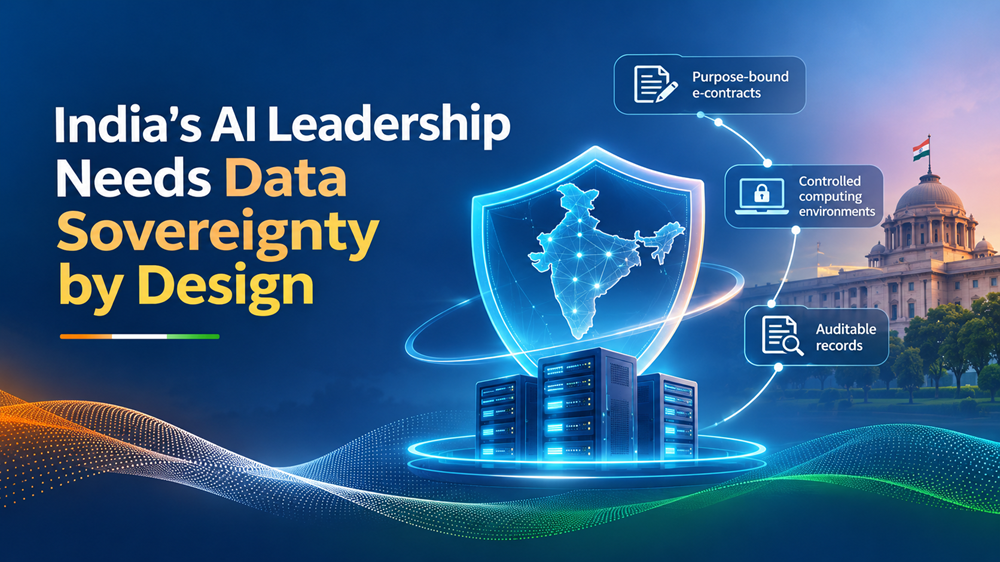
DEPA Private AI Training and Inferencing frameworks embody India’s DPI-centric techno-legal approach to AI regulation, which binds legal obligations to technical controls, enabling institutions to develop and use AI without surrendering control over their data. Rather than relying solely on legal guarantees of appropriate use, the frameworks seek to establish technological safeguards that constrain the ability to misuse data in the first place. They achieve this by embedding governance into the architecture through:

  • purpose-bound e-contracts that encode what data may be used, for what purposes and under what conditions;
  • controlled computing environments and privacy-enhancing safeguards that constrain how data is accessed and processed and reducing unnecessary exposure of sensitive information; and
  • auditable records that provide evidence of permissions, transactions and relevant decisions to support verification, oversight and accountability.

Together, these mechanisms provide a foundation for making compliance demonstrable and obligations enforceable by design. Their value lies in connecting legal rules to technical controls and records that can be examined by third-party auditors.

The way forward

The Indian government need not reject foreign AI providers or mandate that every AI system run on domestic hardware. It needs the capacity to choose, collaborate and compete without becoming dependent on any single provider’s infrastructure, policies, or rules. DEPA Private AI Training and Inferencing frameworks lay the groundwork for this vision. They are designed to enable institutions to unlock data for AI development with built-in safeguards for security, confidentiality, and accountability, ensuring effective and meaningful institutional control over data access and use.

India’s AI leadership will be determined not only by the models it builds, but also by whether it controls the infrastructure governing the data those models learn from. With this infrastructure now in place, the critical imperative is to operationalise it, enabling India to turn its strategic data assets into a source of enduring AI leadership without compromising its data sovereignty. This also means building the domestic knowledge and capabilities to independently operate and derive value from these assets, rather than relying on foreign actors. Building government personnel’s data and AI literacy will be essential to ensuring they can make informed decisions about data access and AI use.

Please note: The blog post is authored by Raj Shekhar, with inputs from Sunu Engineer, both volunteers with iSPIRT.

DEPA Private Inferencing

At iSPIRT, our work on digital public infrastructure for data has consistently focused on a core question: how do we unlock value of data while preserving the rights and trust of individuals? With DEPA (Data Empowerment and Protection Architecture), we established a consent-driven framework that empowers individuals to control how their data is shared for a specific purpose. But there are many business scenarios where consent alone is not sufficient.

Consider a simple scenario: a user consents to share their bank transaction data with multiple lenders for the purpose of credit underwriting. The consent artifact clearly specifies purpose, duration, and data scope. However, once that data is shared with the lenders, the user, and even the bank has no technical visibility into how exactly the data is being used by the lender. Are the lenders only computing a credit score, or also deriving behavioral insights for cross-selling? Are any of the lenders retaining longer than necessary? Is the data being combined with other datasets in ways that go beyond the original intent? These questions are becoming increasingly critical as the use of AI for processing personal data expands to pretty much every sphere from agriculture to finance and healthcare. Consent defines permission, but today there are no technical means to ensure that consent is respected.

DEPA Private Inferencing (part of DEPA 2.0) addresses these concerns. It is a framework that enables high-value scenarios, such as AI inference, while ensuring end-to-end, cryptographically verifiable privacy. DEPA Inferencing introduces a new paradigm: controlled data sharing within clean room environments. It allows data to be shared, but only within secure, purpose-limited and verifiable execution environments. This ensures that users’ consent is enforced while data consumers retain flexibility to run complex computations such as AI models while minimizing compliance costs.


✨ Highlights

👉 Unlocks cross-institution inference without exposing customer data to counterparties

👉 Today: 2 million+ private customer inferences in BFSI sector processed within 2 weeks

👉 Open-source stack available for ecosystem adoption and innovation


Before we dive in, let’s quickly recall what the Data Empowerment and Protection Architecture (DEPA 1.0) really is.

What is DEPA and why does it matter?

India Stack is evolving at population scale, enabling the flow of people (Aadhaar, eKYC, DigiLocker, DigiYatra, etc), money (UPI, OCEN), and information (DEPA and Account Aggregator) through Digital Public Infrastructure (DPI). DEPA is foundational to this third layer. It enables the responsible flow and use of data between individuals and organisations for higher-order economic activity such as cross-sell, analytics, AI model training, and AI inference.

As the name suggests, DEPA rests on two key elements. The first is protection, founded on the bedrock of privacy, consent, accountability and purpose limitation of data. The second is empowerment, democratizing data access and enabling the ecosystem to responsibly innovate with it, whether for training AI models, personalizing products and services, advancing scientific research, and a lot more.

The first instantiation of DEPA is the Account Aggregator (AA) framework, which enables real-time user-consented data sharing between Financial Information Providers (FIPs), entities who hold citizen data, and Financial Information Users (FIUs) or entities that require citizen data to provide a service. That model has been transformative for many use cases and remains foundational to India’s data ecosystem.

What is DEPA Private Inferencing?

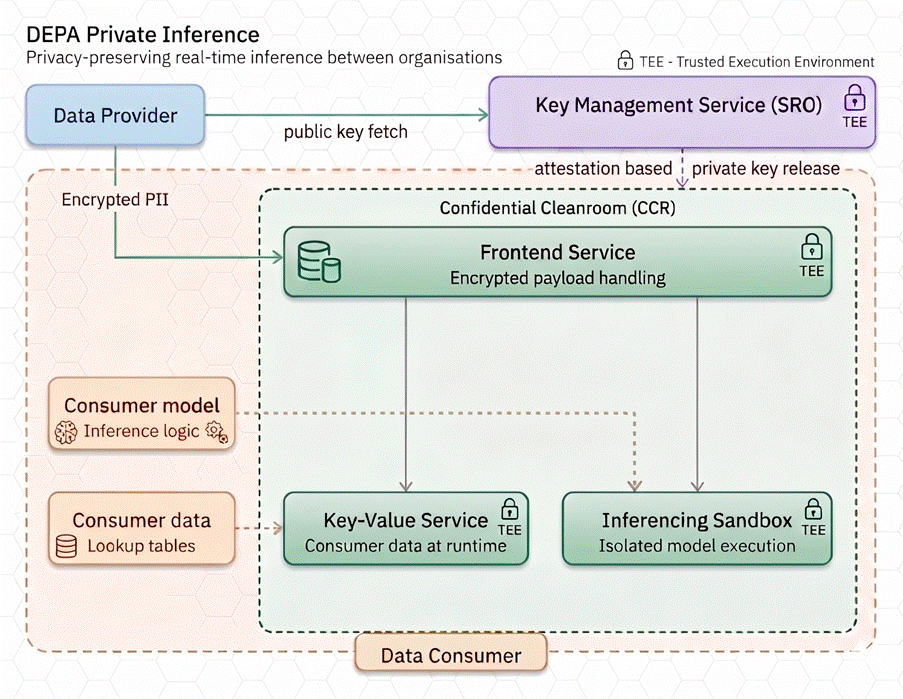
DEPA Private Inferencing builds on this foundation by introducing a new layer of control at the point of computation. Instead of transferring data to the consumer’s environment, data is released into a Confidential Clean Room (CCR), a hardware-based secure execution environment where computation happens under strict policy enforcement.

In this model, a data provider (DP) allows access to relevant data to a data consumer (DC), governed by user consent (obtained using AA or otherwise). However, instead of getting raw access to the user’s data, the data consumer (DC) brings their inference logic (for example, a credit risk model) into a confidential clean room. The clean room itself enforces constraints on what data can be accessed, how it can be processed, and what outputs can be generated.

In the first incarnation, DEPA Private Inferencing supports a clean room environment that allows the data to be enriched using the PDC’s own data hosted in the clean room followed by inference using the PDC’s AI model. During this process, the clean room environment ensures that

a) personal data remains encrypted at all times, even during use,

b) inferencing is stateless i.e., the AI model cannot keep any state once the data has been processed, and

c) only the results of inference in a predetermined format are returned to the DP.

Importantly the clean room environment ensures that the DC (or for that matter the cloud provider) cannot observe or tamper with the data or the computation, even if the DC is hosting this computation. This is a subtle but important shift. Data does move, but only into an environment where its usage is technically controlled and purpose limited, even from the DC.

DEPA Private Inferencing provides these assurances using confidential computing, a new set of primitives in modern CPUs (Intel, AMD and ARM) and GPUs (from NVIDIA) which enable creation of cryptographically verifiable isolated execution environments called Trusted Execution Environments (TEEs). TEEs ensure that data remains protected throughout its lifetime, at rest, in transit, and during use. TEEs are now broadly available on most cloud platforms and have been battle-tested in large scale deployments such as WhatsApp and Signal.

If the confidential clean room is where trust is enforced, key management is what ensures that this trust cannot be bypassed. In DEPA Private Inferencing, keys for encrypting data as it is transferred from the DP to the DC are generated and governed within a dedicated, transparent key management service (KMS) operated by Samyog, a neutral not-for-profit self regulated organization (SRO) set up for this purpose. Access to private keys is tightly coupled with attestation. Personal data is encrypted using public keys from the KMS. However, before an inferencing service hosted by a PDC can decrypt data, it must prove, using hardware-backed attestation, that it is running clean room code approved by Samyog inside a genuine TEE. Only after this verification does the KMS release the required decryption key securely wrapped so it can only be used within that specific clean room environment. This creates a separation of control, ensuring that no single participant in the ecosystem can unilaterally access sensitive data.

Similar to the clean room, the KMS itself runs within a tamper-evident, fault-tolerant TEE, with transparency and auditability over key release policies, ensuring even administrators of the KMS cannot access private keys.

DEPA Private Inferencing in action

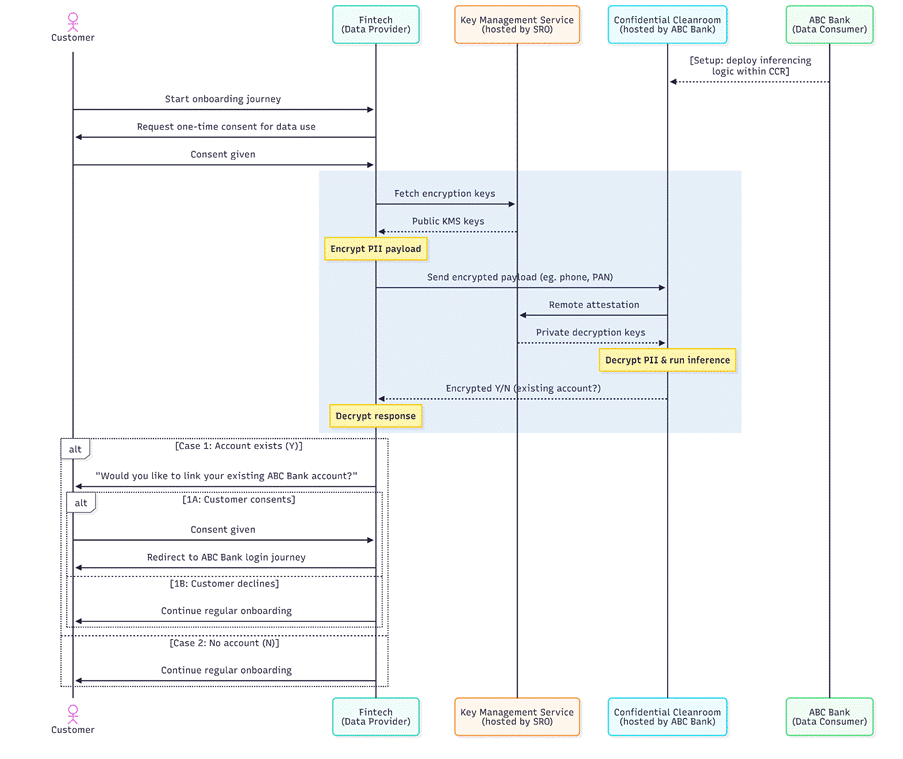
Our first production deployment of DEPA Private Inferencing connects a leading commercial bank (Data Consumer) with a regulated fintech (Data Provider) to run a simple private inference: Does this fintech customer already hold an account at the bank?

Once the DPDP Act is operationalized, even answering this simple question today will be challenging, because as soon as the customer’s data (e.g., mobile number and PAN card) is exposed to the bank, the bank is responsible for managing the entire consent and data lifecycle. Given banks today typically integrate with dozens of such partners, this creates significant operational and compliance overhead.

With DEPA Private Inferencing, the bank can receive this data in encrypted form inside a CCR pre-loaded with its own customer information, process it, and generate a yes/no response – while proving to the fintech partner that the data was used only for this specific purpose, and that the bank has no technical means to access or retain this data. This builds trust, reduces exposure of raw data, and significantly simplifies partner integrations at scale.

Already, within the first two weeks of deployment, DEPA Private Inferencing has processed over 2 million cross-institution inferences, with a p99 latency of < 100ms, while meeting all of the bank’s security and compliance requirements.

Figure: Example Private Inference flow between a Fintech and a Bank.

A New Primitive for the Data Economy

DEPA Private Inferencing represents a shift from thinking about data as something that must be transferred, to thinking about computation as something that can be safely hosted. The clean room becomes the unit of trust, a neutral, enforceable space where data and algorithms interact under well-defined constraints. As India’s digital public infrastructure continues to evolve, this approach lays the groundwork for a more trustworthy and scalable data economy, one where innovation does not come at the cost of control, and where consent is not just captured, but meaningfully upheld.

Get started

👉 Dive into the code: DEPA‑Inferencing on GitHub 🛠️
👉 Reach out to [email protected] for more info.
👉 Watch the Open House video: YouTube 🎬

👉 Think big: What challenges has data privacy kept off-limits? What data has felt forever inaccessible? With DEPA, those doors may finally open. 💡

Interested in contributing to DEPA? Join our group of no-greed no-glory volunteers! Apply here